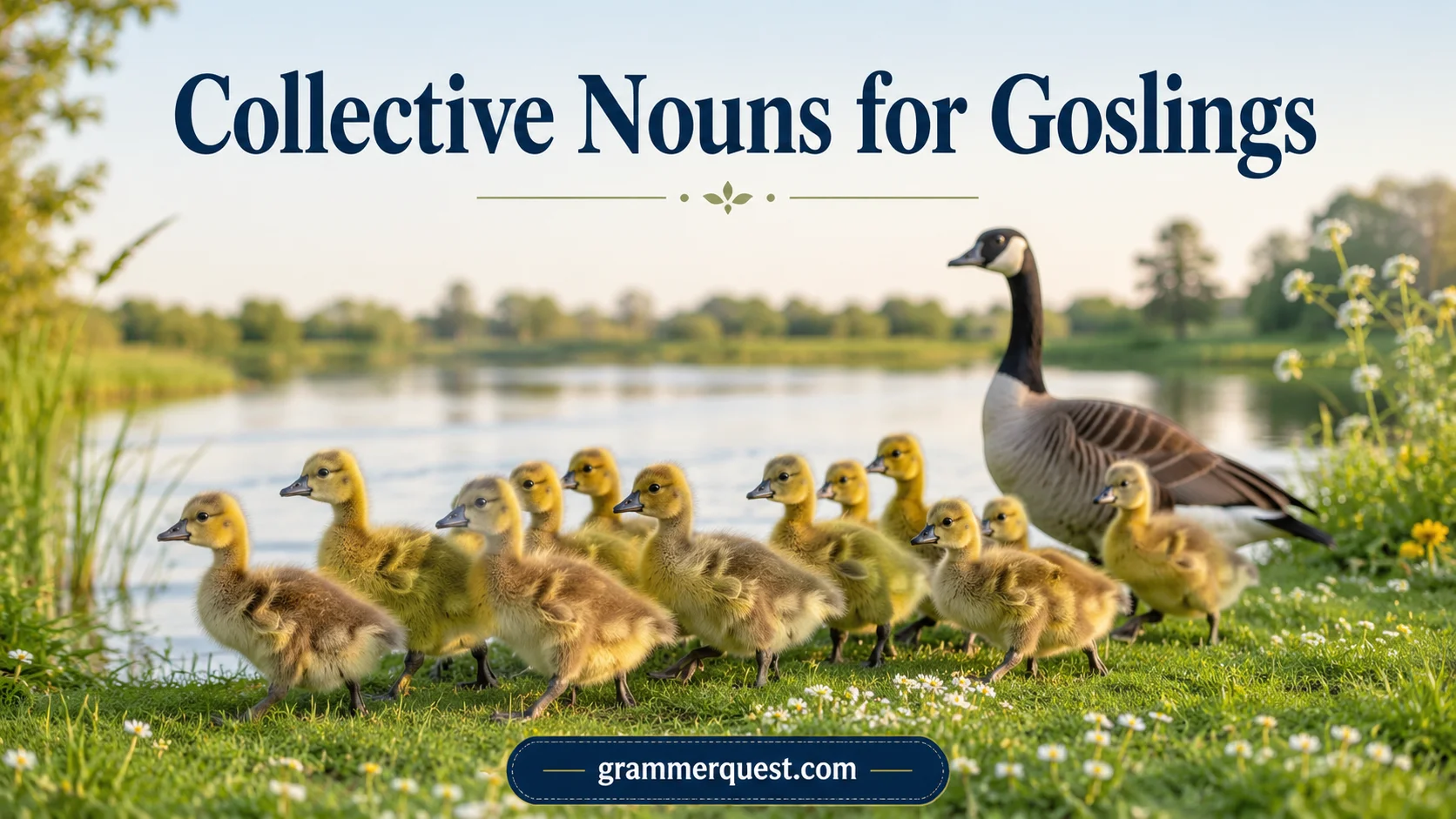
Collective Nouns for Goslings helps explain how goslings and geese live together in social groups. These gregarious birds rarely stay alone and are usually seen in a flock or large groups. The most common collective noun changes with place and movement. A group of geese on land or water may be called a gaggle, while many people simply use flock because it works almost everywhere.
During migration and outside the breeding season, geese become more active and often appear noisy while moving close together. When they are flying or in flight, they can create a V formation and may be called a skein, team, or wedge. Watching these birds in the air shows why there is more than one name. Different locations and movement patterns create different collective terms.
Collective Nouns Used for Goslings
Table of Collective Nouns for Goslings
| Collective Noun | Type | Simple Example |
| Brood | Family Group | A brood of goslings followed the mother goose. |
| Gaggle | Group on Land | A gaggle of goslings walked near the pond. |
| Flock | Large Group | A flock of goslings rested in the field. |
| Team | Moving Group | A team of goslings crossed the farm path. |
| Plump | Compact Group | A plump of goslings stayed close together. |
Brood of Goslings
What Does “Brood” Mean?
A brood refers to a family group of baby birds cared for by their parents. Since goslings stay under the protection of adult geese, this term is commonly used for them.
Example
- A brood of goslings slept beside the lake.
- The farmer watched a brood of goslings near the barn.
- A brood of goslings followed their mother through the grass.
- We saw a brood of goslings swimming quietly.
- A brood of goslings searched for food together.
- The children admired a brood of goslings at the park.
- A brood of goslings rested under the tree.
- The mother goose protected her brood of goslings carefully.
- A brood of goslings crossed the pathway slowly.
- Early in the morning, a brood of goslings explored the pond.
Gaggle of Goslings
What Does “Gaggle” Mean?
A gaggle is a well-known collective noun for geese and goslings when they are walking or gathering on land.
Example
- A gaggle of goslings wandered near the riverbank.
- We heard a gaggle of goslings making soft sounds.
- A gaggle of goslings moved across the garden.
- The tourists photographed a gaggle of goslings.
- A gaggle of goslings stayed close to the adult geese.
- The dog carefully avoided a gaggle of goslings.
- A gaggle of goslings gathered beside the fence.
- The park ranger protected a gaggle of goslings from danger.
- A gaggle of goslings walked through the muddy path.
- Near sunset, a gaggle of goslings rested by the pond.
Flock of Goslings
What Does “Flock” Mean?
The word flock is used for a larger group of birds gathered together. It can also describe goslings traveling or feeding together.
Example
- A flock of goslings played near the water.
- The visitors noticed a flock of goslings in the meadow.
- A flock of goslings followed the older geese.
- We photographed a flock of goslings beside the lake.
- A flock of goslings rested peacefully in the field.
- The shepherd saw a flock of goslings near the stream.
- A flock of goslings moved together in perfect order.
- Heavy rain scattered a flock of goslings briefly.
- A flock of goslings searched for seeds and grass.
- During spring, a flock of goslings appeared in the wetlands.
Team of Goslings
What Does “Team” Mean?
A team describes goslings moving together cooperatively, especially while following their parents in a line.
Example
- A team of goslings crossed the small bridge.
- We watched a team of goslings learning to swim.
- A team of goslings marched behind the goose.
- The farmer smiled at a team of goslings in the yard.
- A team of goslings searched for insects in the grass.
- The children fed a team of goslings near the pond.
- A team of goslings stayed together for warmth.
- Along the river, a team of goslings moved carefully.
- A team of goslings rested after a long walk.
- The guide pointed toward a team of goslings near the reeds.
Plump of Goslings
What Does “Plump” Mean?
The term plump is sometimes used for a tightly packed group of water birds, including goslings, sitting close together.
Example
- A plump of goslings huddled near the shore.
- We noticed a plump of goslings under the bushes.
- A plump of goslings stayed close during the cold morning.
- The mother goose guarded a plump of goslings carefully.
- A plump of goslings floated quietly on the pond.
- The campers observed a plump of goslings by the lake.
- A plump of goslings gathered for safety.
- Near the reeds, a plump of goslings rested peacefully.
- A plump of goslings followed the sound of their mother.
- The birdwatcher photographed a plump of goslings at sunrise.
Read More: Collective Nouns for Martens
Interesting Facts About Goslings
Longevity and Growth
Goslings grow surprisingly fast during their first few months of life. While they begin as tiny, fluffy chicks, they quickly develop feathers and stronger wings. Wild geese can live for many years, and some species survive for over two decades in safe environments. Their early growth is important because goslings must learn swimming, feeding, and migration skills from their parents within a short period of time.
Unique Physiological Features
Goslings are born with soft yellow or gray down feathers that help keep them warm. One of their most remarkable features is their ability to swim shortly after hatching. Unlike many baby birds, goslings are highly mobile and can walk, swim, and follow their parents almost immediately. Their webbed feet make them excellent swimmers, while their developing feathers prepare them for future migration flights.
Dietary Habits of Goslings
Young goslings mainly eat grass, small plants, seeds, and aquatic vegetation. They spend a large part of the day searching for food with their families. Their plant-based diet helps them grow quickly and stay healthy. In natural habitats, goslings learn feeding habits by copying adult geese, which teaches them survival skills from an early age.
Social Behavior of Goslings
Goslings are extremely social animals and rarely wander far from their family group. They communicate through soft chirping sounds and body movements. Staying together in groups protects them from predators and helps them learn important behaviors. This strong sense of family is one reason collective nouns for goslings are so meaningful and descriptive.
Migration and Family Bonds
As goslings mature, they begin learning migration routes from adult geese. Families often stay together during long journeys, forming organized flying patterns. These close family bonds are essential for survival and demonstrate the teamwork found among geese and goslings in nature.
FAQs :
1. What is the most common collective noun for goslings?
The most common collective noun linked with goslings and geese is a flock, although other names are also used depending on location.
2. What is a group of geese called on land?
A group of geese on land is commonly called a gaggle.
3. What is a group of geese called while flying?
When geese are flying, they may be called a skein, team, or wedge.
4. Why do geese have different collective nouns?
Different names are used because geese behave differently depending on where they are and how they move.
5. Are goslings included in these collective nouns?
Yes, goslings are usually grouped with geese, so the same collective terms are commonly used.
6. What does a wedge of geese mean?
A wedge describes geese flying together, often in a V-shaped formation.
7. What is a plump of geese?
A plump is another less common term sometimes used for geese when they are on water.
8. Why are geese called gregarious birds?
Geese are called gregarious because they naturally stay together in groups and social communities.
9. Do geese stay together during migration?
Yes, geese usually travel together during migration for protection and easier movement.
10. Can flock be used for geese anywhere?
Yes, flock is the most general term and can be used in most situations.
Conclusion
Understanding Collective Nouns for Goslings becomes easier when you observe how geese behave in different places. Whether they are resting on land, swimming on water, or flying overhead, their group names change with their actions. Learning these collective terms makes bird vocabulary more interesting and easier to remember.

George Whitaker is the voice behind GrammarQuest, dedicated to making grammar simple, engaging, and easy to understand. He helps learners turn confusion into confidence with clear explanations and real-world examples.