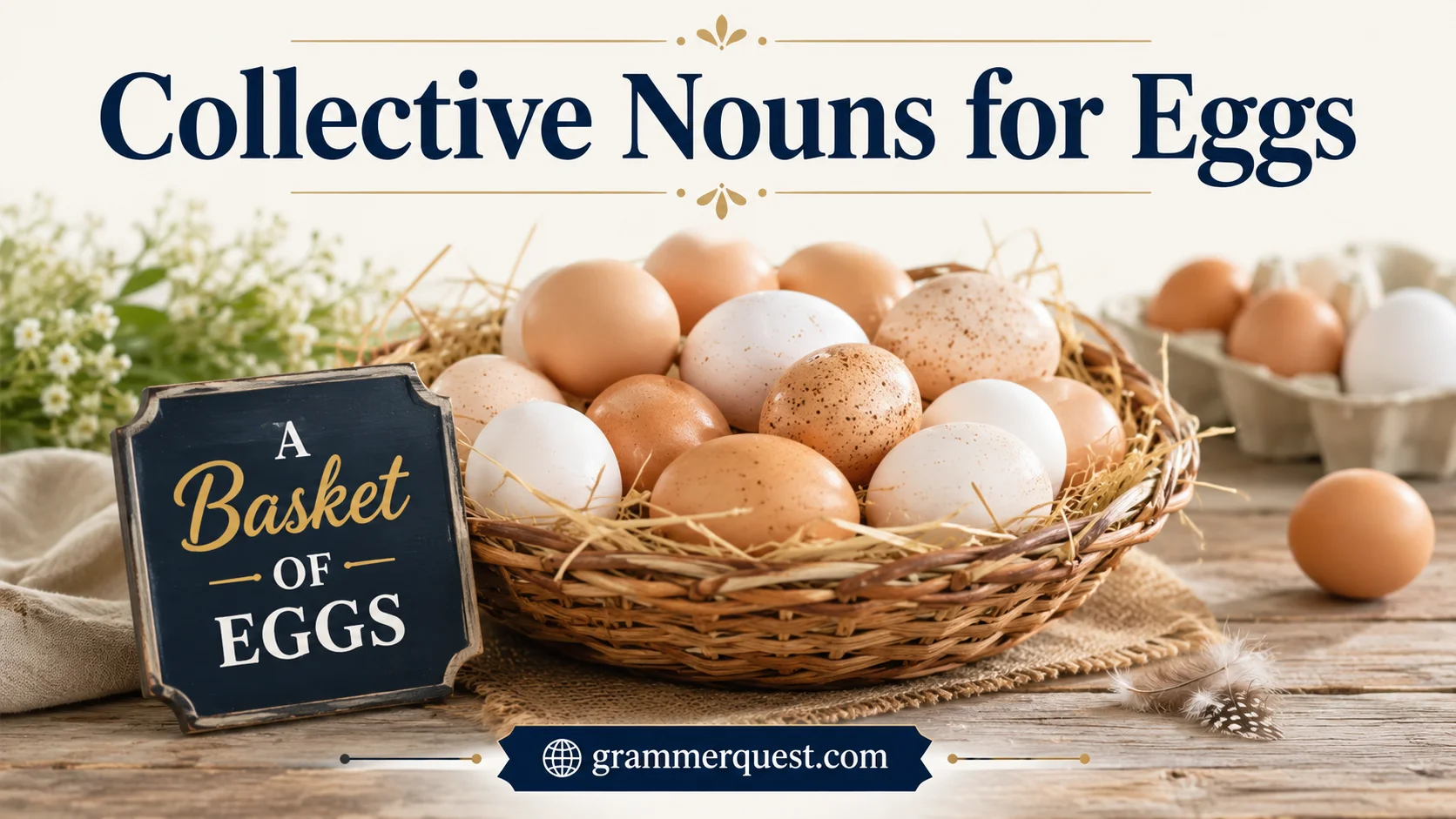
Collective Nouns for Eggs refer to the specific words used to describe groups of eggs in English grammar, making language more precise and meaningful. The most important term is clutch, which is commonly used for eggs laid together by birds or reptiles. Other useful words include batch, brood, and carton, which describe eggs in cooking, nesting, or packaging contexts. Learning these collective nouns helps improve vocabulary, strengthens grammar understanding, and makes communication more natural when talking about eggs in everyday life.
These terms are not only useful in English grammar but also reflect how we observe eggs in different situations, from nature to kitchens. A brood often refers to eggs being incubated, while a carton is used in stores for packaged eggs, and a batch describes eggs prepared for cooking. Understanding such collective nouns connects language with real-life use in animals, food, and daily routines. It also enhances writing skills and gives learners a deeper appreciation of how English organizes and names groups of things.
Collective Nouns for Eggs
| Collective Noun | Type | Simple Example |
| Clutch | Eggs in a nest | A clutch of eggs rested in the nest. |
| Batch | Eggs collected together | A batch of eggs was prepared for sale. |
| Carton | Eggs packed in a container | A carton of eggs sat on the table. |
| Basket | Eggs gathered in a basket | A basket of eggs was carried home. |
| Collection | A group of eggs together | A collection of eggs was displayed. |
Clutch of Eggs
A clutch is the most common collective noun for eggs, especially those laid by birds, reptiles, and amphibians in a nest.
Examples of a Clutch of Eggs
- The robin protected a clutch of eggs in her nest.
- We found a clutch of eggs under the bush.
- The turtle buried a clutch of eggs in the sand.
- A clutch of eggs rested safely among the leaves.
- The scientist studied a clutch of eggs carefully.
- A small clutch of eggs hatched last week.
- The bird returned to her clutch of eggs every hour.
- The nest contained a healthy clutch of eggs.
- A clutch of eggs was hidden from predators.
- The farmer showed us a clutch of duck eggs.
Batch of Eggs
A batch refers to eggs collected, processed, or grouped together, often for cooking or commercial purposes.
Examples of a Batch of Eggs
- The farmer gathered a batch of eggs this morning.
- A fresh batch of eggs arrived at the store.
- The chef used a batch of eggs for baking.
- We inspected a batch of eggs for quality.
- The batch of eggs was packed carefully.
- A large batch of eggs was sent to market.
- The bakery ordered a batch of eggs.
- The batch of eggs came from free-range hens.
- Workers sorted the batch of eggs quickly.
- A new batch of eggs was delivered today.
Carton of Eggs
A carton is commonly used when eggs are packaged and sold in stores.
Examples of a Carton of Eggs
- I bought a carton of eggs from the supermarket.
- The carton of eggs was placed in the refrigerator.
- She opened a carton of eggs for breakfast.
- A carton of eggs fell from the shelf.
- The carton of eggs contained twelve eggs.
- He carried a carton of eggs carefully.
- The carton of eggs was labeled organic.
- We used half a carton of eggs for the recipe.
- A carton of eggs sat on the kitchen counter.
- The cashier scanned the carton of eggs.
Basket of Eggs
A basket of eggs refers to eggs collected and stored in a basket, often on farms.
Examples of a Basket of Eggs
- The farmer carried a basket of eggs.
- A basket of eggs stood near the barn.
- She filled a basket of eggs before noon.
- The basket of eggs looked fresh and clean.
- We delivered a basket of eggs to our neighbors.
- A basket of eggs was placed on the table.
- The child helped gather a basket of eggs.
- The basket of eggs came from local hens.
- They sold a basket of eggs at the market.
- A full basket of eggs was ready for transport.
Collection of Eggs
A collection of eggs can refer to eggs gathered together for study, display, or storage.
Examples of a Collection of Eggs
- The museum displayed a collection of eggs.
- A collection of eggs was arranged neatly.
- The researcher examined a collection of eggs.
- We saw a collection of rare eggs.
- The collection of eggs came from different birds.
- A collection of eggs was kept in glass cases.
- The collector owned a large collection of eggs.
- The collection of eggs attracted many visitors.
- Students studied a collection of eggs in class.
- A valuable collection of eggs was preserved carefully.
Read More: Collective Nouns for Stars
Interesting Facts About Eggs
Eggs Have Remarkable Longevity
Eggs are designed to protect and nourish developing embryos until they hatch. Depending on the species, eggs can remain viable for days, weeks, or even months before hatching. Some reptile eggs can survive in challenging environmental conditions, while bird eggs are carefully incubated to ensure successful development.
Eggs Possess Unique Physiological Features
Eggs have extraordinary structures that support life. The shell protects the embryo while allowing oxygen to enter through tiny pores. Inside, the yolk provides nutrients, and the egg white offers water and protein. This self-contained life-support system makes eggs one of nature’s most efficient reproductive adaptations.
Eggs Reflect Diverse Dietary Habits
The quality, color, and nutritional composition of eggs can be influenced by the diet of the parent animal. For example, hens that consume nutrient-rich diets often produce eggs with stronger shells and richer yolks. Wild birds also lay eggs that vary in size and color depending on their feeding habits and environment.
Eggs Come in Many Shapes and Colors
Eggs are not always white or oval. Bird eggs can be blue, green, brown, speckled, or even pinkish. Different species have evolved unique egg appearances that help with camouflage and protection from predators.
Eggs Are Essential to Ecosystems
Eggs play a vital role in maintaining wildlife populations. They ensure the continuation of countless species and provide food for various animals, making them an important part of many natural food chains.
Why Learning Collective Nouns for Eggs Matters
Understanding collective nouns for eggs enriches vocabulary and improves communication. Whether discussing wildlife, farming, cooking, or biology, terms like clutch, batch, carton, basket, and collection help describe groups of eggs more accurately and effectively.
FAQs :
Q1: What is the most common collective noun for eggs?
The most common collective noun is clutch, used for eggs laid together by birds or reptiles.
Q2: What does “clutch” mean in eggs?
It refers to a group of eggs laid at one time in a nest.
Q3: Is “batch” a collective noun for eggs?
Yes, batch is used for eggs, especially when they are prepared or cooked together.
Q4: What is a “brood” of eggs?
A brood refers to eggs being incubated or cared for by a bird.
Q5: What does “carton” mean in eggs?
A carton is a packaged group of eggs sold in stores.
Q6: Are these terms used in daily English?
Yes, they are commonly used in cooking, shopping, and biology.
Q7: Why do we use collective nouns for eggs?
They help describe groups of eggs clearly and correctly in English.
Q8: Is “clutch” only used for birds?
Mostly yes, but it can also refer to reptiles laying eggs together.
Q9: Can “batch” refer to cooked eggs?
Yes, it is often used for eggs prepared or cooked together.
Q10: Do collective nouns improve English skills?
Yes, they improve vocabulary and make communication more precise.
Conclusion :
Collective nouns for eggs like clutch, batch, brood, and carton make English more structured and meaningful. They help describe eggs in nature, cooking, and packaging with clarity. Understanding these terms improves grammar skills, enriches vocabulary, and makes everyday communication more accurate and natural.

Emma Brooke is a passionate language enthusiast and the voice behind GrammarQuest.com. With a sharp eye for detail and a love for clear communication, she simplifies complex grammar rules into easy, practical lessons. Her goal is to help you write with confidence, clarity, and style—whether you’re a student, professional, or everyday writer.