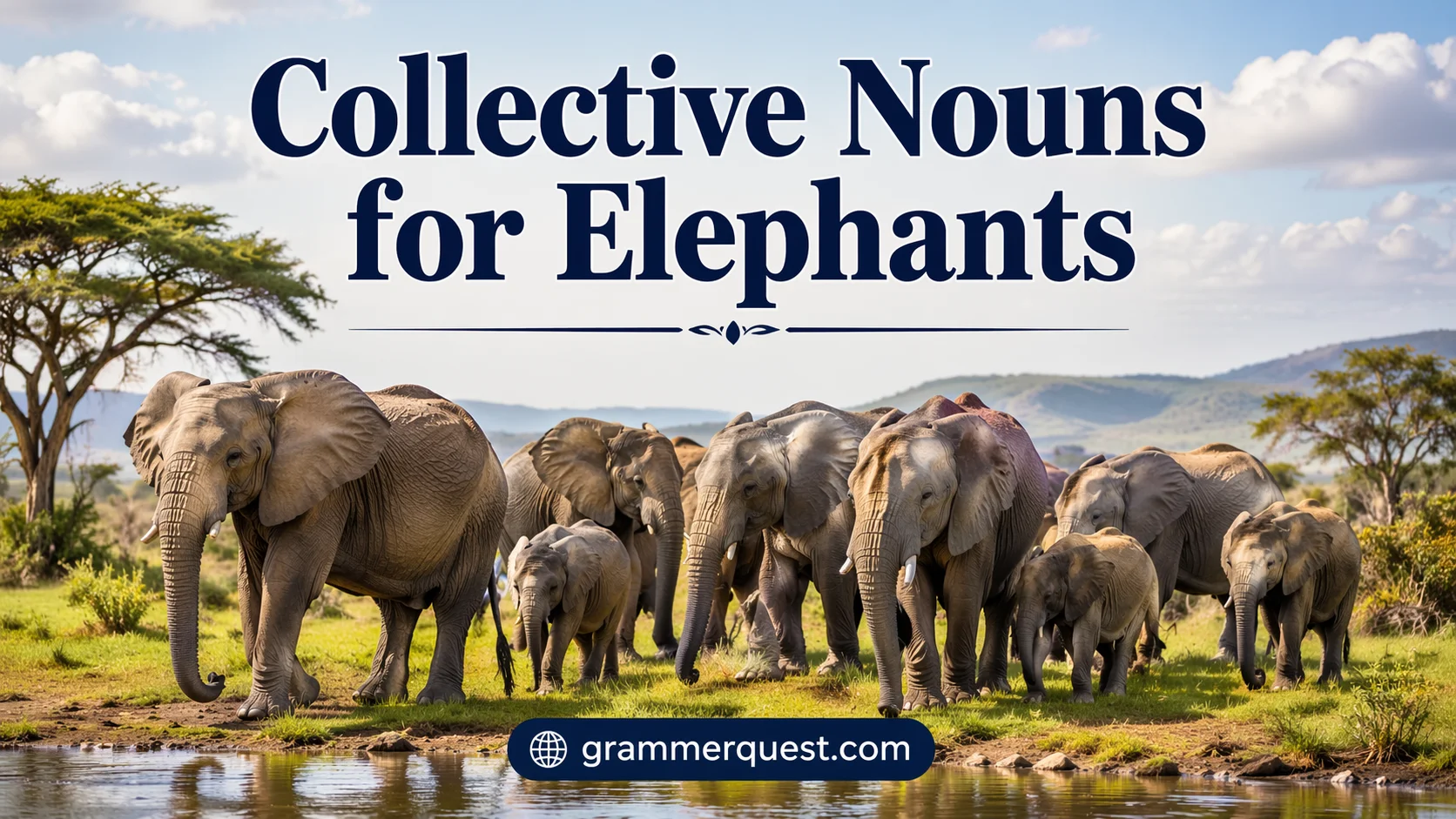
Collective Nouns for Elephants show that a group of elephants is called a herd, revealing their social bonds, shared movement, and powerful family life in nature today across African plains.
On an African safari, especially in Southern Africa, a herd can be one of the most exciting sights for travellers. The region’s diverse ecosystems support an extraordinary variety of animals, including the Big Five. Watching vast herds move across open savannas during a game drive gives people a rare chance to witness nature at its most powerful, while also making the trip feel personal and unforgettable for every family visitor.
These collective nouns do more than name groups. They reflect behaviour, social structure, and even physical traits, which is why they are useful in education and wildlife learning. A knowledgeable ranger can turn simple facts into memorable stories, helping children, travellers, and fellow guests understand why a grouping matters. In my experience, this kind of detail makes an animal sighting feel richer, easier to remember, and far more meaningful overall.
Common Collective Nouns for Elephants
| Type | Simple Example |
| Herd | A herd of elephants |
| Parade | A parade of elephants |
| Memory | A memory of elephants |
| Gathering | A gathering of elephants |
| Troop | A troop of elephants |
Herd of Elephants
A “herd” is the most commonly used collective noun for elephants. It refers to a family group led by a matriarch.
Example Sentences (Herd)
- A herd of elephants was seen near the river.
- The herd moved slowly across the savannah.
- A large herd of elephants protected the young ones.
- The herd gathered under the shade of trees.
- A herd of elephants traveled together for water.
- The herd stopped when they sensed danger.
- Tourists watched a herd of elephants in the wild.
- The herd communicated using low rumbles.
- A herd of elephants crossed the dusty plain.
- The herd stayed close during the storm.
Parade of Elephants
A “parade” describes elephants walking in an organized and majestic line.
Example Sentences (Parade)
- A parade of elephants marched through the forest.
- The parade looked graceful in the morning light.
- A parade of elephants impressed the tourists.
- The parade moved slowly but confidently.
- Children watched a parade of elephants in awe.
- A parade of elephants crossed the muddy path.
- The parade followed the leader closely.
- A parade of elephants created dust clouds while walking.
- The parade stopped near the waterhole.
- A parade of elephants is a beautiful sight in nature.
Memory of Elephants
The term “memory” highlights the elephant’s famous ability to remember places, faces, and routes.
Example Sentences (Memory)
- A memory of elephants returned to the same water source.
- The memory of elephants helped them find food.
- A memory of elephants recognized old paths.
- The memory of elephants is truly remarkable.
- A memory of elephants guided the herd home.
- The memory of elephants lasted for many years.
- A memory of elephants avoiding dangerous areas.
- The memory of elephants impressed scientists.
- A memory of elephants remembered distant watering holes.
- The memory of elephants is vital for survival.
Gathering of Elephants
A “gathering” is used when elephants come together temporarily, often for social or survival reasons.
Example Sentences (Gathering)
- A gathering of elephants formed near the lake.
- The gathering was peaceful and calm.
- A gathering of elephants shared the waterhole.
- The gathering grew larger in the evening.
- A gathering of elephants communicated softly.
- The gathering protected the young calves.
- A gathering of elephants enjoyed the cool shade.
- The gathering slowly dispersed at night.
- A gathering of elephants moved toward the forest.
- The gathering showed strong social bonds.
Troop of Elephants
Although “troop” is more commonly used for monkeys, it can sometimes be used informally for elephants to emphasize group movement.
Example Sentences (Troop)
- A troop of elephants crossed the dry riverbed.
- The troop moved together in search of food.
- A troop of elephants traveled long distances.
- The troop protected each other from predators.
- A troop of elephants rested under tall trees.
- The troop followed the matriarch closely.
- A troop of elephants made deep rumbling sounds.
- The troop walked through the jungle slowly.
- A troop of elephants stayed united.
- The troop reached the forest safely.
Read This: Collective Nouns for Flamingoes
Interesting Facts About Elephants
Elephants are among the most intelligent and socially complex animals on Earth. They are known for their emotional depth, long memory, and strong family bonds.
Facts About Elephants
- Elephants can live up to 60–70 years.
- They have highly developed brains and strong memory skills.
- Their trunks have over 40,000 muscles.
- They consume up to 150 kg of food daily.
- They are herbivores, eating grass, bark, fruits, and leaves.
FAQs:
1. What is a group of elephants called?
A group of elephants is called a herd.
2. Why are elephants called a herd?
Because they live and move in strong social groups with family bonds.
3. Do elephants always stay in herds?
Yes, most elephants live in family herds, especially females and calves.
4. Are male elephants part of the herd?
Adult males often leave the herd and live more solitary lives.
5. What do collective nouns mean?
They are words used to describe groups of animals.
6. Why are collective nouns important?
They help in learning, education, and understanding animal behaviour.
7. Where can you see elephant herds?
You can see them on an African safari, especially in Southern Africa.
8. How do elephant herds move?
They move together in organized groups showing social structure.
9. Do all animals have collective nouns?
Yes, many animals like lions (pride) and birds (flock) have them.
10. What makes elephant herds special?
Their strong family bonds and intelligent behaviour make them unique.
Conclusion:
Elephants are not just large animals; they are deeply social creatures that live in organized herds. Understanding collective nouns for elephants helps us see how closely they stay connected in family groups. It also improves wildlife learning and makes safari experiences more meaningful. From African safaris to classroom education, this simple term opens a deeper view into their behaviour, structure, and natural intelligence, making elephants even more fascinating to study and observe.

George Whitaker is the voice behind GrammarQuest, dedicated to making grammar simple, engaging, and easy to understand. He helps learners turn confusion into confidence with clear explanations and real-world examples.