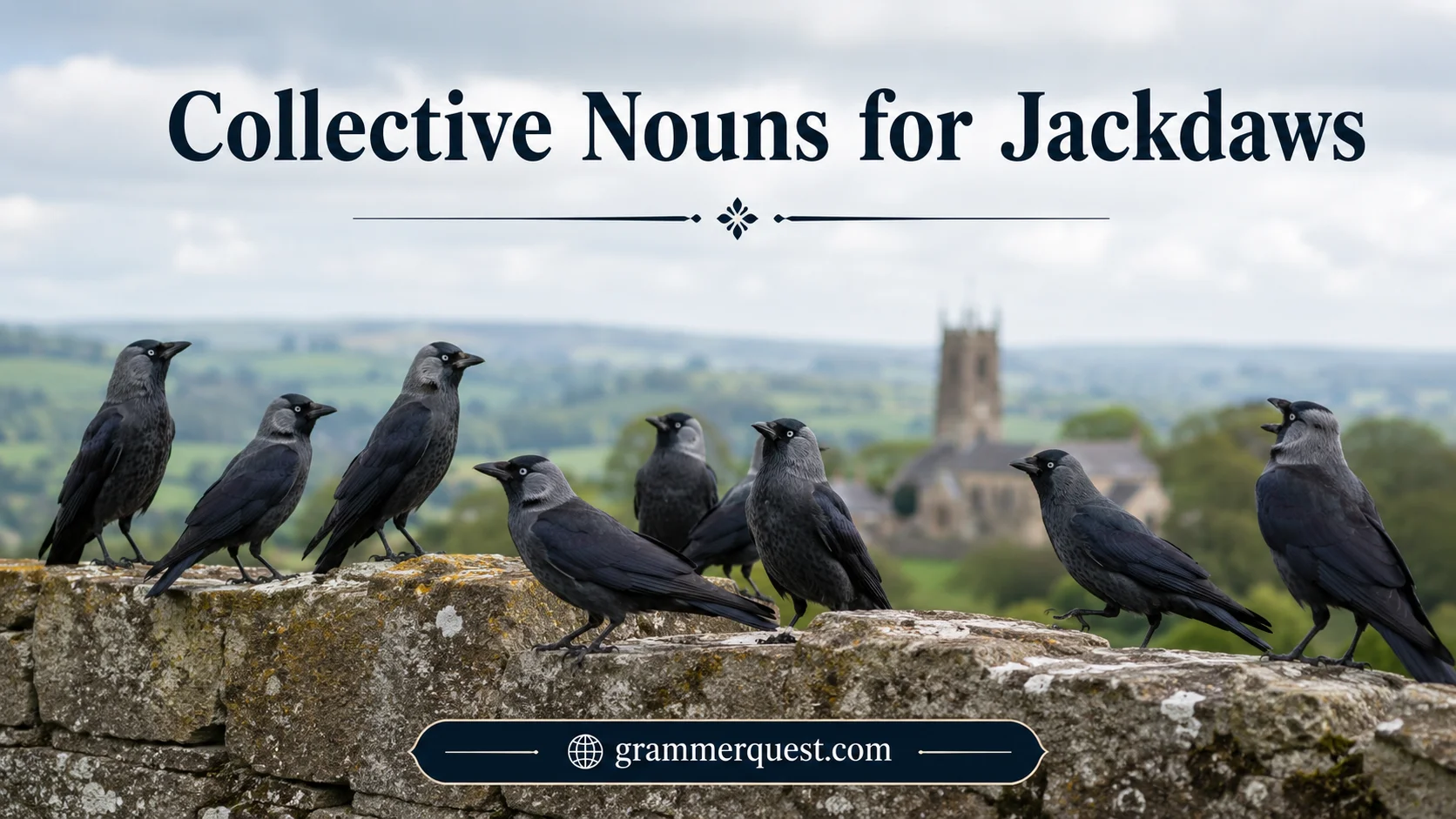
Collective Nouns for Jackdaws explain how these clever birds live, feed, and move together in groups. Their social behavior, noisy calls, and nesting habits make Jackdaws fascinating birds in the animal kingdom.
Jackdaws are part of the crow family and are well known for their strong collective behavior and communal nesting habits. These smart birds often live in a large flock near farmland, gardens, and old buildings with chimney pots. Many birdwatchers enjoy hearing their distinctive kjack call while observing their shiny black plumage, pale neck, and bright ice-blue eyes. Their social nature creates strong public fascination across different parts of Earth.
During the breeding season, faithful partners return to the same nesting sites over many successive years. Female Jackdaws usually lay four eggs or five eggs, and the chicks hatch through asynchronous hatching. The stronger chicks often receive more food, while weaker hatchlings struggle to survive because of food competition among siblings. This natural survival process helps researchers better understand bird collective nouns, wildlife behavior, and the daily life of these noisy birds.
Collective Nouns for Jackdaws Table
| Collective Noun | Simple Example |
| A clattering of jackdaws | A clattering of jackdaws circled the church tower. |
| A train of jackdaws | A train of jackdaws flew across the field. |
| A cast of jackdaws | A cast of jackdaws rested on the fence. |
| A flock of jackdaws | A flock of jackdaws searched for food together. |
| A mob of jackdaws | A mob of jackdaws made loud noises in the trees. |
A Clattering of Jackdaws
The term “clattering” is commonly used because jackdaws are noisy birds. Their constant calls and chatter create a clattering sound that can easily be heard from far away.
Example
- A clattering of jackdaws flew over the old castle.
- We heard a clattering of jackdaws near the forest.
- A clattering of jackdaws gathered on the rooftop.
- The farmer watched a clattering of jackdaws in the field.
- A clattering of jackdaws scared the smaller birds away.
- Children pointed at the clattering of jackdaws above them.
- A clattering of jackdaws filled the air with noise.
- The sunset revealed a clattering of jackdaws in the sky.
- A clattering of jackdaws perched on the church tower.
- We photographed a clattering of jackdaws beside the river.
A Train of Jackdaws
The word “train” describes the way jackdaws often fly together in a long line, especially during migration or while searching for food.
Example
- A train of jackdaws crossed the evening sky.
- We noticed a train of jackdaws above the hills.
- A train of jackdaws followed the windy path.
- The birdwatcher admired a train of jackdaws in flight.
- A train of jackdaws disappeared behind the clouds.
- The village children counted a train of jackdaws overhead.
- A train of jackdaws flew toward the forest.
- Farmers often see a train of jackdaws after harvest.
- A train of jackdaws moved quickly through the air.
- The travelers watched a train of jackdaws at dawn.
A Cast of Jackdaws
“Cast” is another collective noun for jackdaws. It is less common but still used in literature and bird-related discussions.
Example
- A cast of jackdaws rested near the barn.
- We spotted a cast of jackdaws in the park.
- A cast of jackdaws searched for insects together.
- The old tree sheltered a cast of jackdaws.
- A cast of jackdaws landed beside the lake.
- The hikers saw a cast of jackdaws on the rocks.
- A cast of jackdaws filled the field with movement.
- The gardener chased away a cast of jackdaws.
- A cast of jackdaws nested in the chimney.
- Tourists admired a cast of jackdaws near the castle walls.
A Flock of Jackdaws
“Flock” is the most common and widely understood collective noun for many birds, including jackdaws.
Example
- A flock of jackdaws flew above the trees.
- We watched a flock of jackdaws near the riverbank.
- A flock of jackdaws gathered in the cornfield.
- The farmer heard a flock of jackdaws early in the morning.
- A flock of jackdaws landed on the roof.
- The sky darkened with a flock of jackdaws.
- A flock of jackdaws searched for seeds together.
- Birdwatchers photographed a flock of jackdaws in flight.
- A flock of jackdaws nested close to the cliffs.
- We saw a flock of jackdaws while hiking.
A Mob of Jackdaws
The word “mob” is used because jackdaws can become very loud and active when gathered together in large numbers.
Example
- A mob of jackdaws surrounded the tall tree.
- We heard a mob of jackdaws before we saw them.
- A mob of jackdaws swooped across the field.
- The noisy mob of jackdaws woke the villagers.
- A mob of jackdaws fought over food scraps.
- The children laughed at the mob of jackdaws.
- A mob of jackdaws perched on the telephone wires.
- The forest echoed with a mob of jackdaws.
- A mob of jackdaws chased another bird away.
- We observed a mob of jackdaws near the farm.
Read More: Collective Nouns for Pigs
Interesting Facts About Jackdaws
Jackdaws Can Live for Many Years
Jackdaws are surprisingly long-lived birds. In the wild, they can survive for more than a decade, while some captive jackdaws have been known to live even longer. Their strong survival instincts, intelligence, and social cooperation help them adapt well to changing environments and avoid dangers from predators.
Jackdaws Have Unique Physical Features
Jackdaws are smaller than many other members of the crow family, but they stand out because of their shiny black feathers and pale gray necks. Their bright eyes give them a clever and curious appearance. They are also highly intelligent birds with excellent memory and problem-solving abilities, making them one of the smartest bird species.
Jackdaws Eat a Wide Variety of Foods
Jackdaws are omnivores, meaning they eat both plants and animals. Their diet includes insects, seeds, fruits, grains, worms, and small scraps of food left by humans. This flexible diet allows them to survive in forests, farmlands, villages, and cities. They are also known for storing food for later use when resources become limited.
Jackdaws Are Extremely Social Birds
Jackdaws prefer living in groups and form strong social bonds with one another. They communicate using different calls and body movements. These birds often work together to find food and warn each other about danger, showing impressive teamwork within their flocks.
Jackdaws Build Clever Nests
Jackdaws commonly build nests in chimneys, tree holes, cliffs, and abandoned buildings. They use sticks, grass, wool, and feathers to create comfortable nests for their young. Pairs usually stay together for life, showing loyalty and cooperation during nesting seasons.
10faqs and conclusion
FAQs:
1. What is the collective noun for Jackdaws?
The most common collective noun for Jackdaws is a clattering or a train of Jackdaws.
2. Are Jackdaws part of the crow family?
Yes, Jackdaws belong to the crow family and are closely related to crows and Rooks.
3. Why are Jackdaws called social birds?
Jackdaws are highly social because they live in groups, feed together, and show strong collective behavior.
4. Where do Jackdaws usually build nests?
They often create nests in old buildings, trees, and chimney pots during the nesting season.
5. What color are Jackdaws?
Jackdaws usually have black plumage, a grey neck, and bright ice-blue eyes.
6. How many eggs do Jackdaws lay?
Most female Jackdaws lay four eggs or five eggs during breeding season.
7. What is asynchronous hatching?
Asynchronous hatching happens when chicks hatch at different times because incubation starts before all eggs are laid.
8. Why do stronger chicks survive better?
The stronger chicks often receive more food during feeding, giving them a better chance of survival.
9. What sound do Jackdaws make?
Jackdaws are known for their loud distinctive kjack call and other noisy bird sounds.
10. Why are Collective Nouns for Jackdaws important?
Collective Nouns for Jackdaws help people understand bird groups, grammar usage, and wildlife communication more clearly.
Conclusion:
Collective Nouns for Jackdaws make bird language more interesting and meaningful. These intelligent birds are admired for their social lifestyle, strong nesting habits, and unique group behavior. From their noisy calls to their organized flocks, Jackdaws continue to attract birdwatchers and wildlife lovers around the world.

George Whitaker is the voice behind GrammarQuest, dedicated to making grammar simple, engaging, and easy to understand. He helps learners turn confusion into confidence with clear explanations and real-world examples.