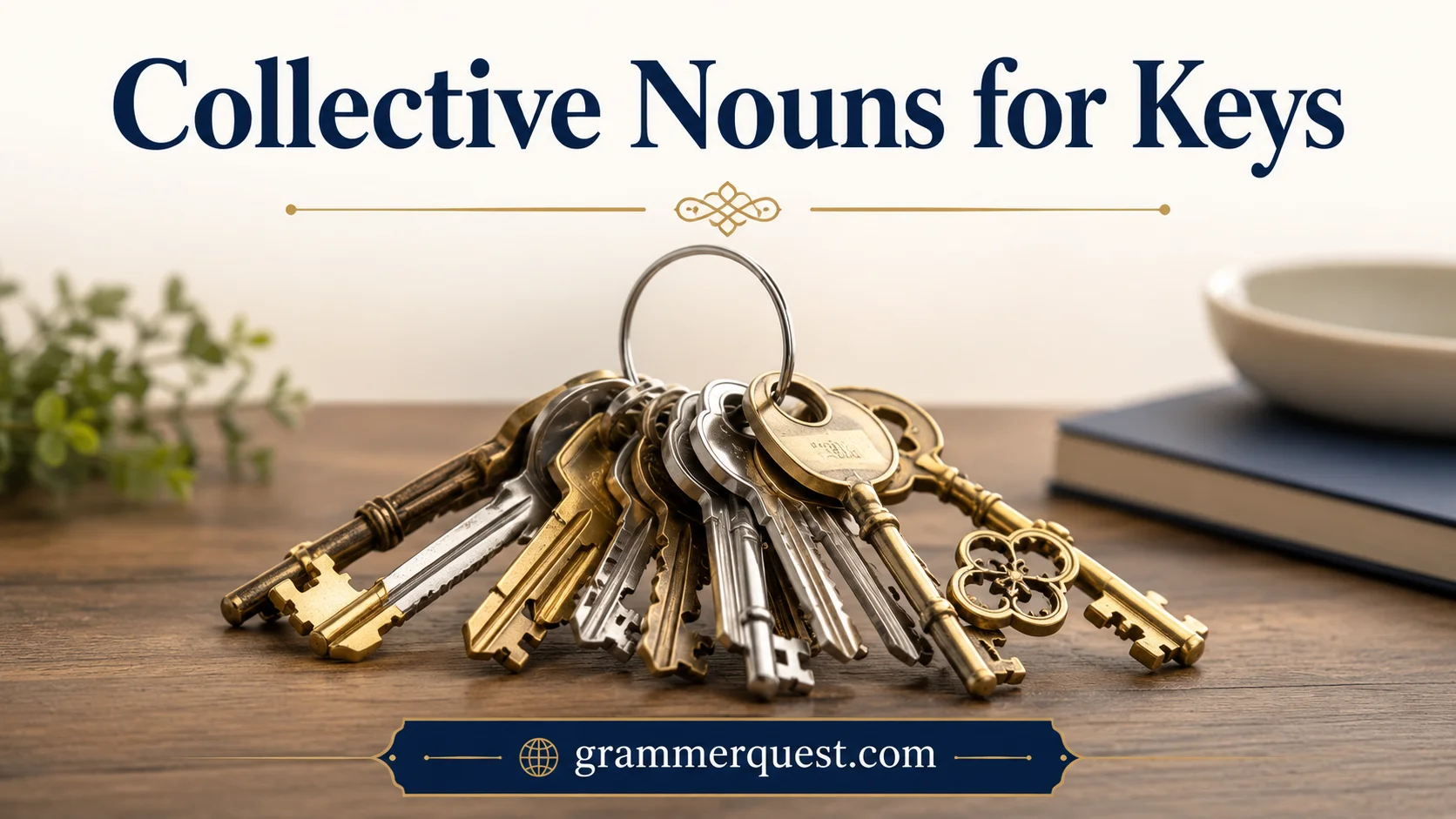
Collective Nouns for Keys are special words used to describe a group of keys as a single unit. Just as we use collective nouns for people, animals, and objects, keys can also be grouped and named in a unique way. Learning these terms helps improve vocabulary and makes writing more descriptive. Whether you see keys on a keyring, in a toolbox, or hanging together, understanding collective nouns, groups, and keys can make language more interesting and easier to use in everyday communication.
Collective nouns add variety and color to the English language by helping us describe multiple items more effectively. When talking about several keys together, using the correct collective term creates clearer and more engaging sentences. These expressions are useful for students, writers, and anyone interested in grammar. Exploring examples, vocabulary, grammar, and group names for keys can strengthen language skills while making learning both enjoyable and practical for readers of all ages.
Collective Nouns for Keys Table
| Type | Simple Example |
| Bunch of Keys | A bunch of keys hung on the wall. |
| Ring of Keys | A ring of keys opened several doors. |
| Set of Keys | A set of keys was left on the table. |
| Collection of Keys | The museum displayed a collection of keys. |
| Cluster of Keys | A cluster of keys jingled in his pocket. |
Bunch of Keys
A bunch of keys is the most common collective noun used when several keys are grouped together.
Examples of Bunch of Keys
- A bunch of keys was hanging near the door.
- She carried a bunch of keys in her handbag.
- The caretaker held a bunch of keys.
- A bunch of keys fell onto the floor.
- He found a bunch of keys under the desk.
- The janitor carried a bunch of keys every day.
- A bunch of keys jingled loudly.
- They discovered a bunch of keys in the drawer.
- The guard checked a bunch of keys before leaving.
- A bunch of keys rested on the kitchen counter.
Ring of Keys
A ring of keys refers to keys attached to a keyring.
Examples of Ring of Keys
- The ring of keys opened the office door.
- She placed the ring of keys on the desk.
- A ring of keys hung from his belt.
- The manager carried a ring of keys.
- He lost his ring of keys yesterday.
- The ring of keys made a jingling sound.
- A ring of keys was found in the hallway.
- The guard handed over the ring of keys.
- She organized her ring of keys neatly.
- The ring of keys contained ten different keys.
Set of Keys
A set of keys usually refers to keys intended for a specific lock or purpose.
Examples of Set of Keys
- I received a set of keys for my new house.
- The landlord provided a set of keys.
- She misplaced her set of keys.
- A set of keys was left on the shelf.
- The mechanic handed over a set of keys.
- He carried a spare set of keys.
- The set of keys opened all the rooms.
- They found a set of keys in the car.
- A set of keys lay beside the notebook.
- The receptionist stored a set of keys safely.
Collection of Keys
A collection of keys refers to many keys gathered, often for historical, decorative, or hobby purposes.
Examples of Collection of Keys
- The museum displayed a collection of keys.
- Her collection of keys included rare antiques.
- He started a collection of keys as a hobby.
- The collection of keys attracted visitors.
- A collection of keys filled the cabinet.
- They admired the collection of keys.
- The collector expanded his collection of keys.
- A collection of keys was showcased at the event.
- She inherited a collection of keys.
- The collection of keys contained unique designs.
Cluster of Keys
A cluster of keys describes several keys grouped closely together.
Examples of Cluster of Keys
- A cluster of keys hung beside the window.
- The cluster of keys rattled loudly.
- He picked up a cluster of keys.
- A cluster of keys rested on the table.
- The guard carried a cluster of keys.
- She found a cluster of keys in the drawer.
- The cluster of keys sparkled in the sunlight.
- A cluster of keys lay near the entrance.
- They organized a cluster of keys carefully.
- The cluster of keys belonged to the old building.
Read More: Collective Nouns for Squirrels
Interesting Facts About Keys
Keys have been used for thousands of years and remain one of humanity’s most important security tools. Ancient civilizations such as the Egyptians and Romans created some of the earliest locking mechanisms, proving the remarkable longevity of keys throughout history. One of the most unique features of keys is their specially cut patterns, which allow them to fit only particular locks. Modern keys come in many forms, including traditional metal keys, magnetic keys, electronic key cards, and smart digital keys.
Keys themselves do not have dietary habits because they are objects rather than living creatures. However, they play a vital role in daily human life by protecting homes, vehicles, offices, and valuable possessions. Their evolution from simple wooden designs to advanced digital systems highlights human innovation and the ongoing need for security.
Why Learn Collective Nouns for Keys?
Learning collective nouns for keys improves both written and spoken English. These expressions make descriptions more precise and engaging. Whether you refer to a bunch of keys, a ring of keys, or a collection of keys, using the correct collective noun helps communicate ideas clearly and effectively.
FAQs :
1. What is a collective noun for keys?
A collective noun for keys is a word used to describe a group of keys together.
2. Why do we use collective nouns for keys?
We use them to make our language clearer, shorter, and more natural.
3. What is the most common collective noun for keys?
The most common collective noun is a bunch of keys.
4. Can keys be called a set?
Yes, in some cases, people may also say a set of keys.
5. Is “ring of keys” correct?
Yes, a ring of keys is also a correct and common phrase.
6. Are collective nouns used only for people and animals?
No, collective nouns are also used for things like keys, books, and clothes.
7. Can I use “bundle of keys”?
Yes, bundle of keys can be used, especially when several keys are grouped together.
8. Which phrase is best for daily use?
A bunch of keys is the most common and natural choice in daily English.
9. Do collective nouns make writing better?
Yes, they make writing more interesting, clear, and descriptive.
10. Should students learn collective nouns for keys?
Yes, because it improves grammar, vocabulary, and speaking skills.
Conclusion :
Collective nouns for keys help us describe a group of keys in a simple and natural way. Common phrases like a bunch of keys, a set of keys, and a ring of keys make English more expressive and easy to understand. Learning these words can improve both writing and speaking skills.

Henry Collins is a passionate grammar expert and the voice behind GrammerQuest.com. With a sharp eye for language and a love for clear communication, he simplifies complex grammar rules into easy, practical lessons.