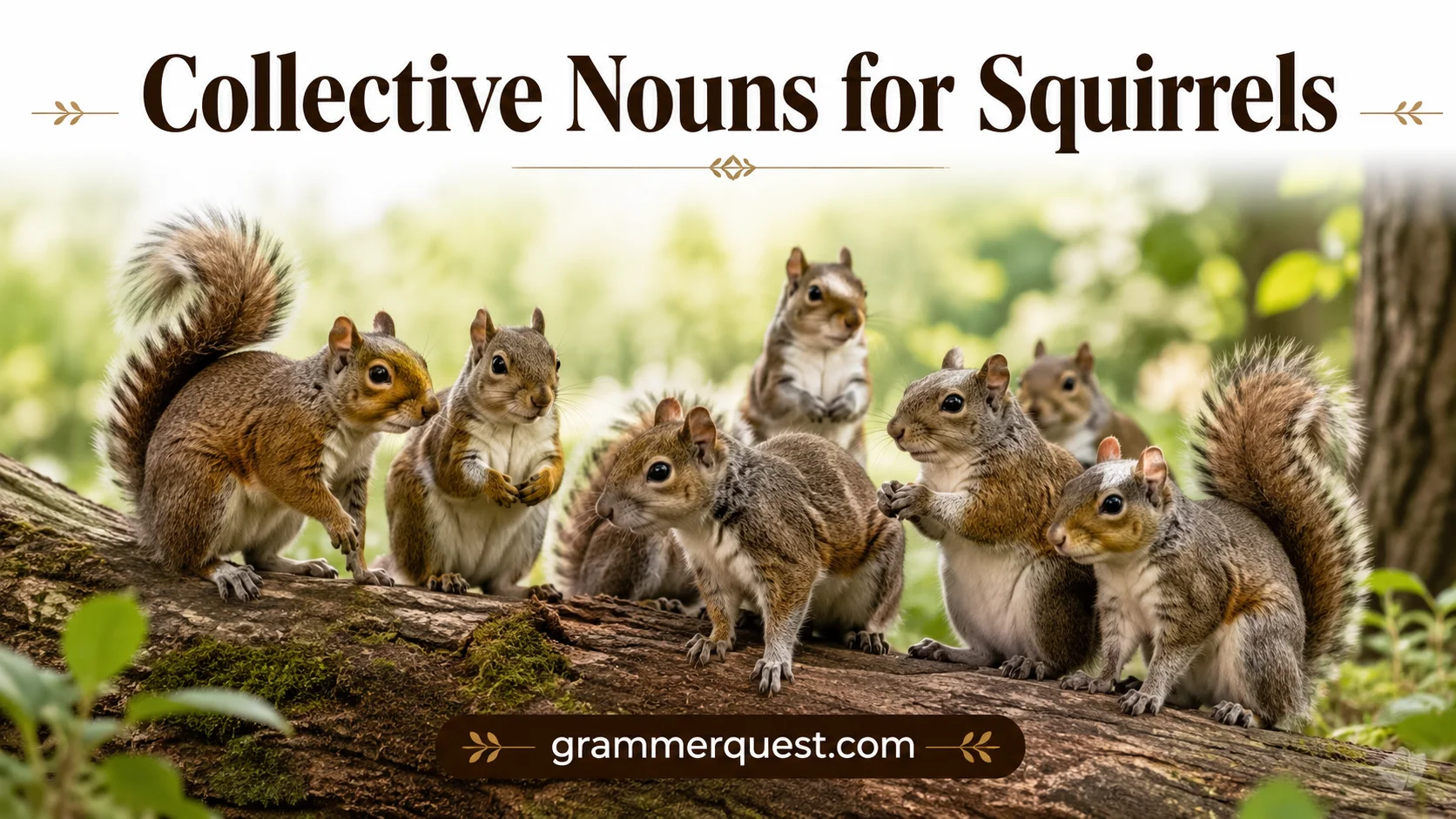
Collective Nouns for Squirrels describe how a scurry of squirrels is the most commonly used term in English, showing how animal group names like flock, pack, and pod developed over time. These terms come from old medieval lists where hunters and writers created special names for groups of animals and birds. While many of these words were rarely used in real conversation, they became part of modern vocabulary and are still taught today as interesting English expressions for animal groupings.
Over time, many creative and unusual collective nouns were added, such as a clowder of cats, a parliament of owls, a murmuration of starlings, a crash of rhinoceroses, and a confusion of wildebeest. Although everyday English usually prefers simple terms like flock or pack, these expressive names remain popular in learning and writing about animals. The idea of collective nouns continues to grow from curiosity about wildlife, their habitats, and how groups behave in nature.
What Are Collective Nouns?
A collective noun is a word that refers to a group of individuals as one entity. Examples include a flock of birds, a herd of deer, and a school of fish.
When it comes to squirrels, collective nouns provide a creative way to describe multiple squirrels gathered in one place. Although squirrels are often seen alone, groups can sometimes be observed feeding, nesting, or exploring together.
Collective Nouns for Squirrels
The table below highlights some of the most commonly used collective nouns for squirrels.
| Collective Noun | Simple Example |
| Scurry | A scurry of squirrels ran across the park. |
| Dray | A dray of squirrels gathered near the oak tree. |
| Colony | A colony of squirrels lived in the forest. |
| Nest | A nest of squirrels rested in the tree. |
| Cluster | A cluster of squirrels searched for nuts. |
Scurry of Squirrels
A scurry is the most popular and widely recognized collective noun for squirrels. It reflects their quick and energetic movements.
Examples of Scurry of Squirrels
- A scurry of squirrels crossed the path.
- We saw a scurry of squirrels near the lake.
- A scurry of squirrels climbed the trees.
- The scurry of squirrels searched for acorns.
- A scurry of squirrels played in the garden.
- The scurry of squirrels disappeared into the woods.
- A scurry of squirrels ran across the field.
- We watched a scurry of squirrels gather food.
- A scurry of squirrels rested beneath the tree.
- The scurry of squirrels scattered when a dog approached.
Dray of Squirrels
The word dray traditionally refers to a squirrel’s nest and is also used as a collective noun for squirrels.
Examples of Dray of Squirrels
- A dray of squirrels lived in the tall tree.
- We spotted a dray of squirrels in the forest.
- The dray of squirrels collected nuts.
- A dray of squirrels moved between branches.
- The dray of squirrels stayed close together.
- A dray of squirrels explored the park.
- The dray of squirrels rested during the afternoon.
- We observed a dray of squirrels near the river.
- A dray of squirrels searched for food.
- The dray of squirrels quickly climbed higher.
Colony of Squirrels
A colony refers to a group of squirrels living in the same area over a long period.
Examples of Colony of Squirrels
- A colony of squirrels lived near the forest edge.
- The colony of squirrels shared the area peacefully.
- We found a colony of squirrels in the park.
- A colony of squirrels gathered around the trees.
- The colony of squirrels stored food for winter.
- A colony of squirrels occupied several nests.
- The colony of squirrels thrived in the woodland.
- We watched a colony of squirrels feeding together.
- The colony of squirrels expanded over time.
- A colony of squirrels was active at sunrise.
Nest and Cluster of Squirrels
Although less common, nest and cluster can sometimes describe groups of squirrels depending on the situation.
Examples of Nest of Squirrels
- A nest of squirrels slept in the tree.
- The nest of squirrels stayed warm together.
- We noticed a nest of squirrels overhead.
- A nest of squirrels rested quietly.
- The nest of squirrels remained hidden.
- A nest of squirrels sheltered from the rain.
- We found a nest of squirrels near the woods.
- The nest of squirrels became active at dawn.
- A nest of squirrels occupied the hollow tree.
- The nest of squirrels appeared safe and secure.
Examples of Cluster of Squirrels
- A cluster of squirrels gathered near the feeder.
- We saw a cluster of squirrels in the garden.
- The cluster of squirrels searched for seeds.
- A cluster of squirrels played together.
- The cluster of squirrels moved from tree to tree.
- A cluster of squirrels explored the area.
- We watched a cluster of squirrels feeding.
- The cluster of squirrels stayed close together.
- A cluster of squirrels ran across the lawn.
- The cluster of squirrels disappeared into the trees.
Read More: Collective Nouns for Hares
Interesting Facts About Squirrels
Squirrels are fascinating animals with remarkable adaptations that help them survive in a variety of environments. Depending on the species, squirrels can live anywhere from 5 to 20 years, though many wild squirrels have shorter lifespans due to predators and environmental challenges. One of their most distinctive features is their bushy tail, which helps them maintain balance while climbing and jumping, keeps them warm during cold weather, and even serves as a communication tool. Squirrels possess strong hind legs that allow them to leap impressive distances and sharp claws that make climbing easy. Their diet is highly varied and includes nuts, seeds, fruits, berries, fungi, and occasionally insects or bird eggs. They are also famous for caching food, burying nuts in numerous locations and relying on their excellent memory to recover many of them later. This behavior unintentionally helps forests grow because forgotten seeds often sprout into new plants and trees.
Why Learning Collective Nouns for Squirrels Matters
Collective nouns add richness and precision to language. By learning terms such as scurry, dray, and colony, readers can describe groups of squirrels in a more engaging and accurate way. These terms also provide insight into how humans have observed and categorized wildlife throughout history.
FAQs :
1. What is the collective noun for squirrels?
The collective noun for squirrels is a scurry.
2. Why is a group of squirrels called a scurry?
It is called a scurry because squirrels move quickly and energetically, which matches the meaning of the word.
3. Is scurry the only collective noun for squirrels?
No, but scurry is the most common and widely accepted collective noun for squirrels.
4. Do people use the word scurry in daily English?
Yes, people use it in writing, learning, and sometimes in everyday speech when talking about squirrels.
5. Are collective nouns for animals always used in real life?
Not always. Some collective nouns are traditional or creative and are more common in grammar books than in daily conversation.
6. What are some other collective nouns for animals?
Examples include a flock of birds, a pack of dogs, and a pod of whales.
7. What is the importance of learning collective nouns for squirrels?
They help improve English vocabulary, grammar, and writing skills.
8. Are collective nouns for animals the same in British and American English?
Most are the same, but usage can vary depending on region and style.
9. Can I say a group of squirrels instead of a scurry of squirrels?
Yes, you can. A group of squirrels is correct and simple, while a scurry of squirrels is more specific.
10. Why are animal collective nouns interesting?
They make English more fun, creative, and descriptive, especially when learning about animals.
Conclusion :
In short, the collective noun for squirrels is a scurry, and it is one of the most interesting animal group names in English. Learning these words not only improves vocabulary but also makes grammar more engaging and enjoyable.

Henry Collins is a passionate grammar expert and the voice behind GrammerQuest.com. With a sharp eye for language and a love for clear communication, he simplifies complex grammar rules into easy, practical lessons.