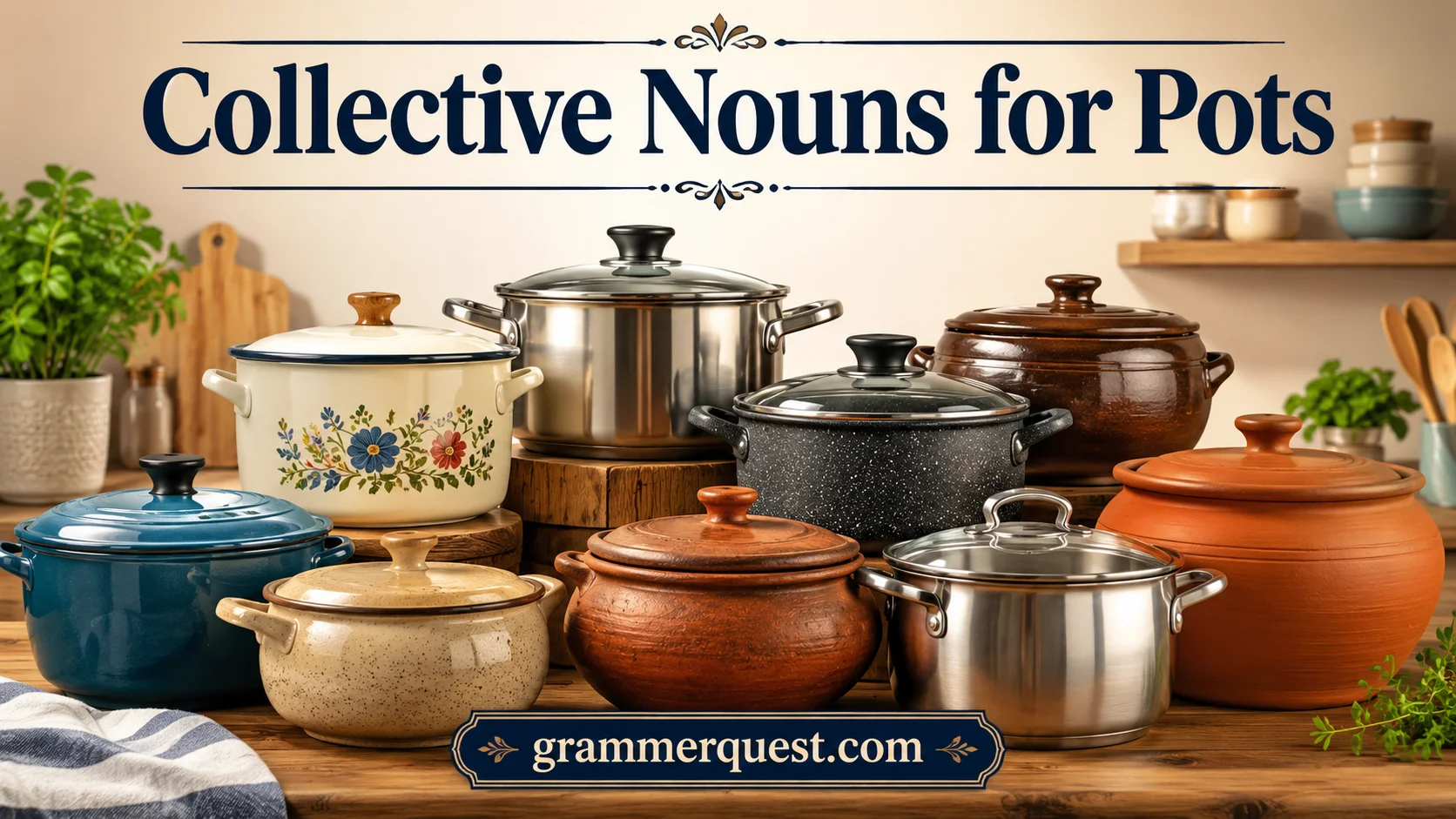
The term Collective Nouns for Pots helps describe a group of pots with a single, meaningful word. Instead of saying “many pots,” English uses expressions like a stack of pots or a row of pots. These collective nouns make writing and speaking more descriptive, especially when talking about gardening, storage, or kitchen items. Learning these terms also improves your vocabulary and helps you communicate more naturally in everyday English.
Whether you enjoy gardening, studying grammar, or simply expanding your English skills, understanding collective nouns for pots is both useful and interesting. These expressions add variety to your sentences and make descriptions clearer. In this guide, you will discover the most common collective nouns for pots, their meanings, easy examples, and helpful facts that make learning simple and enjoyable for readers of all ages.
What Are Collective Nouns?
A collective noun is a word that refers to a group of people, animals, places, or objects as a single unit. Instead of naming each item individually, a collective noun allows us to describe the entire group with one word.
For example:
- A set of pots
- A collection of pots
- A stack of pots
These expressions are commonly used in everyday English and are easy to understand.
Collective Nouns for Pots
| Type | Simple Example |
| Set | A set of pots was placed on the shelf. |
| Collection | She displayed a collection of pots. |
| Stack | A stack of pots stood in the kitchen. |
| Group | A group of pots was ready for sale. |
| Assortment | The shop offered an assortment of pots. |
Set of Pots
A set is the most common collective noun for pots because pots are often sold or used together as matching cookware.
Examples
- She bought a set of pots for her new kitchen.
- The set of pots included five different sizes.
- Our set of pots is made of stainless steel.
- A set of pots was displayed in the showroom.
- They received a beautiful set of pots as a wedding gift.
- Every set of pots came with matching lids.
- The chef used a large set of pots during cooking.
- We cleaned the entire set of pots after dinner.
- The set of pots looked elegant on the shelf.
- This set of pots will last for many years.
Collection of Pots
The word collection is suitable when referring to decorative, antique, or valuable pots gathered over time.
Examples
- She owns a beautiful collection of pots.
- The museum displayed a rare collection of pots.
- His collection of pots came from different countries.
- We admired the colorful collection of pots.
- The artist created a unique collection of pots.
- Their collection of pots filled an entire room.
- Every collection of pots tells a different story.
- The antique collection of pots attracted many visitors.
- She expanded her collection of pots every year.
- The collection of pots included handmade pottery.
Stack of Pots
A stack describes pots placed one on top of another to save space.
Examples
- A stack of pots stood beside the sink.
- The cook arranged a stack of pots neatly.
- We carried the stack of pots carefully.
- A stack of pots was drying after washing.
- The stack of pots nearly touched the shelf above.
- She moved the stack of pots to the cupboard.
- The children counted the stack of pots.
- The kitchen contained a tall stack of pots.
- He cleaned every pot in the stack of pots.
- The stack of pots looked perfectly organized.
Group of Pots
The word group is a general collective noun that works whenever several pots are gathered together.
Examples
- A group of pots decorated the garden.
- We saw a group of pots near the entrance.
- The group of pots contained colorful flowers.
- A group of pots was placed on the balcony.
- The gardener watered the group of pots every morning.
- The group of pots added beauty to the yard.
- Visitors admired the group of pots.
- A group of pots lined the pathway.
- The shop displayed a group of pots outside.
- The group of pots looked attractive together.
Assortment of Pots
An assortment refers to pots of different sizes, shapes, colors, or materials.
Examples
- The store sold an assortment of pots.
- We purchased an assortment of pots for gardening.
- The kitchen contained an assortment of pots.
- An assortment of pots filled the display rack.
- She selected an assortment of pots for her plants.
- The assortment of pots included clay and ceramic designs.
- They packed an assortment of pots for shipping.
- An assortment of pots decorated the greenhouse.
- The assortment of pots suited every gardening style.
- Customers appreciated the wide assortment of pots.
Read More: Collective Nouns for Snow
Interesting Facts About Pots
Pots have been an essential part of human civilization for thousands of years. Archaeologists have discovered clay pots that are over 20,000 years old, making pottery one of the oldest human crafts. Pots are made from a variety of materials, including clay, ceramic, stainless steel, aluminum, cast iron, copper, and glass. Their durability allows many high-quality pots to last for decades with proper care. Garden pots also play an important role in supporting healthy plant growth by providing space for roots, retaining moisture, and protecting plants. Unlike animals, pots do not have biological traits or dietary habits, but their design, material, and purpose have evolved significantly to meet different cooking, storage, and gardening needs across cultures.
Why Learn Collective Nouns for Pots?
Learning collective nouns for pots offers several benefits:
- Improves English vocabulary.
- Makes writing more descriptive.
- Helps students understand grammar better.
- Enhances speaking and communication skills.
- Makes everyday descriptions more natural.
FAQs :
1. What are Collective Nouns for Pots?
Collective nouns for pots are words used to describe a group of pots, such as a stack of pots or a row of pots.
2. What is the most common collective noun for pots?
The most common collective noun is a stack of pots, especially when pots are placed one on top of another.
3. Can I say a row of pots?
Yes. A row of pots is correct when the pots are arranged in a straight line.
4. Are collective nouns for pots officially recognized?
Some terms are commonly used in everyday English, while others depend on context rather than strict grammar rules.
5. Why should I learn collective nouns for pots?
They improve your vocabulary and make your writing and speaking more descriptive.
6. Where are collective nouns for pots commonly used?
They are often used in gardening, home decoration, nurseries, and English learning materials.
7. Is “collection of pots” correct?
Yes. A collection of pots is a suitable phrase, especially for decorative or valuable pots.
8. Are collective nouns only used for animals?
No. Collective nouns can describe groups of people, animals, objects, and even things like pots.
9. How can I remember collective nouns for pots?
Practice using them in simple sentences and relate each term to how the pots are arranged.
10. What is the easiest collective noun for beginners?
A stack of pots is the easiest and most commonly understood collective noun for beginners.
Conclusion
Learning Collective Nouns for Pots is a simple way to improve your English vocabulary and writing skills. Words like stack of pots, row of pots, and collection of pots make descriptions clearer and more engaging. By practicing these terms in everyday sentences, you can communicate more naturally and confidently while gaining a better understanding of collective nouns.

Emma Brooke is a passionate language enthusiast and the voice behind GrammarQuest.com. With a sharp eye for detail and a love for clear communication, she simplifies complex grammar rules into easy, practical lessons. Her goal is to help you write with confidence, clarity, and style—whether you’re a student, professional, or everyday writer.