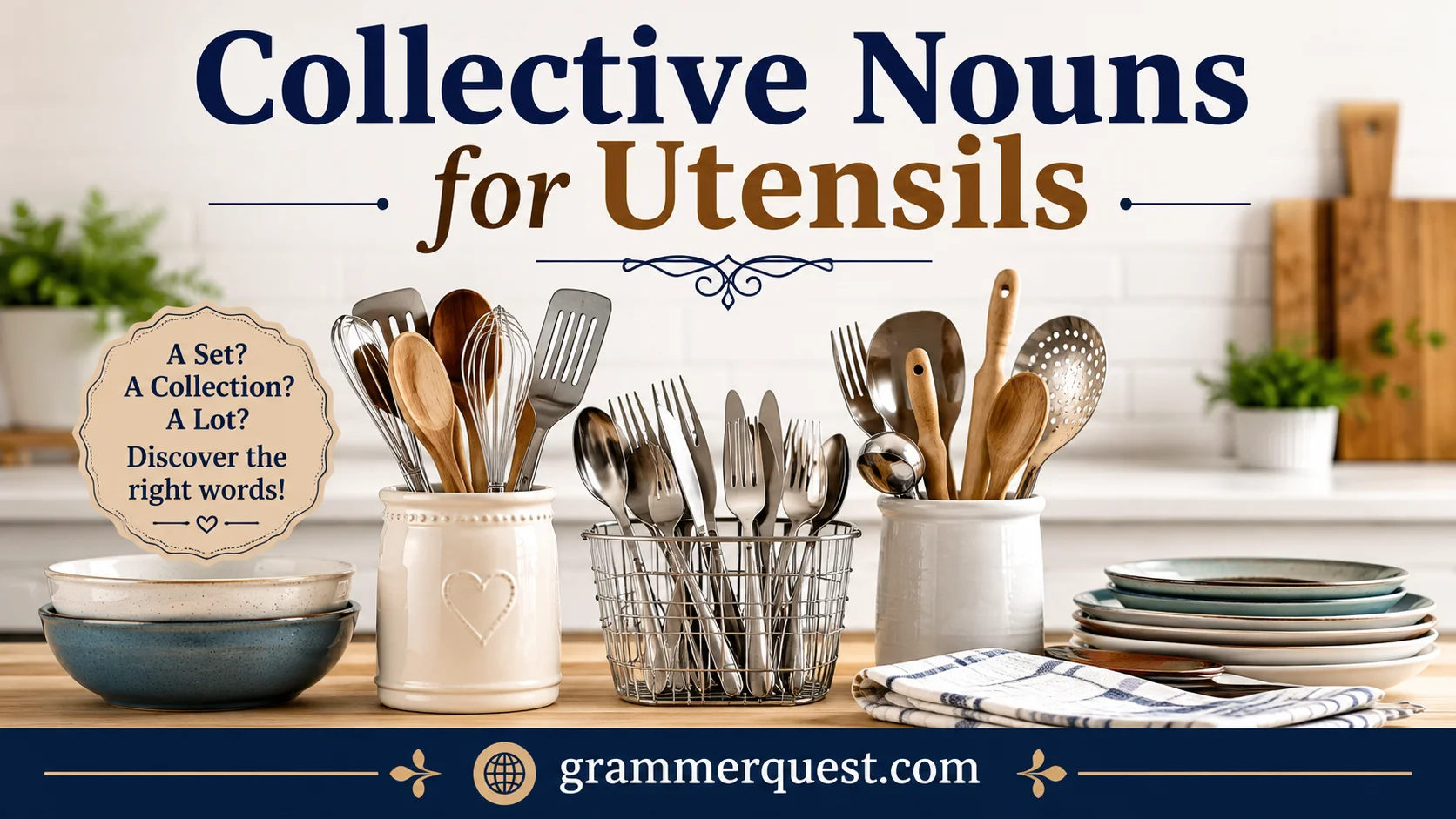
Collective Nouns for Utensils help us describe a group of kitchen tools in a simple and accurate way. Whether you are talking about cutlery, tableware, spoons, forks, knives, or plates, using the correct collective noun makes your English more natural and interesting. Learning these terms improves vocabulary, enhances writing skills, and helps students and English learners communicate with greater confidence in both speaking and writing.
Understanding collective nouns is useful because they replace long descriptions with one clear expression. Common examples include a set of cutlery, a set of dishes, and a collection of utensils. These words make sentences easier to read while adding variety and style. Writers, teachers, and learners can use them to describe groups of kitchen items clearly, making everyday conversations and written English more accurate and engaging.
| Type of Collective Noun | Simple Example |
| Set of utensils | A set of utensils was placed on the table. |
| Collection of utensils | She kept a collection of utensils in the drawer. |
| Bundle of utensils | A bundle of utensils was tied together for the picnic. |
| Assortment of utensils | The shop displayed an assortment of utensils. |
| Rack of utensils | A rack of utensils hung near the sink. |
Set of Utensils
A set of utensils is one of the most common ways to describe a group of kitchen tools that belong together. A set usually includes matching items such as spoons, forks, knives, or serving tools.
Examples
- I bought a new set of utensils for my kitchen.
- The hotel placed a set of utensils on every dining table.
- She washed the set of utensils after lunch.
- We received a shiny set of utensils as a wedding gift.
- The chef chose a strong set of utensils for daily cooking.
- A set of utensils is useful for both cooking and serving.
- My mother keeps a set of utensils in the top drawer.
- The restaurant uses a clean set of utensils for each customer.
- He packed a set of utensils for the camping trip.
- The children arranged a set of utensils for the picnic basket.
Collection of Utensils
A collection of utensils usually means a group of different utensils gathered together. The items may not match, but they are still kept as one group.
Examples
- She has a large collection of utensils in her kitchen.
- The museum showed a collection of utensils from old times.
- A collection of utensils was displayed on the shelf.
- My aunt owns a beautiful collection of utensils.
- The box contained a collection of utensils for cooking.
- He organized his collection of utensils by size.
- The shop had a collection of utensils made of steel.
- We found a collection of utensils in the back cupboard.
- The chef examined a collection of utensils before starting work.
- A collection of utensils can include spoons, spatulas, and ladles.
Bundle of Utensils
A bundle of utensils is used when utensils are tied, wrapped, or packed together. This phrase is helpful when utensils are being carried, sold, or stored.
Examples
- The vendor carried a bundle of utensils to the market.
- She tied a bundle of utensils with string.
- A bundle of utensils was packed for the school event.
- The campers brought a bundle of utensils for outdoor cooking.
- He found a bundle of utensils in the storage room.
- A bundle of utensils can be easy to transport.
- The workers delivered a bundle of utensils to the kitchen.
- We bought a bundle of utensils for the new house.
- The package included a bundle of utensils and plates.
- She opened the bundle of utensils and arranged them carefully.
Assortment of Utensils
An assortment of utensils means a mixed group of utensils of different kinds, sizes, or uses. This phrase is useful when the group is varied and not all the items are the same.
Examples
- The kitchen had an assortment of utensils on the counter.
- We saw an assortment of utensils in the store.
- The chef selected an assortment of utensils for the recipe.
- A colorful assortment of utensils filled the drawer.
- The picnic basket contained an assortment of utensils.
- The display showed an assortment of utensils for cooking and serving.
- She cleaned an assortment of utensils after dinner.
- The family bought an assortment of utensils for daily use.
- A useful assortment of utensils makes kitchen work easier.
- The restaurant kept an assortment of utensils ready for customers.
Rack of Utensils
A rack of utensils refers to utensils that are hung or stored on a rack. This phrase is common in kitchens where tools are kept within easy reach.
Examples
- A rack of utensils hung beside the stove.
- She placed the spoons on a rack of utensils.
- The chef reached for a rack of utensils while cooking.
- A clean rack of utensils kept the kitchen tidy.
- The wall had a rack of utensils near the sink.
- We saw a rack of utensils in the restaurant kitchen.
- He organized the tools on a rack of utensils.
- The mother dried the spoons on a rack of utensils.
- A rack of utensils saves space in a small kitchen.
- The new apartment came with a rack of utensils already installed.
Read More: Collective Nouns for Pots
Interesting Facts About Utensils
Utensils do not have biological traits or dietary habits because they are not living things, but they do have interesting features in everyday life. Many utensils last for years when made from strong materials like stainless steel, wood, or silicone, which shows their long usefulness and durability. Their physical features are also unique: some are long and thin, some are flat, and some are curved or sharp, each designed for a special task such as stirring, cutting, scooping, or serving. In a kitchen, the “dietary habits” of utensils can be understood as the foods they are used with most often, such as soup, rice, salad, or dessert, which makes each utensil a helpful tool for different meals.
FAQs :
1. What are collective nouns for utensils?
Collective nouns for utensils are words used to describe a group of kitchen tools, such as a set of cutlery or a collection of utensils.
2. What is the most common collective noun for utensils?
The most common collective noun is a set of utensils because it refers to utensils grouped together for everyday use.
3. Is “set of cutlery” a collective noun?
Yes. A set of cutlery is a widely accepted collective noun for knives, forks, and spoons.
4. What is the difference between utensils and tableware?
Utensils are tools used for cooking or eating, while tableware includes plates, bowls, cups, and other dining items.
5. Why should I learn collective nouns for utensils?
Learning them improves your English vocabulary, makes your writing clearer, and helps you avoid repeating the same words.
6. Can I use “collection of utensils” in writing?
Yes. Collection of utensils is correct when referring to many utensils gathered or displayed together.
7. Are collective nouns important for students?
Yes. They help students write better sentences and improve their grammar and communication skills.
8. Are there creative collective nouns for spoons?
Yes. Besides a set of spoons, some writers creatively use a stirring of spoons in descriptive writing.
9. Can collective nouns be used in everyday English?
Absolutely. They are commonly used in conversations, classrooms, recipes, and written English.
10. How can I remember collective nouns for utensils?
Practice using them in daily sentences and reading English books or articles that include collective nouns.
Conclusion :
Learning Collective Nouns for Utensils helps you describe groups of kitchen tools in a simple, accurate, and natural way. Terms like a set of utensils, a set of cutlery, and a collection of utensils make your writing more organized and expressive. By understanding and practicing these collective nouns, students, writers, and English learners can improve their vocabulary, strengthen their grammar, and communicate with greater clarity and confidence.

George Whitaker is the voice behind GrammarQuest, dedicated to making grammar simple, engaging, and easy to understand. He helps learners turn confusion into confidence with clear explanations and real-world examples.