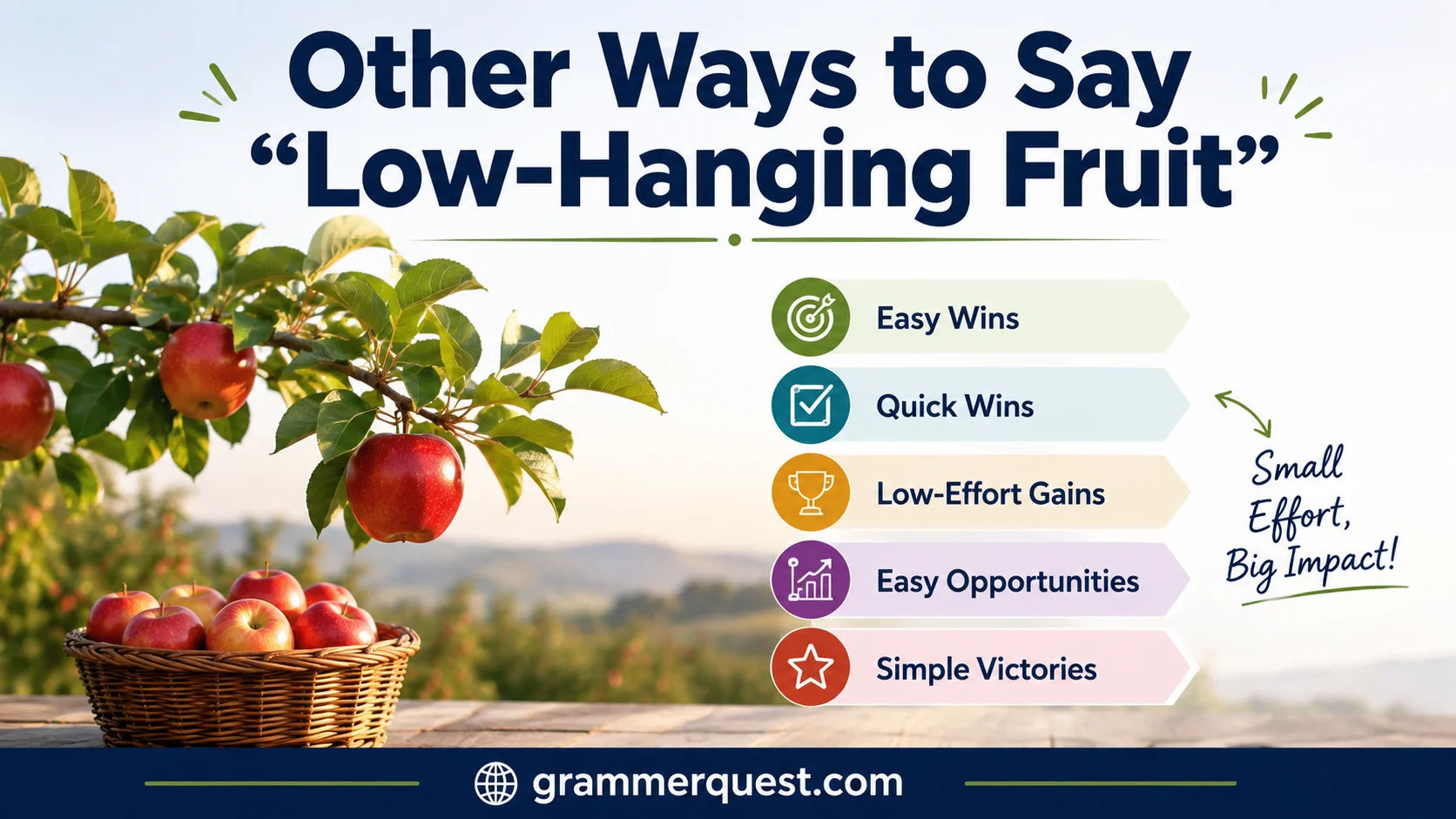
The phrase Low-Hanging Fruit describes easy opportunities, simple tasks, and goals that can be completed with little effort. Other Ways to Say “Low-Hanging Fruit” (With Examples) helps writers and speakers discover better expressions to convey ideas clearly. This common expression is used in business, education, and everyday conversations to explain quick results and practical solutions.
Finding new alternatives improves communication, increases productivity, and helps people choose the right words for different situations. Using fresh phrases instead of repeating low hanging fruit makes writing more engaging, professional, and flexible. These expressions support better problem-solving, clearer discussions, and stronger messages in many contexts.
Did You Know: Low-Hanging Fruit Meaning and Usage
The phrase “low-hanging fruit” originally comes from the simple image of fruit growing on a tree. The fruit that hangs closest to the ground is the easiest to pick because it requires the least effort. Over time, this idea became a popular metaphor for easy opportunities, quick improvements, and simple solutions that deliver immediate benefits.
In modern communication, low-hanging fruit is frequently used in business strategy, project management, marketing, and personal development. Companies often identify low-hanging fruit when they want to improve performance quickly before moving toward more complex challenges.
For example, a company might fix small website errors before redesigning the entire platform. Those small fixes are considered low-hanging fruit because they are simple actions that can create noticeable improvements.
What Does “Low-Hanging Fruit” Mean?
The phrase “low-hanging fruit” means something that is easy to accomplish, easy to obtain, or requires minimal effort while producing a useful result. It usually refers to opportunities, tasks, problems, or goals that can be achieved quickly without significant resources.
In professional settings, low-hanging fruit often describes quick wins that help organizations make progress. Leaders use this concept to prioritize simple improvements before investing time and money into complicated projects.
For example:
“Improving customer service response time is the low-hanging fruit that can immediately increase customer satisfaction.”
This means improving response time is a simple action that can create a positive impact quickly.
Professional or Political Way to Say “Low-Hanging Fruit”
In professional or political communication, the phrase “low-hanging fruit” may sometimes sound informal. More polished alternatives can make your message sound strategic and diplomatic.
Some professional ways to say low-hanging fruit include:
- Quick wins
- Immediate opportunities
- Easily achievable goals
- High-impact opportunities
- Short-term improvements
- Simple solutions
- Accessible opportunities
- Priority actions
In politics, leaders may use phrases like “immediate priorities” or “practical improvements” instead of low-hanging fruit when discussing policies or reforms. These expressions sound more serious and focused on public benefit.
For example:
Instead of saying:
“We should focus on the low-hanging fruit first.”
A politician or executive may say:
“We should address the immediate priorities that can create meaningful improvements for citizens.”
“Low-Hanging Fruit” Synonyms
- Quick Wins
- Easy Gains
- Immediate Opportunities
- Simple Solutions
- Accessible Opportunities
- Straightforward Improvements
- Easy Targets
- Fast Results
- Ready Opportunities
- Immediate Priorities
- Simple Victories
- Effortless Gains
- High-Impact Opportunities
- Practical Improvements
- Basic Improvements
- Early Successes
- First-Step Opportunities
- Visible Improvements
- Small Wins
- Immediate Benefits
- Easily Achievable Goals
- Simple Breakthroughs
- Strategic Opportunities
- Promising Prospects
- Quick Results
1. Quick Wins
Definition: Quick wins refer to actions, changes, or achievements that can be completed in a short period and provide noticeable benefits. They are simple opportunities that create immediate positive outcomes.
Meanings: The phrase quick wins means achieving success quickly with limited effort, resources, or time. In business and personal development, quick wins are often used to build confidence, improve motivation, and demonstrate progress.
Example: “Updating the company website’s outdated information was a quick win that improved customer trust.”
Detailed Explanation: Quick wins are one of the most common professional alternatives to low-hanging fruit. Organizations often search for quick wins when they need visible progress without waiting for long-term projects to finish. These actions may include fixing small problems, improving existing processes, or making simple changes that create immediate value. Quick wins help teams gain momentum and encourage further improvement.
Tone: Professional, positive, strategic, and business-friendly.
Best Use: Use quick wins in business meetings, project planning, leadership discussions, presentations, and workplace communication.
2. Easy Gains
Definition: Easy gains describe improvements or benefits that can be achieved without much difficulty. They represent simple opportunities that require minimal effort but offer valuable results.
Meanings: The term easy gains refers to situations where success can be reached through straightforward actions. It highlights efficiency and the ability to achieve progress without unnecessary complexity.
Example: “Reducing unnecessary expenses is one of the easiest gains the company can achieve this year.”
Detailed Explanation: Easy gains are similar to low-hanging fruit because they focus on obtaining benefits through simple actions. This phrase is useful when discussing efficiency, productivity, or improvement strategies. Businesses often look for easy gains before making major investments because these small changes can create measurable results. It encourages people to focus on practical solutions rather than complicated approaches.
Tone: Casual, professional, and practical.
Best Use: Use easy gains in workplace conversations, financial discussions, productivity planning, and improvement strategies.
3. Immediate Opportunities
Definition: Immediate opportunities are chances for improvement or success that can be acted upon quickly. They represent available options that can produce results in the near future.
Meanings: The phrase means opportunities that do not require long preparation or extensive resources. It focuses on timing, accessibility, and the ability to take action quickly.
Example: “The company should identify immediate opportunities to improve customer satisfaction.”
Detailed Explanation: Immediate opportunities provide a more formal alternative to low-hanging fruit, especially in strategic discussions. This phrase emphasizes the importance of recognizing available possibilities before they disappear. Leaders and decision-makers often use this expression when creating plans because it suggests a proactive approach. It also sounds more professional when discussing growth, policy changes, or organizational improvements.
Tone: Formal, strategic, and business-oriented.
Best Use: Use immediate opportunities in reports, presentations, corporate communication, and professional conversations.
4. Simple Solutions
Definition: Simple solutions are easy-to-understand answers or actions that solve problems without unnecessary complexity. They focus on practicality and effectiveness.
Meanings: The phrase refers to straightforward methods that address challenges efficiently. A simple solution does not mean a weak solution; it often means an effective approach with fewer complications.
Example: “Automating appointment reminders was a simple solution that reduced missed meetings.”
Detailed Explanation: Simple solutions are a useful alternative to low-hanging fruit when talking about problem-solving. Many organizations prefer simple solutions because they save time, reduce costs, and are easier for people to adopt. Instead of searching for complicated answers, teams can focus on changes that immediately improve results. This phrase works well when emphasizing clarity and practicality.
Tone: Neutral, professional, and approachable.
Best Use: Use simple solutions in technology, business, education, management, and everyday conversations.
5. Accessible Opportunities
Definition: Accessible opportunities are chances for improvement or success that are available and easy for people to reach. They require fewer barriers, resources, or complex processes.
Meanings: This phrase highlights opportunities that are within reach and can be successfully achieved. It focuses on availability, fairness, and practical possibilities.
Example: “Providing online training creates accessible opportunities for employees to develop new skills.”
Detailed Explanation: Accessible opportunities offer a more inclusive and thoughtful alternative to low-hanging fruit. While low-hanging fruit focuses mainly on ease, accessible opportunities emphasize that people can realistically take advantage of available options. This phrase is useful in education, business development, social programs, and leadership discussions. It creates a positive message by focusing on opportunity rather than simplicity alone.
Tone: Professional, inclusive, and positive.
Best Use: Use accessible opportunities in leadership, education, community discussions, workplace development, and social initiatives.
6. Straightforward Improvements
Definition: Straightforward improvements are simple changes that make something better without requiring complicated methods or major resources. They focus on clear, practical actions that create positive results.
Meanings: The phrase straightforward improvements means easy-to-understand adjustments that can enhance performance, quality, or efficiency. These improvements usually involve removing problems, fixing weaknesses, or making existing systems work better.
Example: “Updating the employee training materials was a straightforward improvement that increased productivity.”
Detailed Explanation: Straightforward improvements are a professional alternative to low-hanging fruit because they emphasize simplicity and effectiveness. In organizations, teams often identify straightforward improvements when they want to make progress without facing unnecessary challenges. These changes may include improving communication, reducing waste, or simplifying processes. This phrase works well when describing realistic actions that deliver measurable benefits without requiring major investments.
Tone: Professional, practical, and solution-focused.
Best Use: Use straightforward improvements in business reports, project discussions, management meetings, and professional writing.
7. Easy Targets
Definition: Easy targets refer to goals, tasks, or objectives that can be achieved with little difficulty. They are opportunities that require less effort compared to more challenging goals.
Meanings: The phrase easy targets describes things that are simple to accomplish or obtain. It is often used when prioritizing tasks based on difficulty level and expected results.
Example: “The marketing team identified easy targets that could increase sales within a few weeks.”
Detailed Explanation: Easy targets can replace low-hanging fruit when discussing goals or objectives that are simple to reach. However, the phrase may sometimes sound competitive because the word “target” suggests something being aimed at or achieved. In business strategy, it is useful for describing short-term objectives that help teams make early progress. It allows people to focus their energy on achievable goals before moving toward more complex challenges.
Tone: Casual, strategic, and goal-oriented.
Best Use: Use easy targets in planning sessions, sales discussions, project management, and goal setting.
8. Fast Results
Definition: Fast results describe outcomes that are achieved quickly after taking action. They focus on speed, efficiency, and immediate impact.
Meanings: The phrase means receiving benefits or improvements within a short period. It highlights actions that create visible changes without requiring long waiting periods.
Example: “Improving the checkout process can deliver fast results by increasing online purchases.”
Detailed Explanation: Fast results are commonly used when discussing strategies that provide immediate benefits. Similar to low-hanging fruit, this phrase highlights the value of achieving progress quickly. Businesses often seek fast results when they need to improve performance, satisfy customers, or demonstrate success. However, fast results do not always mean long-term solutions, so they are often combined with larger strategic plans.
Tone: Energetic, professional, and results-driven.
Best Use: Use fast results in business, marketing, productivity discussions, and performance improvement conversations.
9. Ready Opportunities
Definition: Ready opportunities are available chances for improvement or success that can be used immediately. They require little preparation before action can begin.
Meanings: The phrase refers to opportunities that are already present and waiting to be explored. It suggests that success is possible by recognizing and acting on existing possibilities.
Example: “The company has several ready opportunities to improve customer engagement through social media.”
Detailed Explanation: Ready opportunities provide a positive alternative to low-hanging fruit because they focus on availability rather than ease alone. This expression suggests that the opportunity already exists and only requires attention or action. Leaders often use this idea when reviewing markets, resources, or internal processes. It encourages people to recognize valuable possibilities that may already be within reach.
Tone: Professional, optimistic, and strategic.
Best Use: Use ready opportunities in business strategies, leadership discussions, investment planning, and professional communication.
10. Immediate Priorities
Definition: Immediate priorities are important tasks or goals that need attention quickly. They represent actions that should be handled first because they can create meaningful results.
Meanings: The phrase means areas that deserve quick focus due to their importance or potential impact. It is often used when organizing plans and deciding what actions should come first.
Example: “Improving public safety is one of the government’s immediate priorities.”
Detailed Explanation: Immediate priorities are a formal and professional way to express the idea of low-hanging fruit. While low-hanging fruit emphasizes ease, immediate priorities emphasize importance and urgency. This phrase is especially useful in political, corporate, and organizational settings where decision-makers need to explain their focus areas. It creates a serious tone and shows that actions are being selected carefully.
Tone: Formal, responsible, and strategic.
Best Use: Use immediate priorities in political speeches, business plans, official reports, and leadership communication.
11. Simple Victories
Definition: Simple victories are small achievements that can be accomplished easily and provide a sense of success. They represent progress gained through manageable actions.
Meanings: The phrase describes small but meaningful successes that help build confidence and motivation. Simple victories may not solve everything, but they create positive movement.
Example: “Completing small tasks each morning gives employees simple victories that improve motivation.”
Detailed Explanation: Simple victories are a more human and motivational alternative to low-hanging fruit. This phrase focuses on the emotional benefit of achieving progress. In personal growth, teamwork, and leadership, celebrating simple victories can encourage continued effort. It reminds people that even small achievements can contribute to larger goals over time.
Tone: Positive, encouraging, and motivational.
Best Use: Use simple victories in coaching, personal development, teamwork discussions, and motivational writing.
12. Effortless Gains
Definition: Effortless gains describe improvements or benefits that can be achieved with very little difficulty. They represent opportunities where the reward is greater than the effort required.
Meanings: The phrase refers to situations where progress comes easily and efficiently. It highlights the relationship between minimal effort and valuable results.
Example: “Switching to energy-efficient lighting created effortless gains in reducing monthly expenses.”
Detailed Explanation: Effortless gains are closely related to the idea of low-hanging fruit because both focus on achieving benefits with limited effort. However, effortless gains can sometimes sound like the result requires almost no work at all. In professional communication, it is better used when describing improvements that are naturally easy to implement. It highlights efficiency and smart decision-making.
Tone: Positive, efficient, and slightly casual.
Best Use: Use effortless gains in productivity discussions, financial planning, lifestyle advice, and improvement strategies.
13. High-Impact Opportunities
Definition: High-impact opportunities are chances that can create significant positive results with effective action. They focus on possibilities that provide valuable outcomes and meaningful improvements.
Meanings: The phrase refers to opportunities that have the potential to produce strong benefits compared to the effort or resources invested. It emphasizes value, influence, and measurable results.
Example: “Improving customer support systems is a high-impact opportunity for increasing customer loyalty.”
Detailed Explanation: High-impact opportunities are a more strategic alternative to low-hanging fruit because they focus on the importance of the result rather than only the simplicity of the task. Businesses and leaders often use this phrase when identifying actions that can create noticeable improvements. These opportunities may be easy to achieve, but their main value comes from the positive effect they create. The phrase is especially useful when discussing growth strategies, innovation, and organizational success.
Tone: Professional, strategic, and results-oriented.
Best Use: Use high-impact opportunities in business plans, executive meetings, consulting reports, and strategic discussions.
Read More: 25 Other Ways to Say “Looking Forward to Talking to You” (With Examples)
14. Practical Improvements
Definition: Practical improvements are realistic changes that can be implemented easily and create useful benefits. They focus on solutions that work effectively in real situations.
Meanings: The phrase means improvements that are sensible, achievable, and valuable. It highlights actions that solve problems without unnecessary complexity or unrealistic expectations.
Example: “Adding clearer instructions to the product packaging was a practical improvement.”
Detailed Explanation: Practical improvements are a strong replacement for low-hanging fruit because they emphasize usefulness and real-world results. In workplaces, practical improvements often involve small adjustments that make systems better. They are especially valuable because they can usually be introduced without major costs or disruption. This phrase shows that an action is not only easy but also meaningful and beneficial.
Tone: Professional, realistic, and solution-focused.
Best Use: Use practical improvements in business communication, education, technology, management, and problem-solving discussions.
15. Basic Improvements
Definition: Basic improvements are simple changes that make something better by addressing fundamental issues. They usually involve fixing essential areas before making advanced changes.
Meanings: The phrase refers to small but necessary upgrades that improve overall quality or performance. It focuses on strengthening the foundation before moving toward bigger goals.
Example: “Improving website navigation was one of the basic improvements needed before launching new features.”
Detailed Explanation: Basic improvements can be used as an alternative to low-hanging fruit when discussing foundational changes. These improvements may appear small, but they often have an important impact on overall success. Organizations frequently begin with basic improvements because they create stability and prepare systems for future growth. This expression is useful when explaining why simple changes should come before complicated solutions.
Tone: Neutral, practical, and straightforward.
Best Use: Use basic improvements in planning, technology, education, business operations, and development projects.
16. Early Successes
Definition: Early successes are achievements gained at the beginning of a project, plan, or process. They show progress and create confidence for future efforts.
Meanings: The phrase describes initial accomplishments that happen quickly and encourage continued action. These successes may be small but help create momentum.
Example: “The team celebrated early successes after improving response times during the first month.”
Detailed Explanation: Early successes are a positive and motivational alternative to low-hanging fruit. Instead of focusing only on ease, this phrase highlights the importance of gaining progress at the beginning of a journey. Leaders often seek early successes because they help teams stay motivated and demonstrate that a strategy is working. This expression is especially useful in project management, business growth, and personal development.
Tone: Encouraging, positive, and professional.
Best Use: Use early successes in leadership talks, project updates, team meetings, and progress reports.
17. First-Step Opportunities
Definition: First-step opportunities are simple chances that allow people or organizations to begin making progress. They represent starting points that lead toward larger goals.
Meanings: The phrase refers to initial actions that create a foundation for future success. These opportunities are often easier to approach and help build confidence.
Example: “Learning basic communication skills can be a first-step opportunity toward career growth.”
Detailed Explanation: First-step opportunities are useful when you want to express the idea of low-hanging fruit in a more developmental way. This phrase focuses on beginning a process rather than simply achieving quick results. It suggests that small actions can open the door to bigger achievements. It works well when discussing learning, personal growth, business expansion, and long-term improvement.
Tone: Positive, supportive, and growth-oriented.
Best Use: Use first-step opportunities in education, coaching, career development, and strategic planning.
18. Visible Improvements
Definition: Visible improvements are changes that create noticeable differences that people can easily recognize. They provide clear evidence of progress or success.
Meanings: The phrase means improvements that can be seen, measured, or experienced by others. It focuses on outcomes that are easy to observe.
Example: “Cleaning up the company’s website created visible improvements in customer experience.”
Detailed Explanation: Visible improvements are a valuable alternative to low-hanging fruit when discussing changes that produce obvious results. Organizations often prioritize visible improvements because they help demonstrate progress to customers, employees, and stakeholders. These improvements may be simple, but their impact is clear and measurable. The phrase works well when communicating achievements and showing the value of specific actions.
Tone: Professional, clear, and results-focused.
Best Use: Use visible improvements in reports, presentations, business updates, and performance reviews.
19. Small Wins
Definition: Small wins are minor achievements that contribute to larger success. They represent manageable steps that create progress and motivation.
Meanings: The phrase describes small accomplishments that have emotional or practical value. Small wins help people recognize progress even when major goals are still ahead.
Example: “Completing one chapter every week is a small win that helps students finish their studies.”
Detailed Explanation: Small wins are one of the most natural alternatives to low-hanging fruit, especially in personal and team settings. This phrase highlights the importance of celebrating progress rather than waiting for major achievements. Small wins can increase confidence, improve motivation, and encourage consistent effort. In business, they help teams maintain momentum while working toward bigger objectives.
Tone: Friendly, motivational, and positive.
Best Use: Use small wins in teamwork, coaching, personal growth, leadership, and informal professional conversations.
20. Immediate Benefits
Definition: Immediate benefits are advantages or positive results that happen quickly after taking action. They focus on short-term value and fast improvement.
Meanings: The phrase refers to rewards or improvements that can be experienced without a long waiting period. It emphasizes quick value and practical outcomes.
Example: “Using digital payment systems provides immediate benefits for both customers and businesses.”
Detailed Explanation: Immediate benefits are a formal alternative to low-hanging fruit that focuses on the result rather than the task itself. This phrase is useful when explaining why a particular action should be prioritized. Businesses, governments, and organizations often use this expression when discussing policies or strategies that can quickly improve conditions. It communicates value in a clear and professional way.
Tone: Formal, professional, and outcome-focused.
Best Use: Use immediate benefits in reports, proposals, policy discussions, and business presentations.
21. Easily Achievable Goals
Definition: Easily achievable goals are objectives that can be completed without significant difficulty. They represent realistic targets that require manageable effort and resources.
Meanings: The phrase refers to goals that are within reach and can be accomplished through clear planning and action. It highlights practicality, confidence, and the ability to make steady progress.
Example: “Reducing unnecessary meetings is an easily achievable goal that can improve workplace efficiency.”
Detailed Explanation: Easily achievable goals are a direct and professional alternative to low-hanging fruit because both expressions describe objectives that are simple to accomplish. This phrase works especially well when discussing project planning, personal development, or business strategies. It emphasizes that success is possible through realistic expectations and focused effort. By identifying easily achievable goals, individuals and teams can build momentum before working on more complex challenges.
Tone: Professional, encouraging, and practical.
Best Use: Use easily achievable goals in goal setting, management, education, project planning, and performance discussions.
22. Simple Breakthroughs
Definition: Simple breakthroughs are small discoveries, changes, or achievements that create meaningful progress. They represent moments when an easy action leads to an important improvement.
Meanings: The phrase describes successful outcomes that come from straightforward ideas or solutions. It focuses on the positive impact of simple but effective actions.
Example: “Improving the search feature was a simple breakthrough that made the app easier to use.”
Detailed Explanation: Simple breakthroughs provide a more inspiring alternative to low-hanging fruit because they highlight the importance of progress and discovery. A breakthrough does not always need to be a major invention; sometimes a small improvement can create a significant change. This phrase is useful when describing innovations, creative solutions, and improvements that make a noticeable difference. It adds a sense of achievement and excitement to the idea of easy success.
Tone: Positive, creative, and inspiring.
Best Use: Use simple breakthroughs in innovation, technology, education, business development, and motivational writing.
23. Strategic Opportunities
Definition: Strategic opportunities are valuable chances that support long-term goals and create meaningful advantages. They involve opportunities that align with a larger plan or vision.
Meanings: The phrase refers to possibilities that can help an organization or individual achieve important objectives. It focuses on thoughtful decisions rather than quick actions alone.
Example: “Expanding into online services is a strategic opportunity for the company’s future growth.”
Detailed Explanation: Strategic opportunities are a more advanced and professional alternative to low-hanging fruit. While low-hanging fruit often refers to easy achievements, strategic opportunities focus on choices that provide lasting value. This phrase is commonly used by executives, consultants, and business leaders when discussing growth plans. It suggests that an opportunity is not only accessible but also important for future success.
Tone: Formal, professional, and forward-thinking.
Best Use: Use strategic opportunities in business strategy, leadership meetings, investment discussions, and professional reports.
24. Promising Prospects
Definition: Promising prospects are opportunities or possibilities that show strong potential for success. They represent situations where positive outcomes are likely.
Meanings: The phrase describes options that appear valuable and worth pursuing. It focuses on future potential rather than immediate completion.
Example: “The new market presents promising prospects for business expansion.”
Detailed Explanation: Promising prospects can replace low-hanging fruit when discussing opportunities that seem likely to produce good results. Unlike low-hanging fruit, this phrase does not necessarily mean something is easy; instead, it highlights potential and future benefits. It is useful when evaluating investments, career choices, partnerships, or growth opportunities. This expression creates a positive and optimistic impression.
Tone: Professional, optimistic, and future-focused.
Best Use: Use promising prospects in business discussions, career planning, investment conversations, and strategic analysis.
25. Quick Results
Definition: Quick results are outcomes that are achieved in a short amount of time. They describe actions that produce noticeable effects without a lengthy process.
Meanings: The phrase refers to fast achievements that provide immediate value. It emphasizes efficiency, speed, and measurable improvement.
Example: “The company achieved quick results after improving its online marketing strategy.”
Detailed Explanation: Quick results are one of the closest alternatives to low-hanging fruit because both expressions focus on achieving benefits quickly. This phrase is commonly used in professional and everyday communication when discussing actions that create fast progress. However, quick results should usually be balanced with long-term planning because immediate success does not always guarantee lasting improvement. It is an effective phrase for highlighting short-term achievements.
Tone: Professional, energetic, and results-driven.
Best Use: Use quick results in business, marketing, productivity discussions, performance reviews, and everyday conversations.
FAQs:
1. What does Low-Hanging Fruit mean?
Low-Hanging Fruit refers to tasks, goals, or opportunities that are easy to achieve with minimum effort. It describes situations where people can get quick results by focusing on simple actions first.
2. Why should we use Other Ways to Say Low-Hanging Fruit?
Using Other Ways to Say “Low-Hanging Fruit” helps avoid repetitive language and allows writers and speakers to choose phrases that fit different tones, situations, and audiences.
3. Is Low-Hanging Fruit used only in business?
No, Low-Hanging Fruit is used in many areas, including education, personal goals, planning, and daily conversations where people discuss easy solutions or achievable tasks.
4. What are some alternatives for Low-Hanging Fruit?
Some alternatives include quick wins, easy opportunities, simple solutions, straightforward actions, and readily achievable goals.
5. How can using better phrases improve communication?
Choosing the right expressions improves clarity, makes messages more engaging, and helps people communicate ideas confidently in professional and casual settings.
Conclusion
Understanding different expressions for Low-Hanging Fruit helps people improve their communication and choose words that match the situation. Whether in business, education, or everyday conversations, using suitable alternatives makes messages clearer, more professional, and engaging. These phrases help explain simple opportunities, quick solutions, and achievable goals while adding variety to writing and speech

Emma Brooke is a passionate language enthusiast and the voice behind GrammarQuest.com. With a sharp eye for detail and a love for clear communication, she simplifies complex grammar rules into easy, practical lessons. Her goal is to help you write with confidence, clarity, and style—whether you’re a student, professional, or everyday writer.