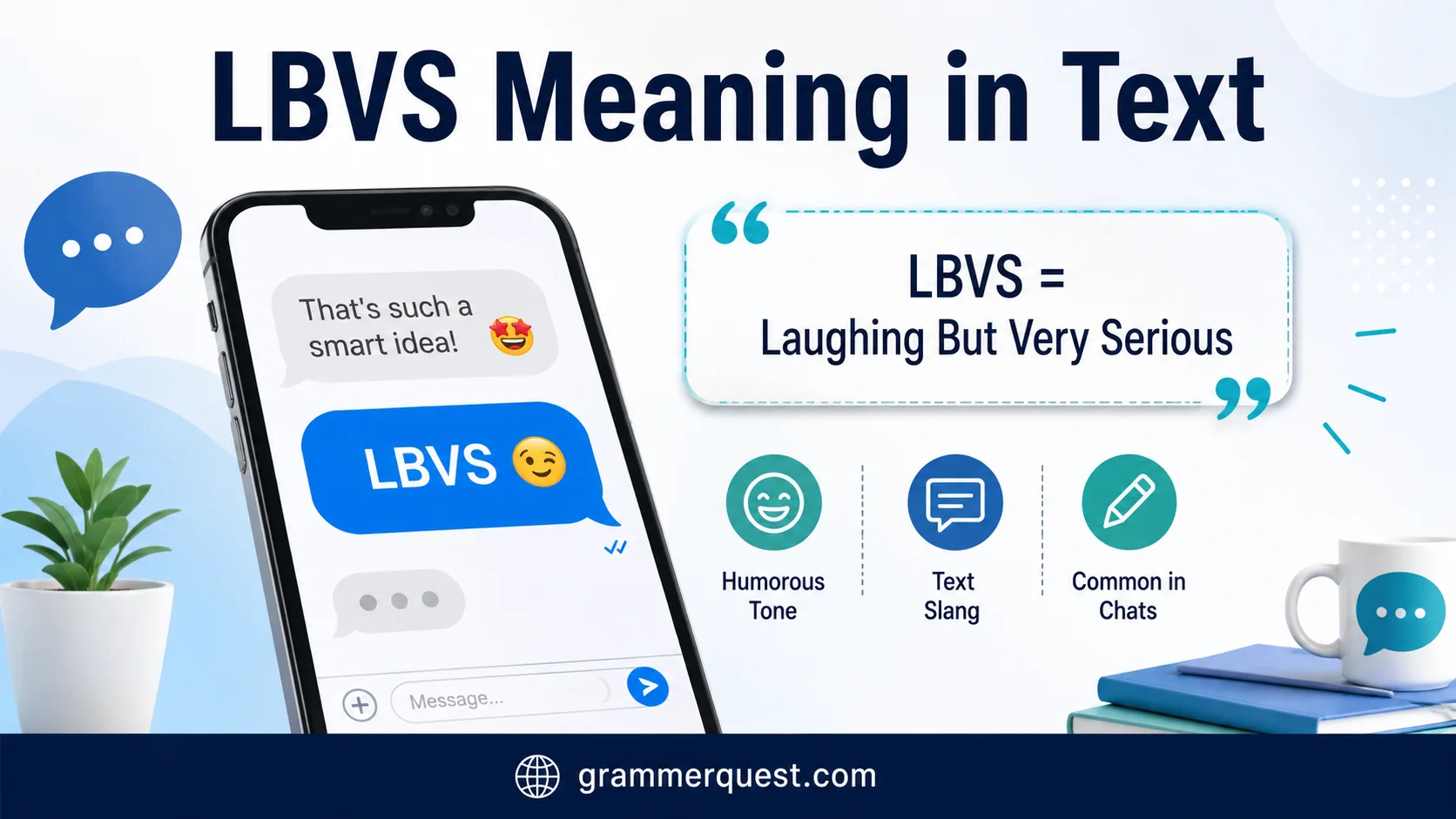
If someone sends you “LBVS” in a text, the four letters can look like a random jumble at first. Unlike familiar abbreviations such as LOL or LMAO, LBVS isn’t instantly obvious to everyone. In texting and online slang, LBVS usually means “Laughing But Very Serious.” It describes a moment when someone finds something funny while still meaning the underlying message.
That combination is what makes LBVS interesting. A person might laugh at a friend’s bad luck, tease someone about a habit, or make a funny complaint while still wanting the other person to understand the serious point. In other words, the message can carry humor and sincerity at the same time.
Because LBVS isn’t as universally recognized as LOL, context matters. If you see it in a casual conversation, the intended meaning is usually clear once you look at the sentence around it. This guide explains the LBVS meaning in text, how people use it, how it differs from other texting abbreviations, and how to respond naturally.
Quick Answer: What Does LBVS Mean in Text?
LBVS means “Laughing But Very Serious.” It’s an informal texting abbreviation used when someone is laughing or being playful while still making a genuine point. The sender is essentially saying, “This is funny, but I’m actually serious about what I’m saying.”
LBVS Meaning at a Glance
| Acronym | Full Meaning | Basic Tone |
| LBVS | Laughing But Very Serious | Funny but genuine |
| LOL | Laugh Out Loud | Amused |
| LMAO | Laughing My Ass Off | Very amused |
| ROFL | Rolling On the Floor Laughing | Extremely amused |
| LBS | Laughing But Serious | Funny but serious |
For example:
“You better save me some pizza next time LBVS.”
The sender may be joking about the pizza, yet the message also carries a real expectation: save me some next time.
That’s the heart of the LBVS meaning in text.
Comparison Overview
LBVS belongs to the huge family of internet abbreviations designed to communicate tone quickly. However, it doesn’t perform exactly the same job as common laughter terms.
| Texting Term | Meaning | What It Usually Communicates | Example |
| LBVS | Laughing But Very Serious | Humor mixed with genuine seriousness | “You’re buying dinner next time LBVS.” |
| LOL | Laugh Out Loud | Something is funny or amusing | “That video was hilarious LOL.” |
| LMAO | Laughing My Ass Off | Strong amusement | “That was so funny LMAO.” |
| ROFL | Rolling On the Floor Laughing | Very strong amusement | “I can’t stop laughing ROFL.” |
| LBS | Laughing But Serious | Humor with a serious point | “I’m laughing but you’re right LBS.” |
| JK | Just Kidding | The speaker isn’t serious | “I hate your new haircut JK.” |
| FR | For Real | Sincerity or agreement | “That movie was amazing FR.” |
| FRFR | For Real For Real | Strong emphasis on sincerity | “You need to try it FRFR.” |
The biggest distinction is simple: LOL tells you something is funny, while LBVS tells you something is funny without removing the seriousness behind it.
That difference can completely change how a message should be interpreted.
Main Differences Between LBVS Meaning in Text and Other Slang
The LBVS meaning in text becomes much easier to understand when you compare it with similar expressions.
LBVS vs. LOL
LOL primarily communicates laughter or amusement. It doesn’t automatically tell the reader that the speaker genuinely means the statement.
Consider these two messages:
“You owe me coffee LOL.”
This could simply be playful.
Now compare:
“You owe me coffee LBVS.”
Here, the sender is still being playful, but there’s a stronger suggestion that they actually expect that coffee.
So, while both expressions can make a message lighter, LBVS adds another layer.
LBVS vs. LMAO
LMAO emphasizes strong laughter. The focus sits on the intensity of the reaction.
LBVS works differently. Its defining feature isn’t how hard someone is laughing. Instead, it highlights the strange combination of laughter and seriousness.
For example:
“I can’t believe you did that LMAO.”
The speaker is emphasizing amusement.
“You’re never planning another trip without me LBVS.”
The speaker may be joking, but the underlying complaint or request remains genuine.
LBVS vs. JK
This comparison matters because the two expressions can point in opposite directions.
JK means “Just Kidding.” It tells the reader to take the previous statement less seriously.
LBVS means “Laughing But Very Serious.” It tells the reader that the humor doesn’t erase the serious point.
Think of it this way:
- JK: “Don’t take me seriously.”
- LBVS: “I’m laughing, but take the point seriously.”
That’s a pretty important difference.
LBVS vs. LBS
LBS can mean “Laughing But Serious,” which is closely related to LBVS.
The extra V in LBVS adds the word “very.” Both expressions communicate a blend of humor and seriousness, although the exact emotional intensity depends on the conversation.
What Does LBVS Really Mean?
At its core, LBVS signals a contradiction in tone.
Someone may laugh because a situation is ridiculous, awkward, ironic, or unexpectedly funny. At the same time, they may recognize that the underlying situation is genuinely serious.
That’s why LBVS can feel more nuanced than ordinary laughter slang.
Breaking Down the Acronym
LBVS stands for:
- L — Laughing
- B — But
- V — Very
- S — Serious
Put together, the phrase means:
Laughing But Very Serious.
The phrase doesn’t necessarily mean that someone is literally laughing out loud at that exact moment. In digital communication, expressions such as this often function as tone markers. They help the reader understand how to interpret the statement.
The Humor Can Come From the Situation
Sometimes the subject itself isn’t necessarily funny. Instead, the circumstances create an awkward or absurd contrast.
For example:
“I studied all night and still forgot everything LBVS.”
The person isn’t necessarily celebrating failure. They’re using humor to describe a frustrating reality while admitting that the frustration is real.
The Humor Can Also Be Teasing
LBVS can soften a playful complaint.
“You really need to stop stealing my fries LBVS.”
The speaker is teasing. However, the message also says something real: stop eating my fries.
That blend gives LBVS its conversational flavor.
How Is LBVS Used in Texting?
People can place LBVS in different parts of a message. Its position can slightly change the rhythm, but the basic meaning remains similar.
LBVS at the End of a Message
This is one of the most natural placements.
“You owe me dinner after making me wait an hour LBVS.”
The acronym works like a tone tag at the end. First comes the statement. Then LBVS tells the reader how to interpret it.
LBVS at the Beginning
A sender can also put it before the main statement:
“LBVS, you really need to stop being late.”
Here, the acronym sets the tone before the reader processes the complaint.
LBVS as a Standalone Reply
Someone might reply:
“LBVS 😂”
This can mean they recognize the funny-but-serious nature of what another person said.
Still, a standalone acronym relies heavily on context. If the previous message isn’t clear, the recipient might not know whether the sender is laughing, agreeing, teasing, or making a serious point.
LBVS Meaning in Text: Examples You Can Actually Understand
Examples are often the fastest way to grasp texting slang. Here are several realistic situations.
Example: A Friend Keeps Showing Up Late
Friend 1: “You were 30 minutes late again.”
Friend 2: “I know 😭”
Friend 1: “Next time I’m leaving without you LBVS.”
The speaker is teasing, but the message isn’t entirely empty. They genuinely don’t want to keep waiting.
Example: Someone Eats Your Food
“You ate my leftovers again LBVS.”
The statement can sound playful, especially between close friends. Yet the sender probably isn’t thrilled about losing their meal.
Example: A Bad Exam
“That exam destroyed me LBVS.”
Here, the humor helps describe genuine frustration. The student isn’t literally claiming the exam destroyed them. They’re exaggerating the experience while admitting that it went badly.
Example: A Friend Gives Terrible Advice
“I’m never asking you for restaurant recommendations again LBVS.”
The speaker is probably teasing. Still, they may genuinely have disliked the restaurant.
Example: A Genuine Warning Wrapped in Humor
“Don’t text me at 3 a.m. again LBVS.”
The sender may be laughing at the situation while seriously asking the other person to stop.
Example: Laughing at Your Own Mistake
“I just locked myself out of my apartment again LBVS.”
The person recognizes the ridiculousness of repeating the mistake. However, the inconvenience remains real.
LBVS Meaning on Social Media
The LBVS meaning on social media generally follows the same idea as its meaning in texting: humor combined with a genuine or serious sentiment.
It can appear in casual comments, posts, captions, and online conversations. Slang references classify LBVS within online chat and social-media language.
For example:
“This is exactly why I don’t trust group projects LBVS.”
The person is making a humorous comment, but there’s probably a real complaint underneath it.
LBVS in Comments
A person might comment:
“You really thought that was going to work LBVS.”
Depending on the context, the comment can be teasing while still expressing a genuine reaction.
LBVS in Captions
Someone might write:
“Trying to save money while ordering takeout every night LBVS.”
The joke points toward a real contradiction in the person’s behavior.
LBVS in Group Chats
Group chats often contain inside jokes, teasing, and exaggerated complaints. LBVS can fit naturally into that environment because everyone already understands the shared context.
However, LBVS isn’t universally recognized. CyberDefinitions specifically describes it as a relatively rare term, which means unfamiliar readers may need context.
When Should You Use LBVS?
LBVS works best when the conversation already feels informal and relaxed.
Good Situations for LBVS
You can use it when:
- You’re joking with close friends.
- You’re teasing someone without wanting the message to sound harsh.
- You’re making a funny complaint that contains a real point.
- You’re laughing at your own mistake.
- You’re describing an ironic or ridiculous situation.
- You want to show that a playful statement still has some truth behind it.
- You’re reacting to something that’s funny despite having a serious side.
When LBVS Doesn’t Fit
Avoid relying on LBVS when clarity matters more than casual tone.
For example, it usually isn’t the right choice for:
- A formal business email
- A job application
- A cover letter
- An academic assignment
- A legal or official document
- A serious workplace complaint
- A sensitive conversation where humor could seem dismissive
That doesn’t mean every workplace bans slang. Workplace cultures differ. The practical rule is simpler: use LBVS when your audience understands casual internet language and the situation can handle humor.
Is LBVS Appropriate at Work?
Usually, LBVS is better suited to informal communication than formal professional writing.
Suppose a coworker sends:
“We have another meeting at 7 a.m. tomorrow LBVS.”
In a close team chat, everyone might understand the humor. In a formal email to a client, however, the abbreviation could create confusion or make the message look overly casual.
Clear language wins when the stakes are high.
Instead of:
“Please send the revised figures by Friday LBVS.”
A professional message would simply say:
“Please send the revised figures by Friday.”
There’s no need to make every message sound like a group chat.
Common Situations Where LBVS Makes Sense
The following patterns capture how the acronym works in real conversation:
| Situation | Example | Why LBVS Fits |
| Playful complaint | “You ate my fries again LBVS.” | The complaint is real but playful. |
| Self-deprecating humor | “I forgot my own password again LBVS.” | The mistake is frustrating but funny. |
| Teasing | “You really thought I’d forget that LBVS.” | The speaker is joking while emphasizing the point. |
| Mild warning | “Don’t make me wait another hour LBVS.” | The warning has a genuine message underneath. |
| Ironic situation | “I bought a planner and still forgot everything LBVS.” | The contradiction creates humor. |
| Bad luck | “Of course it started raining after I washed the car LBVS.” | The frustration becomes funny because of the timing. |
A Closer Look: Why LBVS Can Sound Contradictory
At first glance, “laughing but very serious” sounds like two ideas that shouldn’t coexist.
That’s actually the point.
People don’t communicate emotions in neat little boxes. A situation can be frustrating and funny. Someone can be annoyed while still teasing. A mistake can be embarrassing yet hilarious after the initial shock wears off.
Digital messages make this especially important because text removes many vocal and visual clues.
Imagine someone saying:
“You’re late again.”
In person, a grin might tell you they’re joking. A stern expression might tell you they’re genuinely angry.
Text doesn’t automatically provide either clue.
Adding LBVS gives the reader an extra signal:
“There’s humor here, but don’t completely ignore what I’m saying.”
That makes the acronym useful as a compact tone marker.
How to Respond When Someone Says LBVS
Your response should depend on what the sender actually means.
If They’re Clearly Teasing
You can answer playfully:
- “😂 Okay, okay.”
- “Fair enough.”
- “You got me.”
- “Noted!”
- “I know you’re right.”
If There’s a Real Complaint Behind the Joke
Address the actual point.
For example:
Them: “You’re never on time LBVS.”
You: “Okay, that’s fair. I’ll leave earlier next time.”
The best response doesn’t get trapped by the joke. It recognizes the message underneath it.
If You Don’t Understand LBVS
There’s nothing wrong with asking.
Try:
“Wait, what does LBVS mean?”
Or:
“Does LBVS mean you’re joking or serious?”
That can save you from misreading the tone.
Read This: WTM Meaning in Text
Case Study: How Context Changes the LBVS Meaning
Consider this message:
“You better not cancel on me tomorrow LBVS.”
Without context, the message could sound demanding.
Now imagine two friends who regularly tease each other. One friend has canceled three times recently. The other sends the message with a laughing emoji.
In that context, LBVS likely means:
“I’m joking around, but seriously, please don’t cancel again.”
Now change the situation. Imagine the same phrase appears during a serious disagreement.
Suddenly, the humor may feel sarcastic or dismissive.
The Lesson
The acronym doesn’t work in isolation. Relationship, subject matter, punctuation, emojis, and previous messages all influence tone.
This is why dictionary-style definitions can only take you so far. Understanding slang requires understanding the conversation around it.
Does LBVS Always Mean Someone Is Literally Laughing?
No.
This distinction matters.
In texting, people frequently use expressions associated with laughter to describe a reaction or tone, rather than a literal physical action. Someone might type LBVS because the situation strikes them as absurd, ironic, or darkly funny.
For example:
“I spent three hours looking for my phone. It was in my hand LBVS.”
The person may actually be laughing. They may simply be emphasizing how ridiculous the situation feels.
The acronym therefore works more like a tone signal than a medical-grade report of someone’s facial expression.
Is LBVS Rude?
LBVS isn’t inherently rude. The surrounding message determines whether it feels friendly, sarcastic, dismissive, or inappropriate.
Compare:
“You really need to learn how to cook LBVS 😂”
A close friend might find that hilarious.
Now consider:
“Your cooking is terrible LBVS.”
Sent to someone who has just shared a vulnerable story about their cooking, the same style could feel insulting.
The acronym doesn’t magically make a harsh statement friendly.
Before Using LBVS, Consider:
- Who are you talking to?
- What are you joking about?
- Is the topic sensitive?
- Does the other person understand texting slang?
- Could your message be interpreted as mocking?
A little context goes a long way.
Can LBVS Have Other Meanings?
Yes. Acronyms can mean different things in different fields.
In everyday texting, “Laughing But Very Serious” is the relevant slang interpretation. However, acronym databases list other expansions for LBVS in specialized contexts.
That creates an important distinction:
| Context | Possible Interpretation |
| Casual text | Laughing But Very Serious |
| Online slang | Laughing But Very Serious |
| Social-media conversation | Usually Laughing But Very Serious |
| Technical or professional context | Could represent a specialized abbreviation |
So, don’t automatically apply the slang definition every time you see the letters LBVS.
Context is the filter.
If a friend texts:
“That was so embarrassing LBVS.”
The slang meaning makes obvious sense.
If you encounter LBVS in a technical report, research paper, or specialist document, check the surrounding terminology before assuming it means “Laughing But Very Serious.”
Is LBVS Still Used?
Yes, LBVS continues to appear in online slang references and texting-related content. However, there’s an important nuance: it isn’t as universally recognizable as major abbreviations such as LOL or LMAO.
CyberDefinitions describes LBVS as a rare texting term, while Slang.net categorizes it as social-media and online-chat slang.
That means you shouldn’t assume everyone will understand it immediately.
If your audience is unfamiliar with internet slang, spelling out the phrase may be clearer.
A Useful Rule
Common slang can stay abbreviated. Unfamiliar slang may need context.
That’s especially true when you’re communicating with people from different age groups, regions, workplaces, or online communities.
How to Use LBVS Naturally
If you want to use LBVS in a text message, don’t force it into every joke. The acronym works best when there’s a genuine contrast between humor and seriousness.
Use LBVS When:
- The statement is funny and meaningful.
- You’re teasing someone about something you genuinely care about.
- You’re laughing at an unfortunate situation.
- You’re making a playful complaint.
- Your audience already understands casual texting language.
Don’t Use LBVS Just to:
- Make every message sound trendy.
- Replace every LOL.
- Make a serious conversation seem less serious.
- Confuse someone who doesn’t know internet abbreviations.
The best slang feels effortless. If the abbreviation makes the sentence harder to understand, write the full thought instead.
LBVS Meaning in Different Contexts
Context can slightly change the emotional shade of LBVS even when the basic definition stays the same.
| Context | Likely Tone | Example |
| Close friends | Teasing and sincere | “You owe me fries LBVS.” |
| Group chat | Playful complaint | “Nobody told me about this LBVS.” |
| Social media | Humorous observation | “This is exactly why I don’t cook LBVS.” |
| Dating conversation | Playful seriousness | “You’re taking me out next time LBVS.” |
| Workplace chat | Informal humor | “Another Monday meeting LBVS.” |
| Formal email | Usually inappropriate | Use plain language instead. |
| Sensitive discussion | Potentially risky | Humor may be misunderstood. |
Notice that the meaning doesn’t suddenly transform in every setting. Instead, the emotional effect changes with the relationship and subject.
LBVS and Emojis: Do They Change the Meaning?
Emojis can strengthen the intended tone, especially when the abbreviation might otherwise seem ambiguous.
For example:
“You better not forget again LBVS 😂”
The laughing emoji reinforces the playful side.
Now consider:
“You better not forget again LBVS.”
Without an emoji, the message may sound more pointed.
However, an emoji doesn’t erase the serious part. The sender may still genuinely expect the person not to forget.
That’s why LBVS + context + emoji can communicate a surprisingly detailed emotional message in only a few characters.
Common Misunderstandings About LBVS
LBVS Doesn’t Simply Mean LOL
Although both can signal amusement, LBVS adds seriousness to the message.
LBVS Doesn’t Mean the Entire Statement Is a Joke
The sender may laugh while still wanting you to take the main point seriously.
LBVS Isn’t the Same as JK
JK tells you that the speaker is kidding. LBVS says the speaker is joking while still being serious.
LBVS Isn’t Universally Recognized
Some readers may know it immediately. Others may have never encountered it. Sources describing the term also note that it’s relatively uncommon compared with more familiar slang.
LBVS Doesn’t Automatically Make a Message Friendly
If the underlying statement is insulting, adding LBVS doesn’t guarantee that the recipient will find it funny.
FAQs:
1. What does LBVS mean in text?
LBVS usually means “Laughing But Very Seriously.” People use it in texts and social media to show that something is funny while also expressing a serious point.
2. What does LBVS mean on social media?
On social media, LBVS can add humor to a comment while showing that the person genuinely means what they’re saying. Its exact meaning can depend on the conversation.
3. Is LBVS a slang abbreviation?
Yes, LBVS is an informal internet and texting abbreviation. It’s best suited for casual conversations, chats, comments, and social media rather than formal writing.
4. Can I use LBVS in a professional message?
It’s generally better to avoid LBVS in professional emails or formal communication. Use clear words instead, especially when your audience might not understand texting slang.
5. How should I respond when someone says LBVS?
You can respond naturally based on the conversation. If they’re making a funny comment, you might laugh or agree. If they’re making a serious point, you can address that part directly.
Conclusion:
Understanding LBVS meaning in text can make online conversations much easier to follow. The abbreviation generally adds a mix of humor and seriousness to a message. Since texting slang can have different meanings depending on context, always consider the surrounding conversation before interpreting LBVS. For casual chats and social media, it can make messages feel shorter, more relaxed, and expressive.

George Whitaker is the voice behind GrammarQuest, dedicated to making grammar simple, engaging, and easy to understand. He helps learners turn confusion into confidence with clear explanations and real-world examples.