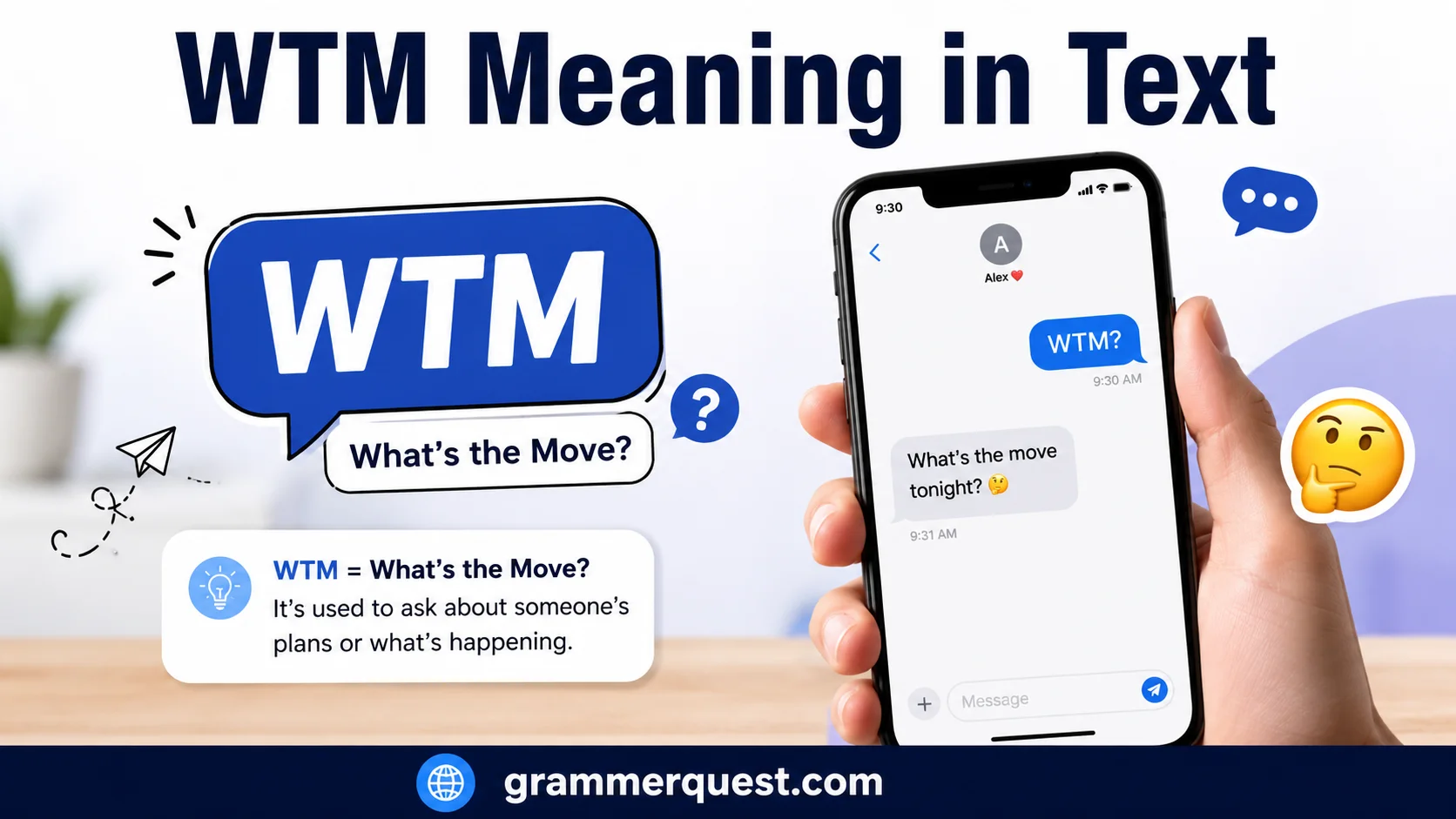
If someone sends you “WTM?”, you might wonder what those three letters mean. In most casual conversations, WTM means “What’s the Move?” It’s a quick way to ask about the plan, the next activity, or what everyone should do. You’ll often see it in texts, group chats, DMs, and social media conversations.
However, WTM meaning in text can change with context. In some conversations, it may mean “What’s the Matter?” or another phrase. That’s why the words around the abbreviation matter. A message about weekend plans points toward one meaning, while a message about someone looking upset can suggest another.
This guide explains what WTM means in text, how people use it, what it means across popular messaging platforms, how to respond, and how to distinguish it from similar abbreviations.
Quick Answer
WTM usually means “What’s the Move?” in text messages.
It’s a casual way to ask:
- What’s the plan?
- What are we doing?
- What should we do next?
- What’s happening tonight?
- What are you thinking?
For example:
“WTM tonight?”
Usually means:
“What’s the move tonight?”
In natural conversation, that could simply mean “What are we doing tonight?”
The meaning isn’t always fixed, though. Depending on context, WTM can sometimes mean “What’s the Matter?” or another phrase. Always check the surrounding conversation before assuming what the sender intended.
Comparison Overview
The easiest way to understand WTM meaning in text is to compare its possible meanings side by side.
| WTM Meaning | What It Means | Common Context | Example |
| What’s the Move? | What’s the plan? | Friends, social plans, group chats | “WTM tonight?” |
| What’s the Matter? | What’s wrong? | Checking on someone | “You seem quiet. WTM?” |
| Want to Meet? | Are you interested in meeting? | Meeting-related conversations | “WTM after work?” |
| Whatever That Means | Expresses uncertainty or sarcasm | Commentary or disagreement | “He called it ‘simple,’ WTM.” |
“What’s the Move?” is the most useful interpretation to recognize in casual texting. The other meanings depend much more heavily on context.
Main Differences Between WTM Meaning in Text
The biggest difference comes from what the conversation is about.
When people discuss dinner, parties, weekends, games, trips, or hanging out, WTM usually points toward “What’s the Move?” The sender wants to know the plan.
When someone asks about a person’s mood or behavior, WTM could instead suggest “What’s the Matter?”
Consider these two messages:
- “WTM after class?” → likely “What’s the move?”
- “You look upset. WTM?” → potentially “What’s the matter?”
The letters haven’t changed. The context has.
That distinction matters because texting removes many clues available in face-to-face speech. You can’t hear someone’s tone, see their facial expression, or watch their body language. Context fills those gaps.
What Does WTM Mean in Text?
In most casual texting situations, WTM means “What’s the Move?”
The expression “What’s the move?” doesn’t usually refer to a literal physical movement. Instead, it asks about a plan, decision, or next step.
For example:
- “WTM this weekend?”
- “WTM after the game?”
- “WTM tonight?”
- “WTM for dinner?”
Each message essentially asks what should happen next.
Think of WTM as a compact version of “So, what’s the plan?”
That’s why friends might use it when they’re trying to organize an outing. One person may know that everyone wants to hang out, but nobody has decided what to do yet.
What Does “What’s the Move?” Actually Mean?
The phrase can carry slightly different shades of meaning.
Depending on the situation, “What’s the move?” can mean:
- What’s the plan?
- What are we doing?
- Where are we going?
- What should we do next?
- What’s happening later?
- What do you want to do?
For example, imagine four friends finish dinner at 8 p.m. Nobody wants to go home yet.
One friend texts:
“WTM?”
The message doesn’t necessarily ask for a detailed itinerary. The person is basically saying, “Okay, what are we doing next?”
That casual, flexible quality makes the abbreviation useful in fast-moving conversations.
What Does WTM Stand For in Texting?
The most common expansion is:
WTM = What’s the Move?
The phrase “what’s the move?” has a conversational meaning rather than a literal one. It often signals that someone wants to make a decision.
Examples of WTM as “What’s the Move?”
Example 1:
Alex: “I’m free tonight.”
Jordan: “WTM?”
Alex: “Let’s grab some food.”
Here, WTM means “What’s the move?” or “What should we do?”
Example 2:
“WTM this weekend? I’m free Saturday.”
The sender wants to know what plans might be available.
Example 3:
“WTM after the movie?”
The person wants to decide what to do once the movie ends.
Why Do People Use WTM Instead of the Full Phrase?
Texting encourages speed and brevity. Short abbreviations let people communicate an idea without typing every word.
“WTM?” takes just three letters and a question mark.
“What’s the move?” takes considerably longer.
That difference seems tiny, but fast conversations often rely on these shortcuts. Abbreviations work particularly well when everyone involved already understands the slang.
Other Meanings of WTM in Text
Although “What’s the Move?” is the main meaning to recognize, WTM doesn’t always mean the same thing.
Context can point toward another interpretation.
WTM Meaning “What’s the Matter?”
In some conversations, WTM may mean “What’s the Matter?”
This interpretation becomes more plausible when someone seems upset, unusually quiet, or uncomfortable.
For example:
“You haven’t said much today. WTM?”
Here, the sender could be asking:
“What’s the matter?”
The context changes everything.
Compare that with:
“WTM tonight?”
That message clearly sounds like a question about plans.
WTM Meaning “Want to Meet?”
Another possible interpretation is “Want to Meet?”
This meaning depends strongly on a conversation already involving meeting up.
For example:
“I’ll be downtown around 6. WTM?”
A reader might understand WTM as “Want to meet?” because the conversation already revolves around location and timing.
Still, this isn’t the interpretation to assume automatically. If the context doesn’t support it, “What’s the Move?” remains a more natural reading.
WTM Meaning “Whatever That Means”
WTM can also appear as shorthand for “Whatever That Means.”
This usage can sound dismissive, skeptical, or sarcastic.
For example:
“He says his new system is ‘revolutionary,’ WTM.”
In this context, the sender may be expressing doubt about the word “revolutionary.”
This interpretation is much more dependent on tone and sentence structure. It shouldn’t be treated as the default meaning.
How to Tell Which WTM Meaning Someone Intended
When WTM meaning in text isn’t obvious, don’t guess immediately. Look at the conversation around it.
1. Look at the Previous Messages
The messages immediately before WTM often provide the strongest clue.
If someone has been discussing:
- Dinner
- Parties
- Weekend plans
- Movies
- Going out
- A road trip
- Sports
- Hanging out
then “What’s the Move?” makes the most sense.
2. Check Whether Someone Seems Upset
If the conversation involves emotions, conflict, stress, or unusual behavior, “What’s the Matter?” becomes more plausible.
3. Look for Meeting-Related Details
If people have already mentioned locations and schedules, “Want to Meet?” may fit.
4. Consider the Tone
Text doesn’t carry vocal tone, so punctuation and surrounding words can help.
Compare:
- “WTM tonight?” — casual planning
- “WTM???” — potentially urgent or excited
- “You’ve been acting strange. WTM?” — possibly asking what’s wrong
5. Don’t Ignore the Subject
A single abbreviation can have several possible expansions. The subject of the conversation usually narrows the possibilities.
WTM Meaning on Snapchat
On Snapchat, WTM generally follows the same casual texting meaning: “What’s the Move?”
Someone might send:
“WTM tonight?”
They may simply want to know what you’re doing later.
Snapchat conversations often move quickly, so short expressions can fit naturally into messages. However, there’s no need to assume WTM has a completely different definition simply because it appears on Snapchat.
Snapchat Examples
Example 1:
“WTM after school?”
Meaning:
“What are we doing after school?”
Example 2:
“WTM this weekend?”
Meaning:
“What’s the plan this weekend?”
Example 3:
“WTM later?”
Meaning:
“What are we doing later?”
The surrounding conversation still determines the precise meaning.
WTM Meaning on Instagram
In Instagram DMs, WTM can work just like it does in ordinary text messages.
A friend might message:
“WTM Friday?”
They’re probably asking about Friday plans.
Someone might also reply to a story with:
“WTM?”
If the story involves an event, restaurant, concert, or outing, the abbreviation may be asking about the plan connected with it.
Common Instagram Contexts
WTM can appear when discussing:
- Weekend activities
- Parties
- Concerts
- Restaurants
- Travel
- Shopping
- Casual meetups
- Group activities
The key point remains simple: Instagram doesn’t automatically give WTM a special meaning. Context does.
WTM Meaning on TikTok
TikTok comments and DMs can also contain WTM.
For example, someone might comment:
“WTM this weekend?”
A friend could understand that as a casual invitation to discuss plans.
In TikTok conversations, however, slang can be highly context-dependent. A phrase may also be used jokingly, ironically, or as part of a specific conversation.
So don’t treat every three-letter abbreviation as a fixed code. Read the sentence around it.
WTM Meaning on WhatsApp and Other Chats
The meaning of WTM doesn’t fundamentally change on WhatsApp, Facebook Messenger, Discord, or standard SMS.
If someone writes:
“WTM tonight?”
the most natural interpretation remains:
“What’s the move tonight?”
The platform changes. The basic slang doesn’t.
Where You Might See WTM
- Text messages
- Instagram DMs
- Snapchat
- TikTok messages
- Facebook Messenger
- Discord
- Group chats
The audience matters more than the app.
If you’re chatting with close friends, WTM may feel perfectly natural. In a professional conversation, the abbreviation could create unnecessary confusion.
Examples of WTM in Text Conversations
Realistic examples make the meaning much easier to recognize.
Example 1: Making Weekend Plans
Sam: “You free Saturday?”
Chris: “Yeah, I am.”
Sam: “WTM?”
Chris: “Let’s go out for dinner.”
Meaning: What’s the move?
Sam is asking what they should do.
Example 2: Deciding What to Do Tonight
Taylor: “I’m done with work.”
Morgan: “Nice. WTM tonight?”
Taylor: “Movie and dinner?”
Here, WTM means “What’s the move?”
Example 3: Group Chat
Mia: “Everyone’s free Friday.”
Noah: “WTM?”
Liam: “Bowling?”
Ava: “I’m in.”
WTM acts as a quick way to push the group toward a decision.
Example 4: Checking on Someone
Jordan: “You’ve barely talked today.”
Casey: “Yeah, rough morning.”
Jordan: “WTM?”
Here, the intended meaning may be “What’s the matter?”
This example shows why context matters so much.
Example 5: An Ambiguous Message
“WTM after work?”
Depending on the conversation, it might mean:
- What’s the move after work?
- Want to meet after work?
If you’re unsure, asking a short clarification question is better than guessing.
How to Reply When Someone Texts “WTM?”
Your response depends on what you think the person means.
If they’re asking about plans, give them a concrete idea.
If WTM Means “What’s the Move?”
You could reply:
- “Let’s grab dinner.”
- “How about a movie?”
- “I’m free after 7. What do you want to do?”
- “Let’s meet downtown.”
- “Nothing planned yet. Got any ideas?”
A good response moves the conversation forward.
If WTM Means “What’s the Matter?”
If someone seems to be asking what’s wrong, you might answer:
- “Nothing serious. I’m just tired.”
- “I’m okay. Just had a long day.”
- “A few things are bothering me, actually.”
- “I’m good. Thanks for checking.”
If You Don’t Know What WTM Means
There’s nothing awkward about asking.
Try:
- “What do you mean by WTM?”
- “WTM as in what’s the plan?”
- “Do you mean what’s the move?”
A quick clarification can prevent a completely unnecessary misunderstanding.
Is WTM Casual or Formal?
WTM is casual texting slang.
It’s appropriate when you’re talking informally with people who understand the abbreviation.
Good Places to Use WTM
- Friends
- Close acquaintances
- Group chats
- Casual DMs
- Informal conversations
- Social media messages
Places to Avoid WTM
- Job applications
- Formal business emails
- Academic assignments
- Official letters
- Customer-service complaints
- Professional reports
Instead of writing:
“WTM regarding tomorrow’s meeting?”
a professional version would be:
“What’s the plan for tomorrow’s meeting?”
Clear language wins when the stakes are higher.
WTM vs. Similar Texting Abbreviations
WTM belongs to a larger family of short texting expressions. Several abbreviations may look similar because they ask about plans or activities, but their meanings aren’t identical.
| Abbreviation | Meaning | What It Usually Asks |
| WTM | What’s the Move? | What’s the plan? |
| WYD | What You Doing? | What are you doing? |
| WYA | Where You At? | Where are you? |
| HBU | How About You? | What about your answer? |
| LMK | Let Me Know | Tell me when you know |
| WBU | What About You? | What’s your situation? |
WTM vs. WYD
These two are easy to confuse.
WYD asks about what someone is currently doing:
“WYD?”
That usually means:
“What are you doing?”
WTM is more likely to ask about a plan or next step:
“WTM tonight?”
That means something closer to:
“What’s the move tonight?”
The difference is subtle but useful.
WTM vs. WYA
WYA means “Where You At?”
It asks about someone’s location.
“WYA?” → “Where are you?”
WTM doesn’t normally ask where you are. It asks what the plan is.
WTM vs. LMK
LMK means “Let Me Know.”
For example:
“LMK if you’re coming.”
That isn’t a question about the plan itself. It’s a request for information.
Read More: DWBI Meaning in Text
Common Mistakes When Interpreting WTM
Even simple slang can cause confusion when you take it out of context.
Assuming WTM Always Means “What’s the Move?”
That’s the biggest mistake.
Although “What’s the Move?” is the main interpretation, context can suggest something else.
Ignoring the Conversation
Never interpret WTM as a standalone code if the previous messages provide clues.
The surrounding words often reveal the intended meaning immediately.
Using WTM in Formal Writing
Texting abbreviations can sound too casual in professional communication.
When clarity matters, spell out the complete phrase.
Assuming WTM Has a Flirtatious Meaning
WTM doesn’t automatically mean someone is flirting.
A friend asking:
“WTM tonight?”
may simply want to make plans.
Don’t assign romantic meaning to ordinary slang without other evidence.
Assuming Every Platform Has a Different Definition
WTM generally keeps its core meaning across messaging platforms.
The conversation matters more than whether the message appears on Instagram, Snapchat, TikTok, WhatsApp, or SMS.
A Simple Context Guide to WTM
When you’re unsure about WTM meaning in text, use this quick guide.
| If the conversation is about… | WTM probably means… |
| Weekend plans | What’s the Move? |
| Going out tonight | What’s the Move? |
| Dinner or entertainment | What’s the Move? |
| Someone acting strangely | What’s the Matter? |
| A possible meetup | Want to Meet? |
| A questionable statement | Whatever That Means |
This isn’t a mathematical rule. It’s a context clue.
The same abbreviation can behave differently depending on the sentence surrounding it.
Interesting Facts About WTM in Texting
A few practical points make WTM easier to understand:
- WTM is an initialism, meaning its letters come from the words in a phrase.
- “What’s the Move?” is the main casual interpretation to recognize.
- WTM is generally associated with informal digital communication.
- Its meaning depends heavily on conversation context.
- A question mark often makes the intended function clearer.
- “WTM tonight?” typically asks about plans.
- “WTM?” can be more ambiguous without surrounding context.
- WTM isn’t normally appropriate for formal business or academic writing.
- The abbreviation can appear in texts, DMs, group chats, and social platforms.
- You don’t need to memorize every possible expansion. Context usually does the heavy lifting.
Case Study: Why Context Changes WTM’s Meaning
Consider the same abbreviation appearing in two completely different conversations.
Conversation A: Planning a Night Out
A: “Are you free after 8?”
B: “Yeah.”
A: “WTM?”
B: “Let’s get pizza.”
Here, WTM clearly points toward “What’s the Move?”
The conversation revolves around availability and plans.
Conversation B: Checking on a Friend
A: “You’ve seemed stressed all day.”
B: “I have a lot going on.”
A: “WTM?”
B: “I’m worried about tomorrow.”
Here, “What’s the Matter?” makes more sense.
The lesson is simple: don’t interpret an abbreviation in isolation.
FAQs:
1. What does WTM mean in text?
WTM usually means “What’s the move?” in texting and online conversations. People use it to ask about plans, activities, or what someone wants to do next.
2. Is WTM commonly used in texting?
Yes, WTM is commonly used in casual texts, chats, and social media. It’s an informal abbreviation, so it’s best suited for conversations with friends or people you know well.
3. What does WTM mean in a conversation?
In most conversations, WTM means “What’s the move?” For example, someone might text, “WTM tonight?” to ask what the plans are for the evening.
4. Can WTM have other meanings?
Yes. WTM can have different meanings depending on the context. However, in casual texting and social media, “What’s the move?” is one of the most common meanings.
5. How should I respond to WTM?
Your response depends on the situation. If you have plans, you can say, “Let’s grab some food,” or “I’m free tonight. What do you want to do?” If you’re unsure, simply ask, “What are you thinking?”
Conclusion:
Understanding WTM Meaning in Text can make casual conversations much easier to follow. In texting, WTM most often means “What’s the move?” and people use it to ask about plans or what to do next. Since it’s informal slang, you’ll usually see it in texts, social media messages, and friendly chats. Knowing abbreviations like WTM helps you understand modern online communication and respond naturally without missing the meaning behind the message.

Emma Brooke is a passionate language enthusiast and the voice behind GrammarQuest.com. With a sharp eye for detail and a love for clear communication, she simplifies complex grammar rules into easy, practical lessons. Her goal is to help you write with confidence, clarity, and style—whether you’re a student, professional, or everyday writer.