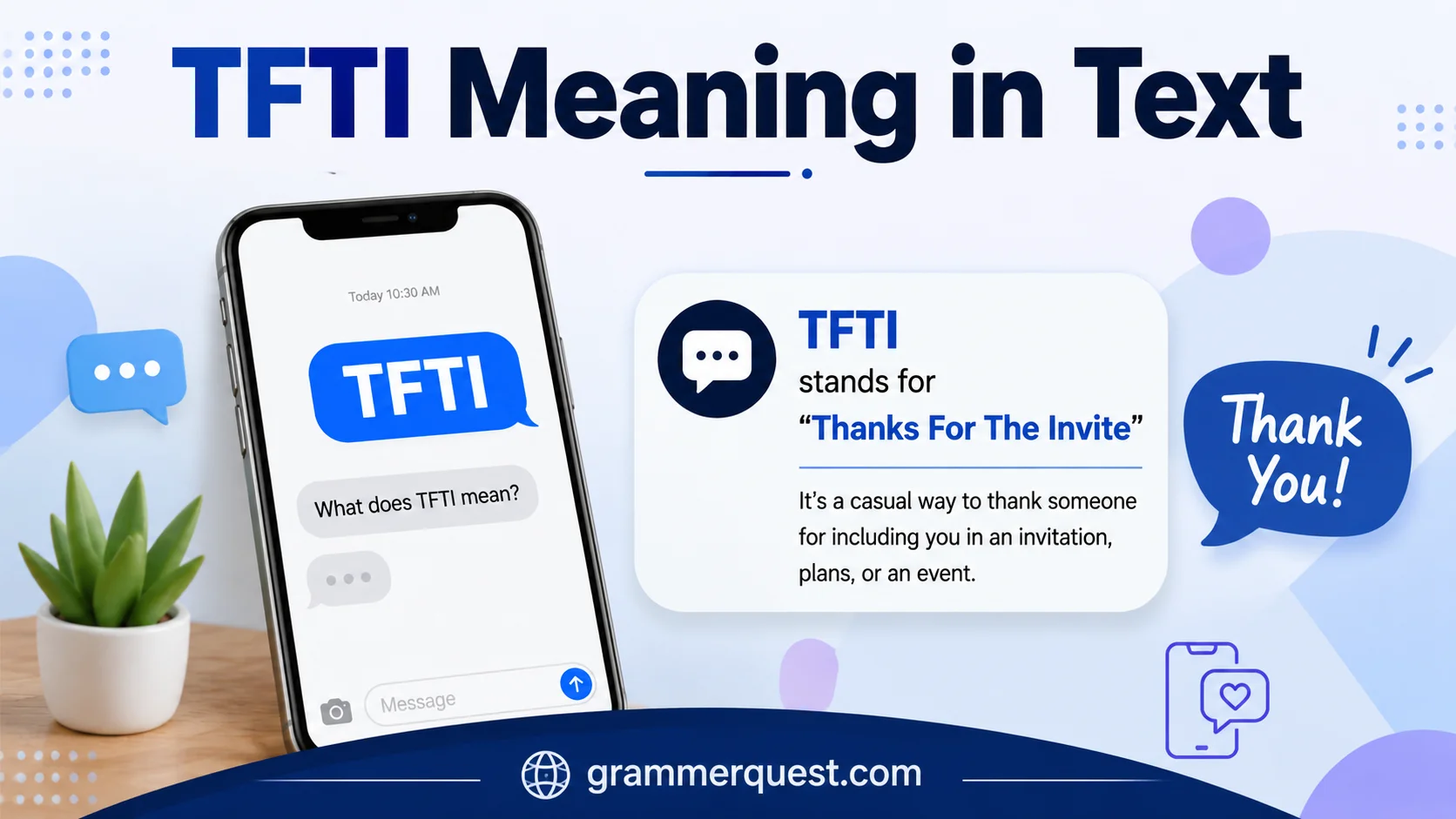
Have you ever seen someone reply “TFTI” after discovering that friends went somewhere without them? At first glance, it looks like a simple thank-you. However, the meaning can carry a playful jab, genuine appreciation, or even mild frustration depending on the conversation.
The most common TFTI meaning in text is “Thanks For The Invite.” People often use it when they weren’t invited to an event, hangout, party, trip, or other social activity. In that setting, the phrase usually sounds sarcastic rather than genuinely thankful.
TFTI can also mean “Thanks For The Information.” That version makes sense when someone shares useful details, an update, or an important fact. Context matters because the same four letters can point to two different phrases.
Quick Answer
TFTI usually means “Thanks For The Invite” in texting, chats, and social media. It often appears when someone wasn’t invited to an activity and wants to jokingly point that out.
For example:
Friend: “We went to the new pizza place last night!”
You: “TFTI 😂”
Here, TFTI means “Thanks For The Invite.” The sender isn’t really thanking the group. They’re teasing them for leaving them out.
However, TFTI has another established meaning: “Thanks For The Information.” If someone gives you useful information and you reply “TFTI,” the context may clearly indicate that interpretation.
Comparison Overview
The meaning of TFTI becomes much easier to understand when you compare its two main uses.
| TFTI meaning | What it stands for | Common tone | Typical situation |
| Thanks For The Invite | Thanks for inviting me | Often sarcastic or playful | Friends go somewhere without you |
| Thanks For The Information | Thanks for telling me | Usually sincere | Someone gives you useful details |
| Thanks For The Invite | Genuine thanks for an invitation | Friendly and appreciative | Someone actually invites you |
| Thanks For The Information | Sarcastic thanks for unwanted information | Occasionally sarcastic | Someone tells you something you didn’t want to hear |
The first meaning tends to dominate when TFTI appears around parties, outings, trips, photos, or social plans. CyberDefinitions specifically lists “Thanks For The Invite” as the more common text interpretation while also recognizing “Thanks For The Information” as another common definition.
That distinction matters. You shouldn’t automatically assume every TFTI message means someone feels excluded.
Main Differences Between TFTI Meanings
Although the abbreviation stays the same, the situation changes its meaning.
TFTI Meaning: “Thanks For The Invite”
This interpretation usually appears around social plans. Someone sees that their friends went somewhere, notices that nobody invited them, and responds with “TFTI.”
The hidden message often sounds like:
“Apparently everyone went except me.”
It can be completely harmless between close friends. In other situations, it may reveal genuine annoyance.
For example:
Alex: “Look at these pictures from the concert last night!”
Sam: “TFTI 😂”
Sam probably isn’t angry. The laughing emoji signals playful teasing.
Now consider a different situation:
Alex: “We went out again last night.”
Sam: “TFTI.”
The missing emoji and short response can make the message feel colder. Sam may actually feel excluded.
TFTI Meaning: “Thanks For The Information”
The second meaning has nothing to do with invitations.
Someone might send:
“The meeting moved to 3 p.m. TFTI.”
In this case, TFTI can mean “Thanks For The Information.” Slang dictionaries and texting references document this interpretation.
The surrounding words usually make the intended meaning obvious.
If the conversation involves dates, locations, updates, instructions, facts, or useful details, “Thanks For The Information” becomes a strong possibility.
What Does TFTI Mean in Texting?
In texting, TFTI works as a compact acronym. Instead of typing “Thanks For The Invite,” someone can write four letters and let the context do the heavy lifting.
The most recognizable texting use involves social exclusion.
Imagine that three friends go for dinner. One of them uploads a photo. Another friend sees it and sends:
“TFTI 😭”
The sender probably means:
“Thanks for the invite. Clearly, you didn’t invite me.”
The humor comes from the contradiction. The person says “thanks” while actually highlighting the fact that no invitation arrived.
That’s what makes TFTI interesting. The literal words and intended message don’t always match.
Why People Use TFTI Instead of a Full Sentence
Texting acronyms save time. They also create a casual tone that a complete sentence might not capture.
Compare these:
- “Why wasn’t I invited?”
- “I see you guys went out without me.”
- “TFTI 😂”
The first sounds direct. The second sounds explanatory. The third feels quick, playful, and slightly cheeky.
That’s why TFTI fits naturally into informal conversations.
Is TFTI Always Sarcastic?
No. That’s one of the biggest points to understand about the TFTI meaning in text.
The phrase often carries sarcasm when it means “Thanks For The Invite,” but the sender’s intention can vary. It might be playful teasing, real disappointment, or genuine gratitude. TFTI can also mean “Thanks For The Information,” which may be sincere.
When TFTI Is Playful
Close friends may use TFTI as friendly banter.
For example:
“You guys went bowling without me? TFTI 😂”
The sender might not actually care about missing the game. They’re simply poking fun at their friends.
Common signs of playful TFTI include:
- Laughing emojis
- “LOL” or “haha”
- A close friendship
- An obviously casual situation
- A follow-up joke
- A history of teasing between the people involved
In these cases, the phrase is more like a raised eyebrow than a serious complaint.
When TFTI Shows Genuine Frustration
Sometimes the joke has a real feeling underneath it.
If someone repeatedly gets left out of plans, a message such as “TFTI” may express actual hurt.
A Reddit discussion about receiving TFTI after a Facebook post illustrates this exact ambiguity. One participant described the phrase as casual yet potentially hostile, while others interpreted it as sarcasm or a sign that the sender felt excluded.
That doesn’t mean TFTI always signals conflict. It simply shows why context matters.
When TFTI Is Sincere
TFTI can also function literally.
Suppose someone invites you to a wedding but you can’t attend:
“TFTI! I really appreciate the invitation.”
Here, “Thanks For The Invite” is genuine. There’s no hidden complaint.
The phrase doesn’t automatically mean “Why didn’t you invite me?” You need to examine what happened before the message.
What Does TFTI Mean on Social Media?
Social media provides an ideal setting for the sarcastic version of TFTI because people constantly share photos and updates about what they’re doing.
A friend might post:
- Vacation pictures
- Dinner photos
- Concert clips
- Birthday celebrations
- Road-trip snapshots
- Beach outings
- Game-night pictures
Someone who wasn’t included may comment “TFTI.”
TFTI on Instagram
Instagram makes this use especially easy to understand because photos provide immediate context.
Imagine your friends post a group picture from a restaurant. You comment:
“TFTI 😂”
Most readers will understand that you’re jokingly saying, “Thanks for the invite.”
The image supplies the missing information. Without it, TFTI might be ambiguous.
TFTI on Snapchat
The same pattern works with Snapchat Stories.
If friends post a Story from a movie night and you weren’t there, you might reply:
“TFTI 😭”
The crying emoji can make the message sound exaggerated and humorous rather than genuinely upset.
TFTI in Group Chats
Group chats can produce more complicated situations.
Suppose someone writes:
“We’re grabbing tacos at 7.”
Another person replies:
“TFTI.”
Now the group needs to decide what that person means.
Perhaps they were joking. Perhaps they expected an invitation. Or perhaps they thought the information was meant for them.
That’s why the messages before and after TFTI matter so much.
TFTI Meaning Examples in Real Conversations
Examples make slang easier to understand because tone can be difficult to explain with a dictionary definition alone.
Example: Dinner Without You
Mia: “We tried that new Italian restaurant last night.”
Jordan: “TFTI 😂”
Meaning: Jordan jokingly means, “Thanks for the invite,” even though nobody invited Jordan.
Example: A Birthday Party
Chris: “Here are some pictures from Saturday!”
Taylor: “Wait, you had a party? TFTI.”
Meaning: Taylor feels left out and may be genuinely surprised.
Example: A Weekend Trip
Sam: “We spent the weekend at the lake.”
Jamie: “TFTI 😭”
Meaning: Jamie is playfully complaining about missing the trip.
Example: A Real Invitation
Maya: “Would you like to come to dinner Friday?”
Nina: “TFTI! I’d love to.”
Meaning: Here, TFTI means “Thanks For The Invite” in a sincere way.
Example: Useful Information
Alex: “The appointment moved to 10 a.m. tomorrow.”
Ben: “TFTI.”
Meaning: Here, the likely meaning is “Thanks For The Information.”
Example: Group-Chat Update
Ryan: “The professor pushed the deadline to Monday.”
Chris: “TFTI. I thought it was still Friday.”
Meaning: Chris is thanking Ryan for providing useful information.
What Does TFTI Mean Besides “Thanks For The Invite”?
The main alternative is “Thanks For The Information.”
This version appears in online conversations where one person provides information that another person needs or appreciates. Slang.net gives examples involving shared details such as contact information, personal situations, and useful facts.
The phrase can be sincere:
“The store closes at 8 tonight.”
“TFTI!”
It can also be sarcastic:
“Oh, you just told me the movie ending? TFTI.”
That second example resembles another common internet pattern: thanking someone for information that wasn’t actually wanted.
How to Tell Which TFTI Meaning Someone Intended
Use the topic of the conversation as your first clue.
| If TFTI appears after… | Likely meaning |
| Party pictures | Thanks For The Invite |
| Vacation photos | Thanks For The Invite |
| Dinner plans | Thanks For The Invite |
| Concert pictures | Thanks For The Invite |
| A schedule update | Thanks For The Information |
| Directions or instructions | Thanks For The Information |
| Helpful details | Thanks For The Information |
| An unwanted spoiler | Possibly sarcastic Thanks For The Information |
This simple context check prevents most misunderstandings.
How to Understand the Tone of TFTI
The words alone don’t tell the whole story. Tone lives in context.
A few tiny details can completely change the emotional temperature of a message.
Look at the Emoji
Consider these examples:
- “TFTI 😂” — likely playful
- “TFTI lol” — probably casual
- “TFTI 😭” — exaggerated disappointment or humor
- “TFTI…” — potentially annoyed
- “TFTI.” — could sound serious or cold
These aren’t strict rules. People use punctuation and emojis differently. Still, they offer useful clues.
Consider Your Relationship
A close friend saying “TFTI 😂” probably isn’t starting a feud.
An acquaintance saying the same thing publicly may sound more pointed.
The relationship provides the emotional background that text messages lack.
Read the Messages Around It
Never interpret an ambiguous acronym in isolation when the surrounding conversation is available.
For example:
“We’re going to the beach tomorrow.”
“TFTI.”
“Haha, I thought you were working!”
The third message reveals that the first TFTI was probably teasing.
How to Respond to “TFTI”
Your response should match the sender’s apparent tone.
If They’re Clearly Joking
Keep the banter light.
- “Haha, next time you’re coming!”
- “My bad 😂 We thought you were busy.”
- “You caught us!”
- “Next outing is on you.”
There’s no need to turn a harmless joke into a courtroom drama.
If You Actually Forgot to Invite Them
A direct response works better.
“Honestly, my bad. I should’ve invited you. We didn’t mean to leave you out.”
If the person feels genuinely excluded, humor may only make the situation worse.
If You Can’t Tell Whether They’re Serious
Don’t guess.
Try:
“Are you joking or actually upset? 😅”
That gives the other person room to explain their intent without creating unnecessary tension.
If TFTI Means “Thanks For The Information”
You don’t need to treat it as a social complaint.
A simple response works:
- “No problem!”
- “Anytime.”
- “Glad I could help.”
- “Of course!”
Is TFTI Rude or Passive-Aggressive?
It can be, but it isn’t automatically rude.
The phrase sits in an interesting middle ground. It can sound like a harmless joke between friends one minute and a pointed complaint the next.
A Reddit discussion about the expression described this exact problem: TFTI can feel casual while also sounding hostile.
When TFTI Is Harmless
It usually stays harmless when:
- Friends regularly tease each other
- The sender uses laughing emojis
- Nobody expected a formal invitation
- The activity was spontaneous
- The conversation already has a playful tone
When TFTI Can Sound Passive-Aggressive
It may feel more pointed when:
- The sender genuinely expected an invitation
- The group deliberately excluded them
- Similar situations happened repeatedly
- The comment appears publicly
- The sender uses a cold or clipped tone
A 2019 Reddit discussion about “thanks for the invite” comments also shows that people can interpret the phrase very differently. Some see it as harmless teasing while others consider repeated use passive-aggressive.
The takeaway is simple: don’t judge the tone from the acronym alone.
TFTI vs. Similar Texting Expressions
TFTI sometimes gets confused with other internet abbreviations. However, each one does a different job.
| Expression | Meaning | What it communicates |
| TFTI | Thanks For The Invite | Appreciation or sarcasm about an invitation |
| FOMO | Fear Of Missing Out | Anxiety or concern about missing an experience |
| TMI | Too Much Information | Someone shared excessive or overly personal information |
| TY | Thank You | General thanks |
| TYSM | Thank You So Much | Stronger casual gratitude |
TFTI vs. FOMO
These two aren’t interchangeable.
TFTI is something you might say after seeing your friends at an event you weren’t invited to.
FOMO describes the feeling of missing out.
For example:
“Everyone went to that concert without me. TFTI.”
That’s a message.
“Seeing all those concert videos gave me serious FOMO.”
That’s a feeling.
One can lead to the other, but they aren’t synonyms.
TFTI vs. TMI
These acronyms have completely different meanings.
TFTI can mean “Thanks For The Invite” or “Thanks For The Information.”
TMI means “Too Much Information.”
If someone tells you an unnecessarily personal detail, TMI is the more natural response.
Is TFTI Appropriate for Work?
Usually, TFTI belongs in casual communication rather than formal business writing.
You might use it with a close coworker who understands your humor. Even then, sarcasm can create unnecessary confusion.
Professional communication benefits from clarity.
Instead of:
“TFTI.”
Consider:
- “Thanks for the invitation.”
- “Thanks for letting me know.”
- “I appreciate the update.”
- “Thanks for sharing that information.”
The choice depends on what you actually mean.
If you’re thanking someone for an invitation, say so clearly. If you’re acknowledging an update, “Thanks for letting me know” leaves almost no room for confusion.
Also Read This: CYA Meaning in Text: What Does CYA Mean in Texting?
Common Mistakes When Using TFTI
Understanding the acronym is easy. Using it well requires a little more care.
Assuming TFTI Always Means “Thanks For The Invite”
That’s the most common mistake.
The “Thanks For The Information” meaning is well documented, so context should always guide interpretation.
Assuming TFTI Is Always Sarcastic
It isn’t.
Someone can genuinely thank you for an invitation. They can also sincerely appreciate useful information.
Missing the Social Tone
A message like “TFTI 😂” can be lighthearted.
A bare “TFTI.” after a sensitive situation may carry more weight.
Don’t ignore the surrounding clues.
Using TFTI With Someone Who Doesn’t Know Slang
If clarity matters, spell out what you mean.
A four-letter abbreviation isn’t helpful if the recipient has to Google it first.
Treating Every Sarcastic TFTI as Serious Anger
Sarcasm exists on a spectrum.
The sender might be:
- Playfully teasing
- Mildly disappointed
- Genuinely annoyed
- Calling attention to exclusion
You need the context to tell the difference.
Why Context Matters So Much With Internet Slang
TFTI demonstrates a broader feature of online communication: short expressions often carry meaning beyond their literal words.
Researchers studying slang have found that slang meaning can vary between communities and contexts. One study on semantic variation argues that different communities can develop different meanings for slang expressions.
Another study of slang interpretation emphasizes the importance of context when determining what an informal expression means.
TFTI is a straightforward example.
The letters don’t change. The situation does.
If someone sends you a restaurant location and says “TFTI,” “Thanks For The Information” may fit.
If someone posts restaurant photos and you weren’t there, “Thanks For The Invite” makes far more sense.
TFTI Meaning: A Simple Case Study
Consider this realistic situation.
The Situation
Four friends regularly hang out. One evening, three of them go to dinner. They post a group picture online.
The fourth friend comments:
“TFTI 😂”
What Could It Mean?
There are at least three possibilities:
Playful teasing:
The person doesn’t mind being left out. They’re simply joking about the picture.
Mild disappointment:
The person wanted to join but wasn’t asked.
Genuine frustration:
The dinner represents another occasion where the group excluded them.
How Should the Friends Respond?
The best response depends on the relationship.
If it was clearly spontaneous:
“Haha, it was totally last-minute. Next time you’re in!”
If they genuinely forgot:
“We’re sorry! We should’ve asked you. That wasn’t intentional.”
If the friend often uses TFTI sarcastically:
“Okay, okay, we hear you 😂 Next dinner is your call.”
This example shows why TFTI meaning in text isn’t purely a dictionary question. Understanding the social setting is just as important.
TFTI Meaning in Text: Key Facts to Remember
Here are the most useful facts at a glance:
- TFTI commonly means “Thanks For The Invite.”
- It often appears when someone wasn’t included in social plans.
- The phrase can be sarcastic, playful, or sincere.
- TFTI can also mean “Thanks For The Information.”
- Context determines which meaning fits.
- Emojis can soften or strengthen the apparent tone.
- “TFTI” isn’t a synonym for FOMO.
- It generally fits casual texting better than formal business writing.
- A short “TFTI.” can sound more serious than “TFTI 😂.”
- You should consider the relationship and surrounding messages before responding.
FAQs:
1. What does TFTI mean in text?
TFTI Meaning in Text usually refers to “Thanks for the Invitation.” It’s commonly used in casual conversations, especially when someone wasn’t invited to an event or gathering.
2. Is TFTI rude?
TFTI can be playful, sarcastic, or slightly rude, depending on the context. If someone says “TFTI” after seeing friends together without them, they may be jokingly pointing out that they weren’t invited.
3. How do you use TFTI in a text?
You can use TFTI casually when someone mentions an event you weren’t invited to. For example: “Oh, you guys went out last night? TFTI 😂”
4. Does TFTI always mean “Thanks for the Invitation”?
Yes, in most texting and social media contexts, TFTI means “Thanks for the Invitation.” However, the exact tone depends on the conversation and relationship between the people involved.
5. Can TFTI be used seriously?
Yes, but it’s more often used humorously or sarcastically. In a formal or serious situation, it’s better to write “Thanks for the invitation” instead of using the abbreviation.
Conclusion:
Understanding TFTI Meaning in Text can help you recognize the tone behind casual online conversations. TFTI generally means “Thanks for the Invitation” and is often used jokingly or sarcastically when someone wasn’t included in an event. Since its tone can vary, always consider the context and relationship before interpreting or using it.

Henry Collins is a passionate grammar expert and the voice behind GrammerQuest.com. With a sharp eye for language and a love for clear communication, he simplifies complex grammar rules into easy, practical lessons.