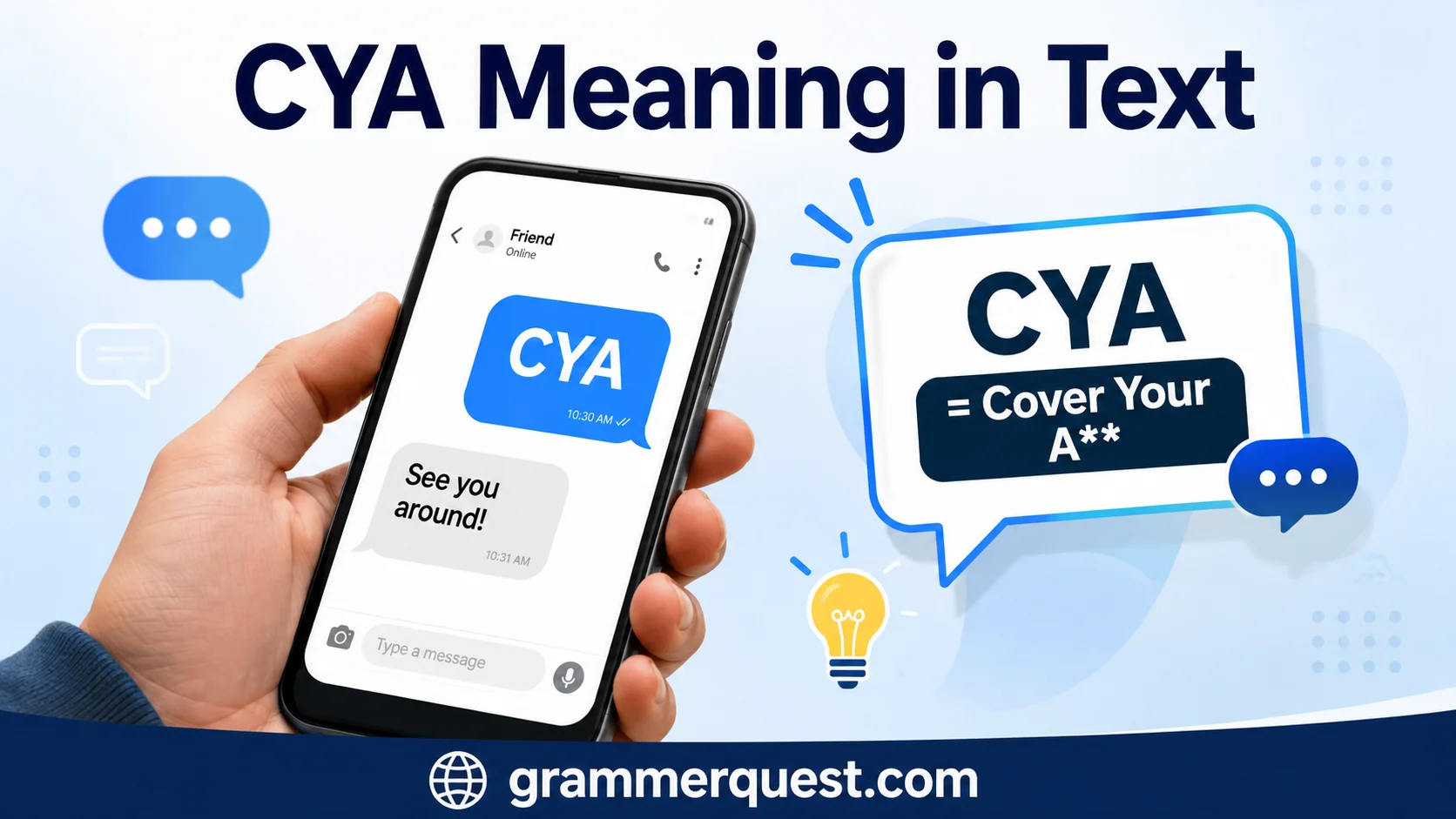
If someone texts “CYA!”, you probably don’t need to reach for a dictionary. In most casual conversations, CYA means “see ya” or “see you.” It’s a quick, relaxed way to say goodbye when you’re ending a conversation, leaving a chat, or signing off for the moment.
However, there’s a twist. CYA also has another established meaning: “cover your ass.” That version appears in workplace, business, and other situations where someone talks about protecting themselves from blame, trouble, or responsibility. Collins Dictionary lists both uses, including “see you” as a farewell and “cover your ass” as a business-related expression.
That second meaning can create confusion. The good news is that context usually makes the intended meaning obvious.
Quick Answer: What Does CYA Mean in Text?
CYA usually means “see ya” or “see you” in text messages, online chats, and social media conversations. It works as an informal goodbye.
For example:
“I gotta head out. CYA!”
This means:
“I have to go. See you later!”
The abbreviation uses C for the sound of “see” and YA for the informal “you.” In other words, CYA is a sound-based shortcut for “see ya.” Wiktionary also identifies cya as an Internet-slang alternative spelling of “see ya.”
There is another meaning:
CYA = “cover your ass.”
In that context, the phrase means protect yourself from blame, criticism, or possible consequences. It’s especially associated with workplace or business situations.
CYA Meaning at a Glance
| CYA Meaning | Where You May See It | What It Means | Tone |
| See ya | Texts, chats, DMs | Goodbye or see you later | Casual |
| See you | Informal messages | Goodbye | Friendly |
| Cover your ass | Work, business, serious discussions | Protect yourself from blame or trouble | Blunt/informal |
The surrounding conversation tells you which meaning applies.
Comparison Overview
Although the spelling stays the same, the two meanings of CYA serve completely different purposes.
| Feature | CYA = See Ya | CYA = Cover Your Ass |
| Main purpose | Say goodbye | Protect yourself |
| Common setting | Texting and online chat | Workplace and business situations |
| Meaning | See you later | Protect yourself from blame or consequences |
| Tone | Casual and friendly | Blunt, cautious, or humorous |
| Example | “Heading home. CYA!” | “Keep the approval email for CYA.” |
| Formality | Informal | Informal and sometimes vulgar |
| Usually connected with | Leaving a conversation | Documentation or self-protection |
The distinction is important because “CYA” isn’t automatically a goodbye in every situation.
Imagine a friend sends:
“I have to go. CYA!”
The intended meaning is almost certainly “see ya.”
Now imagine a coworker says:
“Save that email for CYA.”
That isn’t a farewell. Here, CYA means “cover your ass,” suggesting that keeping the email could help protect the person if someone later questions what happened.
Collins specifically recognizes both meanings, while Dictionary.com labels the “cover your ass” sense as slang and sometimes vulgar.
Main Differences Between CYA Meaning in Text and Workplace Usage
The biggest difference comes down to purpose.
When someone types CYA at the end of a casual conversation, they’re usually saying goodbye. When someone uses CYA while discussing approvals, records, mistakes, or responsibility, they’re more likely talking about self-protection.
CYA as “See Ya”
This is the meaning most people expect in casual texting.
Examples:
- “I’m going to bed. CYA!”
- “Okay, cya tomorrow.”
- “Gotta run. CYA later!”
- “Good game, cya next time.”
- “I’ll message you later. CYA!”
In each example, CYA functions as a short farewell.
The phrase doesn’t necessarily mean that the person will literally see you face-to-face. Someone might text “cya tomorrow” to a friend they expect to meet tomorrow. Someone else might type “cya later” to an online friend they only communicate with digitally.
The phrase has become flexible enough to work as a general informal goodbye.
CYA as “Cover Your Ass”
The second meaning is very different.
“Cover your ass” means taking steps to protect yourself if something goes wrong. That might involve keeping records, saving emails, getting written approval, documenting instructions, or making sure someone knows what decision they made.
For example:
“Keep the manager’s approval in writing. It’s good CYA.”
Here, the speaker isn’t saying goodbye. They’re suggesting that documentation could protect someone if the decision becomes controversial later.
This meaning often appears in conversations about responsibility, accountability, workplace politics, risk, or documentation.
Because the phrase contains profanity, it’s much less suitable for formal professional communication.
What Does CYA Stand for in Texting?
In texting, CYA generally stands for “see ya.”
“See ya” is an informal spoken version of “see you.” CYA turns that phrase into a compact written form.
Think of it like a tiny linguistic shortcut:
C → see
YA → ya / you
CYA → see ya
That’s why the expression feels more like spoken language than formal written English.
Slang.net describes CYA as an abbreviation for “see ya” that people use online, in messages, and on social media. It also notes that the phrase became a common way to end online chats during the rise of Internet messaging.
Is CYA an Acronym?
That’s worth clarifying.
When CYA means “cover your ass,” the letters directly represent the initial letters of the three words:
Cover Your Ass.
When CYA means “see ya,” however, it’s better understood as informal shorthand or a phonetic abbreviation. The C represents the sound of “see,” while “ya” represents the casual pronunciation of “you.”
So the two forms look identical while being formed differently.
How to Understand CYA Meaning in Text From Context
Context is your best detective.
If you’re unsure what CYA means, look at the words immediately before and after it. The subject of the conversation usually gives you the answer.
Look at the Conversation Topic
If you’re discussing weekend plans and someone says:
“Okay, cya Saturday!”
They mean “see you Saturday.”
If you’re discussing a workplace dispute and someone says:
“Save those messages for CYA.”
They probably mean “cover your ass.”
Look at the Person’s Intent
Ask yourself what the person appears to be doing.
Are they:
- Ending the conversation?
- Leaving a game?
- Saying goodbye?
- Talking about meeting later?
Then CYA probably means “see ya.”
Are they:
- Discussing documentation?
- Protecting themselves from blame?
- Talking about workplace problems?
- Saving evidence or written approvals?
Then CYA may mean “cover your ass.”
Check the Words Around CYA
| Message | Likely Meaning |
| “Gotta go now, CYA!” | See ya |
| “CYA tomorrow!” | See ya |
| “Good game, cya!” | See ya |
| “Save that receipt for CYA.” | Cover your ass |
| “Get it approved in writing. CYA.” | Cover your ass |
| “I documented everything for CYA.” | Cover your ass |
Context beats guesswork.
Is CYA Friendly or Rude?
Usually, CYA isn’t rude when it means “see ya.”
It’s simply informal. You might use it with a friend, sibling, gaming buddy, or someone you regularly chat with.
However, tone can shift depending on the message.
Compare these:
“Cya! 😊”
This feels warm and friendly.
“Cya later!”
This sounds casual and relaxed.
“Okay. CYA.”
This can feel more abrupt, especially if the conversation already feels tense.
The abbreviation itself doesn’t automatically communicate anger. Punctuation, surrounding words, timing, and the relationship between the people all influence tone.
That’s an important point when interpreting texting slang. Written messages don’t carry facial expressions or vocal tone, so even ordinary shorthand can occasionally feel colder than intended.
Does CYA Mean Goodbye Forever?
No.
When CYA means “see ya,” it normally functions as an informal goodbye. It doesn’t usually suggest permanent separation.
For example:
“I’m logging off. CYA tomorrow!”
The speaker clearly expects another interaction.
Even “CYA later” generally means something like “see you later” or simply “goodbye for now.”
The phrase isn’t a promise that two people will literally meet again. It’s often just a friendly way to close an interaction.
How to Use CYA in Text Messages
CYA works best when the conversation is casual and informal.
With Friends
Friends can use CYA naturally when ending a conversation.
“I’ve got dinner. CYA!”
“Alright, I’m heading home. Cya!”
In Gaming Chats
Online gaming creates plenty of situations where quick goodbyes make sense.
“I’m getting off for tonight. CYA!”
“Nice game! Cya tomorrow.”
Here, the short form keeps the conversation moving without adding unnecessary words.
In Social Media DMs
You might also see CYA in informal direct messages.
“I’ll send you the pictures later. CYA!”
“Okay, I have class now. Cya!”
The same basic meaning applies.
When Making Plans
CYA can also follow a specific meeting arrangement.
“See you at 6?”
“Yep, cya then!”
In this case, “cya then” means “see you then.”
It works because both people already understand what “then” refers to.
When You Should Avoid CYA
CYA isn’t wrong English. It’s simply very informal.
Avoid it when clarity and professionalism matter more than casual tone.
Skip CYA in:
- Formal business letters
- Job applications
- Cover letters
- Academic papers
- Formal client emails
- Legal documents
- Official announcements
- Professional messages to people you don’t know well
Instead, use a clearer phrase:
- See you later
- See you soon
- Talk to you later
- Take care
- I look forward to seeing you
- I’ll speak with you soon
There’s another reason to avoid CYA at work: the reader could interpret it as “cover your ass.”
That ambiguity isn’t helpful when you’re trying to sound polished.
CYA Text Examples in Real Conversations
Examples are useful because texting abbreviations depend heavily on context.
Example: Friends
Alex: “I’m heading out now.”
Jordan: “No problem. CYA!”
Meaning: See ya / see you later.
Example: Making Plans
Alex: “Are we still meeting at 7?”
Jordan: “Yep, cya then!”
Meaning: See you then.
Example: Gaming
Alex: “I’m logging off. Early morning tomorrow.”
Jordan: “Good game. CYA!”
Meaning: See you later.
Example: Online Chat
Alex: “I’ll send you the file tonight.”
Jordan: “Sounds good. CYA!”
Meaning: Goodbye for now.
Example: Workplace Documentation
Alex: “Should I keep this approval email?”
Jordan: “Definitely. It’s good CYA.”
Meaning: Keep it as protection in case someone later questions the decision.
These examples show why CYA meaning in text can’t always be determined from the abbreviation alone.
CYA Meaning in Different Tones
The same three letters can feel different depending on how they’re written.
| Message | Possible Tone | Explanation |
| “Cya!” | Friendly | The exclamation mark adds energy |
| “cya later” | Relaxed | Lowercase writing feels casual |
| “See ya!” | Warm | Full phrase feels slightly clearer |
| “Okay, cya.” | Neutral or abrupt | Short ending may feel final |
| “CYA 😂” | Playful | Emoji adds humor |
| “Cya tomorrow!” | Friendly | Specific future meeting adds warmth |
Don’t read too much into capitalization alone.
“CYA” and “cya” can mean exactly the same thing.
The surrounding conversation carries more information than the capitalization.
CYA vs. Similar Texting Abbreviations
CYA belongs to a larger family of casual texting shortcuts. However, these expressions aren’t interchangeable in every situation.
| Abbreviation | Full Meaning | Typical Purpose |
| CYA | See ya / See you | Goodbye |
| TTYL | Talk to you later | End a conversation |
| GTG | Got to go | Say you need to leave |
| BRB | Be right back | Temporarily leave |
| CU | See you | Informal farewell |
| B4N | Bye for now | Temporary goodbye |
| L8R | Later | Very informal farewell |
CYA vs. TTYL
CYA focuses on seeing someone again, while TTYL means “talk to you later.”
“I have class now. TTYL!”
This emphasizes a future conversation.
“I have class now. CYA!”
This works more generally as a goodbye.
CYA vs. GTG
GTG means “got to go.”
It explains why the person is ending the conversation.
“GTG, my ride is here.”
CYA can follow it:
“My ride is here. GTG. CYA!”
The two abbreviations can work together because they serve different purposes.
Is CYA Appropriate at Work?
This question gets interesting because CYA has two meanings that can collide in professional communication.
In an informal team chat, coworkers might understand:
“CYA tomorrow!”
as “see you tomorrow.”
But a message such as:
“Make sure you save that email for CYA.”
has a completely different meaning.
In professional writing, it’s better to avoid the abbreviation when there’s any chance of confusion.
Better Professional Alternatives
Instead of using CYA to mean “cover your ass,” consider:
- For documentation purposes
- For the record
- To keep a record
- For reference
- To avoid misunderstandings
- To document the decision
- To protect against future disputes
These alternatives communicate the purpose without profanity or ambiguity.
For example, instead of:
“Save the email for CYA.”
a professional message could say:
“Please keep the email for documentation purposes.”
That’s clearer, cleaner, and easier to use in formal communication.
Read This: MHM Meaning in Text: What Does MHM Mean in Texting?
Case Study: Why Context Changes the CYA Meaning
Consider a fictional but realistic two-message scenario.
Scenario A: Casual Conversation
A friend writes:
“I’m heading home now. CYA tomorrow!”
The conversation concerns dinner plans and tomorrow’s schedule.
Here, CYA clearly means “see ya” or “see you.”
Nothing in the message suggests workplace risk or responsibility.
Scenario B: Workplace Conversation
Now imagine a manager and employee discussing a disputed project decision.
The employee writes:
“I saved the manager’s approval email. CYA.”
Here, CYA means “cover your ass.”
The employee is referring to documentation that could show who approved the decision.
The Lesson
The letters haven’t changed.
The context has.
That’s why interpreting slang requires more than expanding individual letters. You need to understand what the speaker is actually trying to accomplish.
Research into slang interpretation also highlights the importance of context when determining which meaning fits an informal expression.
Common Misunderstandings About CYA Meaning in Text
CYA Always Means “See You”
Not necessarily.
In ordinary texting, “see ya” is usually the intended meaning. However, the workplace expression “cover your ass” is also an established use.
CYA Is Always Rude
No.
The “see ya” version is normally casual rather than rude.
The “cover your ass” version contains profanity and can sound blunt, but even that usage may appear humorously among coworkers or friends.
CYA Means “See You Forever”
Definitely not.
CYA usually acts as a simple farewell. It doesn’t carry a built-in message about permanent separation.
CYA Is Suitable for Formal Writing
Usually, it isn’t the best choice.
Even when the intended meaning is harmless, readers may not know which definition you mean. A formal phrase such as “See you later” or “For documentation purposes” removes that uncertainty.
CYA Always Has the Same Tone
Not quite.
“Cya 😊” and “Okay. CYA.” can feel very different even when both mean “see you.”
Tone depends on the full message, punctuation, relationship, and situation.
How to Reply When Someone Says CYA
If someone sends CYA as a goodbye, your reply can stay just as casual.
Short Replies
- “See ya!”
- “Cya later!”
- “Later!”
- “Take care!”
- “See you!”
Friendly Replies
- “See you tomorrow!”
- “Talk to you soon!”
- “Catch you later!”
- “Have a good one!”
- “See you then!”
If You’re Unsure What They Mean
Look at the conversation first.
If the person is leaving a chat, “see ya” is the natural interpretation.
If you’re discussing workplace documentation, risk, or responsibility, the “cover your ass” meaning may fit.
When the context remains genuinely unclear, simply ask:
“Do you mean see ya?”
There’s no prize for solving an abbreviation mystery the hard way.
CYA Meaning on Social Media and Messaging Apps
The meaning of CYA doesn’t fundamentally change across digital platforms.
You may encounter it in:
- Text messages
- Direct messages
- Online chats
- Social media conversations
- Gaming chats
- Group conversations
- Informal email
The communication style matters more than the platform.
For example:
“Cya later!”
means essentially the same thing whether it appears in a text message or a casual online chat.
The expression belongs to informal digital language, where people often shorten familiar phrases to make communication faster and more conversational. Slang.net describes CYA as a form used in online messages and social media.
Interesting Facts About CYA Meaning in Text
Here are several useful points to remember:
- CYA commonly means “see ya” in casual digital communication.
- “See ya” is an informal form of “see you.”
- The C represents the sound of “see.”
- YA represents the casual pronunciation of “you.”
- CYA can also mean “cover your ass.”
- The second meaning is particularly relevant in business and workplace contexts.
- The “cover your ass” version is considered slang and can be vulgar.
- CYA doesn’t automatically indicate anger, sarcasm, or romantic interest.
- Capitalization doesn’t reliably determine which meaning someone intends.
- Context provides the strongest clue.
- “See ya” doesn’t necessarily mean that the person will literally meet you in person again.
FAQs:
1. What does CYA mean in text?
CYA Meaning in Text usually refers to “See Ya,” a casual way of saying goodbye. It’s commonly used in texts, chats, and social media.
2. Is CYA a formal abbreviation?
No. CYA is an informal abbreviation mainly used in casual conversations with friends, family, or people you know well.
3. What does CYA mean in a text message?
In a text message, CYA most often means “See Ya,” meaning “See you” or “See you later.” For example: “I’ve got to go now. CYA!”
4. Can CYA have other meanings?
Yes. Depending on the context, CYA can also mean “Cover Your Ass,” especially in workplace or informal slang. However, “See Ya” is a common meaning in casual texting.
5. Is it okay to use CYA in professional messages?
It’s better to avoid CYA in formal or professional communication. Instead, use phrases such as “See you later,” “Talk to you soon,” or “Goodbye.”
Conclusion:
Understanding CYA Meaning in Text helps you interpret casual messages more easily. In most texting situations, CYA means “See Ya” and is simply a friendly way to say goodbye. Since abbreviations can have different meanings depending on context, always consider the conversation before interpreting CYA. For professional communication, it’s usually better to use a clear and more formal goodbye.

Emma Brooke is a passionate language enthusiast and the voice behind GrammarQuest.com. With a sharp eye for detail and a love for clear communication, she simplifies complex grammar rules into easy, practical lessons. Her goal is to help you write with confidence, clarity, and style—whether you’re a student, professional, or everyday writer.