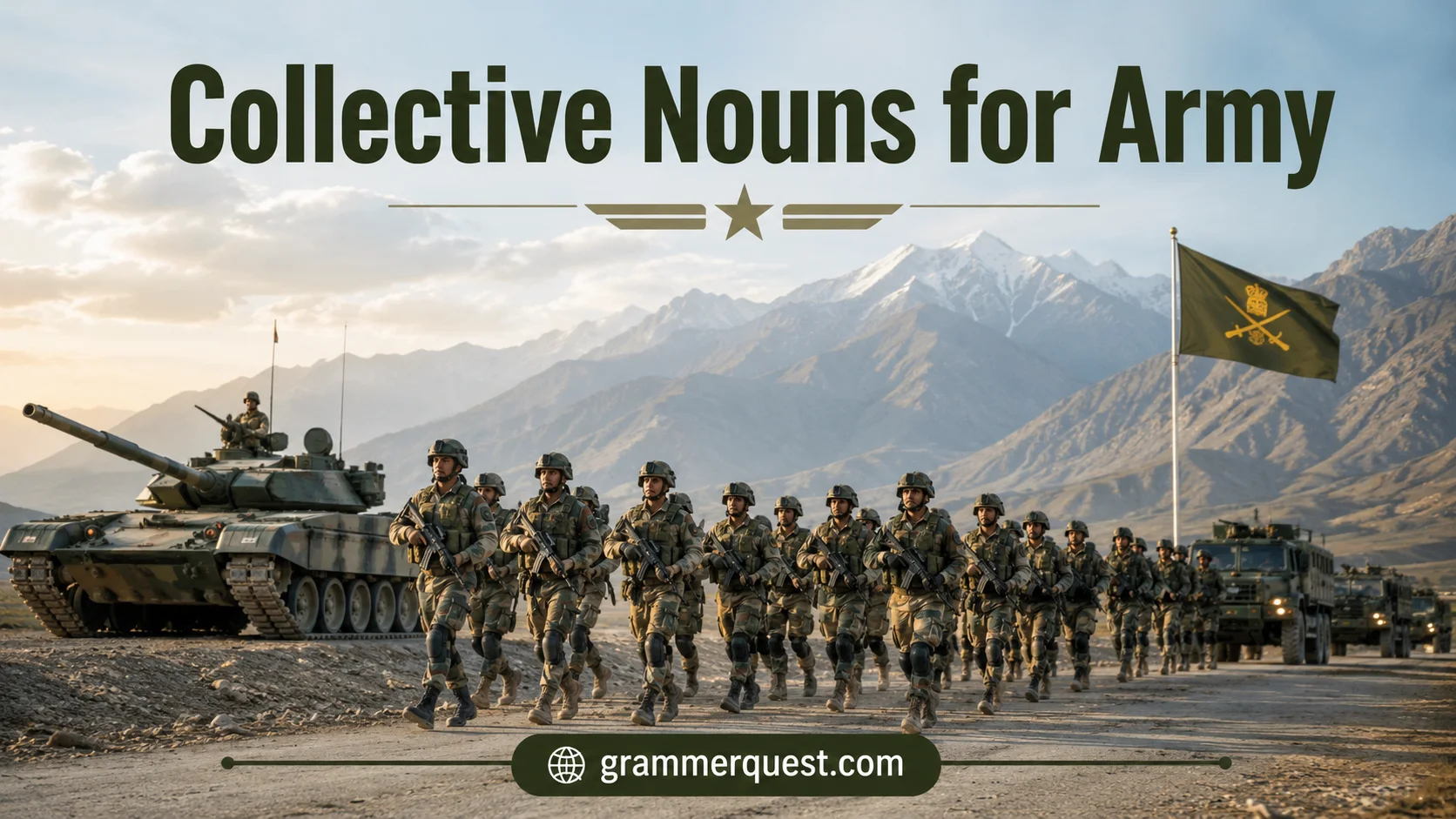
Collective Nouns for Army are useful words that describe a group as a single unit. In English grammar, collective nouns make writing more clear, organized, and interesting. An army usually refers to a large group of soldiers working together toward a common goal. Learning collective nouns helps improve vocabulary and makes it easier to describe groups of people, animals, and things accurately. These terms are commonly used in both everyday conversations and formal writing, making them an important part of effective communication.
Besides an army of soldiers, English includes many other collective nouns such as a team of players, a crowd of people, and a forest of trees. These words allow speakers and writers to express ideas more efficiently without repeatedly mentioning every individual in a group. Understanding collective nouns can strengthen grammar skills and enhance sentence variety. Whether you are a student, teacher, or language enthusiast, knowing these group names can make your writing more engaging, descriptive, and professional.
Collective Nouns Used for Army
The table below shows some common collective nouns associated with an army.
| Collective Noun | Simple Example |
| Army | An army of soldiers marched forward. |
| Troop | A troop of soldiers crossed the river. |
| Regiment | A regiment of soldiers lined up neatly. |
| Battalion | A battalion of troops entered the camp. |
| Brigade | A brigade of soldiers prepared for duty. |
Army of Soldiers Examples
An army is the most common collective noun used for a large organized group of soldiers.
Example Sentences
- An army of soldiers guarded the border.
- The army of warriors moved across the valley.
- An army of troops camped near the river.
- The army marched through the city.
- A strong army defended the kingdom.
- The army trained every morning.
- An army of soldiers waited for orders.
- The army advanced toward the hills.
- The army celebrated its victory.
- A disciplined army protected the nation.
Troop of Soldiers Examples
The word troop often refers to a group of soldiers operating together.
Example Sentences
- A troop of soldiers entered the village.
- The troop crossed the bridge safely.
- A troop of guards protected the gate.
- The troop marched in formation.
- The troop rested after a long journey.
- A troop of soldiers trained in the field.
- The troop received new equipment.
- The troop followed the commander.
- A troop of soldiers camped nearby.
- The troop returned home after service.
Regiment and Battalion of Soldiers Examples
A regiment and a battalion are organized military units within an army.
Regiment Example Sentences
- A regiment of soldiers paraded through town.
- The regiment trained for several weeks.
- The regiment defended the fort.
- A regiment arrived at dawn.
- The regiment followed strict rules.
- The regiment camped near the forest.
- A regiment of troops prepared for battle.
- The regiment moved in perfect order.
- The regiment received praise for bravery.
- The regiment completed its mission.
Battalion Example Sentences
- A battalion of soldiers marched together.
- The battalion reached the camp at sunset.
- A battalion guarded the mountain pass.
- The battalion practiced military drills.
- The battalion followed its commander.
- A battalion crossed the desert.
- The battalion set up tents quickly.
- The battalion received fresh supplies.
- A battalion of troops protected the town.
- The battalion completed the operation successfully.
Brigade of Soldiers Examples
A brigade is another military formation made up of several units.
Example Sentences
- A brigade of soldiers prepared for deployment.
- The brigade marched through the countryside.
- A brigade protected the city.
- The brigade participated in training exercises.
- The brigade received important instructions.
- A brigade of troops arrived at the base.
- The brigade worked together efficiently.
- The brigade completed its assignment.
- A brigade defended the region.
- The brigade celebrated its achievements.
Read More: Collective Nouns for Storks
Interesting Facts About Army
Throughout history, armies have existed for thousands of years and have played a significant role in shaping civilizations. Some of the earliest organized armies appeared in ancient Mesopotamia and Egypt more than 5,000 years ago. Modern armies are highly structured organizations with specialized units, advanced technology, and extensive training programs.
One unique feature of armies is their strict hierarchy, where every member has a specific role and responsibility. This organization helps maintain discipline and ensures that large groups can work together effectively. Armies also rely on teamwork, communication, and leadership to accomplish complex tasks.
Although armies are not living organisms with biological traits or dietary habits, the soldiers within them require balanced nutrition, physical fitness, and regular training to maintain strength and readiness. Proper diets rich in proteins, carbohydrates, vitamins, and minerals help soldiers perform demanding physical activities and remain healthy during service.
The longevity of military organizations is another fascinating aspect. Many armies have existed for centuries, evolving alongside advances in technology, transportation, and strategy while continuing to serve their nations.
FAQs :
1. What is the collective noun for army?
The collective noun for army is simply army, which refers to a large group of soldiers organized for military purposes.
2. What is a collective noun?
A collective noun is a word that represents a group of people, animals, or things as a single unit.
3. Why is “army” considered a collective noun?
An army includes many soldiers, but it is treated as one group, making it a collective noun.
4. Can “army” be used for non-military groups?
Yes, the word army can sometimes be used figuratively to describe a very large group of people working toward the same goal.
5. What are some examples of collective nouns?
Examples include a team of players, a crowd of people, a forest of trees, and an army of soldiers.
6. Is “army” singular or plural?
The word army is generally singular because it refers to one organized group, though it contains many individuals.
7. How do collective nouns improve writing?
Collective nouns make writing more concise, descriptive, and easier to understand.
8. Are collective nouns important in English grammar?
Yes, collective nouns are an important part of English grammar because they help describe groups efficiently.
9. Can collective nouns be used in formal writing?
Absolutely. Collective nouns are commonly used in academic, professional, and everyday writing.
10. How can I learn more collective nouns?
Reading books, grammar guides, and practicing English regularly can help you learn and remember collective nouns.
Conclusion :
Understanding Collective Nouns for Army helps you use English more accurately and effectively. An army represents a group of soldiers acting as one unit, making it a perfect example of a collective noun. By learning collective nouns such as army, team, crowd, and forest, you can improve your vocabulary, strengthen your grammar skills, and make your writing more engaging and professional.

George Whitaker is the voice behind GrammarQuest, dedicated to making grammar simple, engaging, and easy to understand. He helps learners turn confusion into confidence with clear explanations and real-world examples.