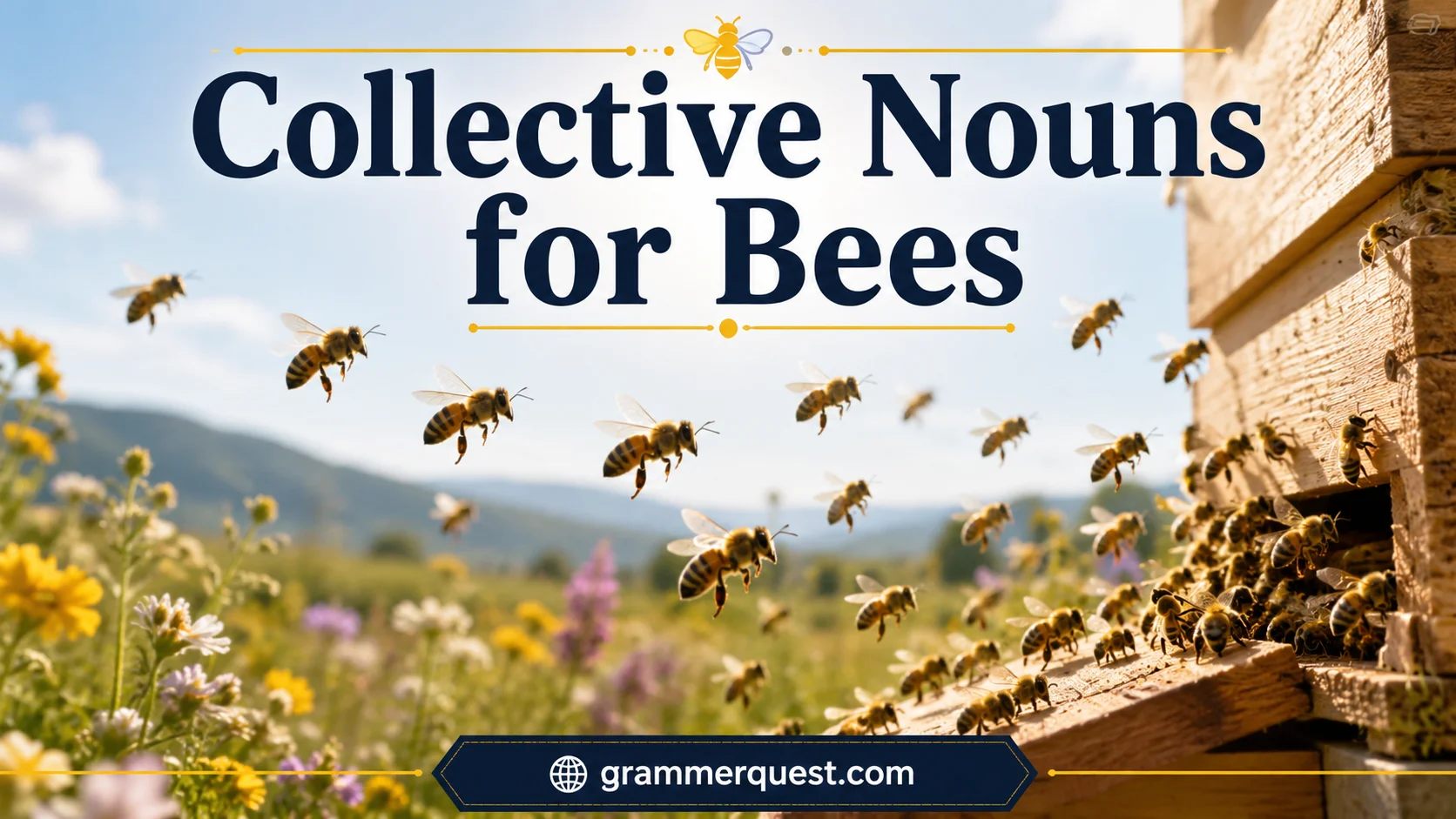
Collective Nouns for Bees are special words used to describe a group of bees as a single unit. The most common and widely accepted collective noun is a swarm, which refers to a large number of bees flying or gathering together. Learning Collective Nouns for Bees helps improve your English vocabulary and makes your writing more accurate and descriptive. These terms are commonly used in grammar lessons, educational materials, and nature-related discussions.
Understanding collective nouns can make language more colorful and engaging. A swarm of bees is a perfect example of how one word can represent many animals at once. Students, teachers, and language learners often study these terms to strengthen grammar skills and communication. Exploring different collective nouns also provides an interesting way to learn about animal behavior while expanding your knowledge of the English language.
Collective Nouns for Bees
The table below lists the most commonly used collective nouns for bees.
| Type | Simple Example |
| Swarm of Bees | A swarm of bees flew over the garden. |
| Colony of Bees | A colony of bees lived inside the hive. |
| Grist of Bees | A grist of bees gathered around the flowers. |
| Hive of Bees | A hive of bees produced fresh honey. |
| Nest of Bees | A nest of bees was hidden in the tree. |
Swarm of Bees
A swarm is the most common collective noun for bees. It usually refers to a large group of bees flying together, often when part of a colony leaves to establish a new home.
Examples of Swarm of Bees
- A swarm of bees crossed the field.
- The swarm of bees settled on a tree branch.
- We watched a swarm of bees from a safe distance.
- The swarm of bees moved toward a nearby garden.
- A swarm of bees filled the air with buzzing sounds.
- The farmer spotted a swarm of bees near the barn.
- A swarm of bees gathered around the queen bee.
- The swarm of bees quickly found a resting place.
- Children observed a swarm of bees from indoors.
- The swarm of bees disappeared into the forest.
Colony of Bees
A colony refers to a complete bee community living together in a hive. It includes the queen, worker bees, and drones.
Examples of Colony of Bees
- A colony of bees lived in the wooden hive.
- The colony of bees worked together efficiently.
- A healthy colony of bees produced plenty of honey.
- The colony of bees protected its queen.
- Scientists studied the colony of bees closely.
- The colony of bees expanded during spring.
- A colony of bees pollinated nearby crops.
- The colony of bees survived the winter.
- Farmers value a colony of bees for pollination.
- The colony of bees remained active all summer.
Grist of Bees
A grist of bees is a rare and traditional collective noun. Although not commonly used today, it remains an interesting term in English vocabulary.
Examples of Grist of Bees
- A grist of bees hovered above the flowers.
- The grist of bees searched for nectar.
- We noticed a grist of bees near the orchard.
- A grist of bees buzzed around the garden.
- The grist of bees moved from flower to flower.
- A grist of bees filled the meadow with activity.
- The grist of bees worked throughout the day.
- A grist of bees gathered around blooming plants.
- The grist of bees contributed to pollination.
- The grist of bees returned to their hive at dusk.
Hive of Bees
The term hive can also be used collectively when referring to the bees living together inside a hive.
Examples of Hive of Bees
- A hive of bees occupied the old box.
- The hive of bees produced delicious honey.
- A hive of bees was placed near the orchard.
- The hive of bees stayed busy during summer.
- Beekeepers monitored the hive of bees regularly.
- The hive of bees expanded rapidly.
- A hive of bees helped pollinate crops.
- The hive of bees remained healthy throughout the season.
- The hive of bees stored honey for winter.
- Visitors observed a hive of bees through glass panels.
Nest of Bees
A nest of bees refers to bees living together in a nesting location, particularly in natural environments.
Examples of Nest of Bees
- A nest of bees was hidden in the tree trunk.
- We found a nest of bees near the hillside.
- The nest of bees remained undisturbed.
- A nest of bees occupied a hollow log.
- The nest of bees attracted researchers.
- A nest of bees was discovered in the garden.
- The nest of bees grew larger each month.
- A nest of bees provided shelter for thousands of insects.
- The nest of bees was carefully relocated.
- The nest of bees remained active throughout the day.
Read More: Collective Nouns for Army
Interesting Facts About Bees
Bees are among the most important pollinators on Earth and play a crucial role in maintaining ecosystems and food production. Although worker honey bees typically live for only a few weeks during active seasons, queen bees can survive for several years, making them some of the longest-living insects in their colonies. Bees possess remarkable physiological features, including specialized pollen baskets on their legs and compound eyes that allow them to detect ultraviolet light. They also communicate through the famous “waggle dance,” which helps other bees locate food sources. In terms of diet, bees primarily consume nectar for energy and pollen for protein, vitamins, and minerals. Honey bees convert nectar into honey, which serves as a stored food source during periods when flowers are scarce.
Why Collective Nouns for Bees Matter
Understanding collective nouns for bees helps us appreciate the highly organized and cooperative nature of these insects. Terms such as swarm, colony, and hive reflect different aspects of bee behavior and social structure. These words enrich our language while providing insight into how bees live, work, and survive together.
FAQs:
1. What is the most common collective noun for bees?
The most common collective noun for bees is a swarm.
2. What does a swarm of bees mean?
A swarm refers to a large group of bees flying or moving together as one unit.
3. Why are collective nouns important?
Collective nouns make writing and speaking more precise by describing a group with a single word.
4. Is “swarm” used only for bees?
No, the word swarm can also describe large groups of other insects.
5. Are there other collective nouns for bees?
While swarm is the most popular term, some sources also mention grist and hive in specific contexts.
6. What is a collective noun?
A collective noun is a word that represents a group of people, animals, or things as a single entity.
7. How can learning collective nouns improve English?
Learning collective nouns expands vocabulary and helps create more descriptive sentences.
8. Do children learn collective nouns in school?
Yes, collective nouns are commonly taught in grammar and language lessons.
9. Can I use “group of bees” instead of “swarm of bees”?
Yes, but swarm of bees is more specific and commonly used.
10. What is an example sentence using a collective noun for bees?
“A swarm of bees gathered around the flowering trees in the garden.”
Conclusion:
Collective Nouns for Bees help make English more vivid and expressive. The term swarm is the most widely recognized collective noun for bees and is frequently used in both writing and conversation. By learning collective nouns, you can improve your vocabulary, strengthen your grammar skills, and make your descriptions more accurate and engaging. Whether you are a student, teacher, or language enthusiast, understanding these terms adds depth and clarity to your communication.

Emma Brooke is a passionate language enthusiast and the voice behind GrammarQuest.com. With a sharp eye for detail and a love for clear communication, she simplifies complex grammar rules into easy, practical lessons. Her goal is to help you write with confidence, clarity, and style—whether you’re a student, professional, or everyday writer.