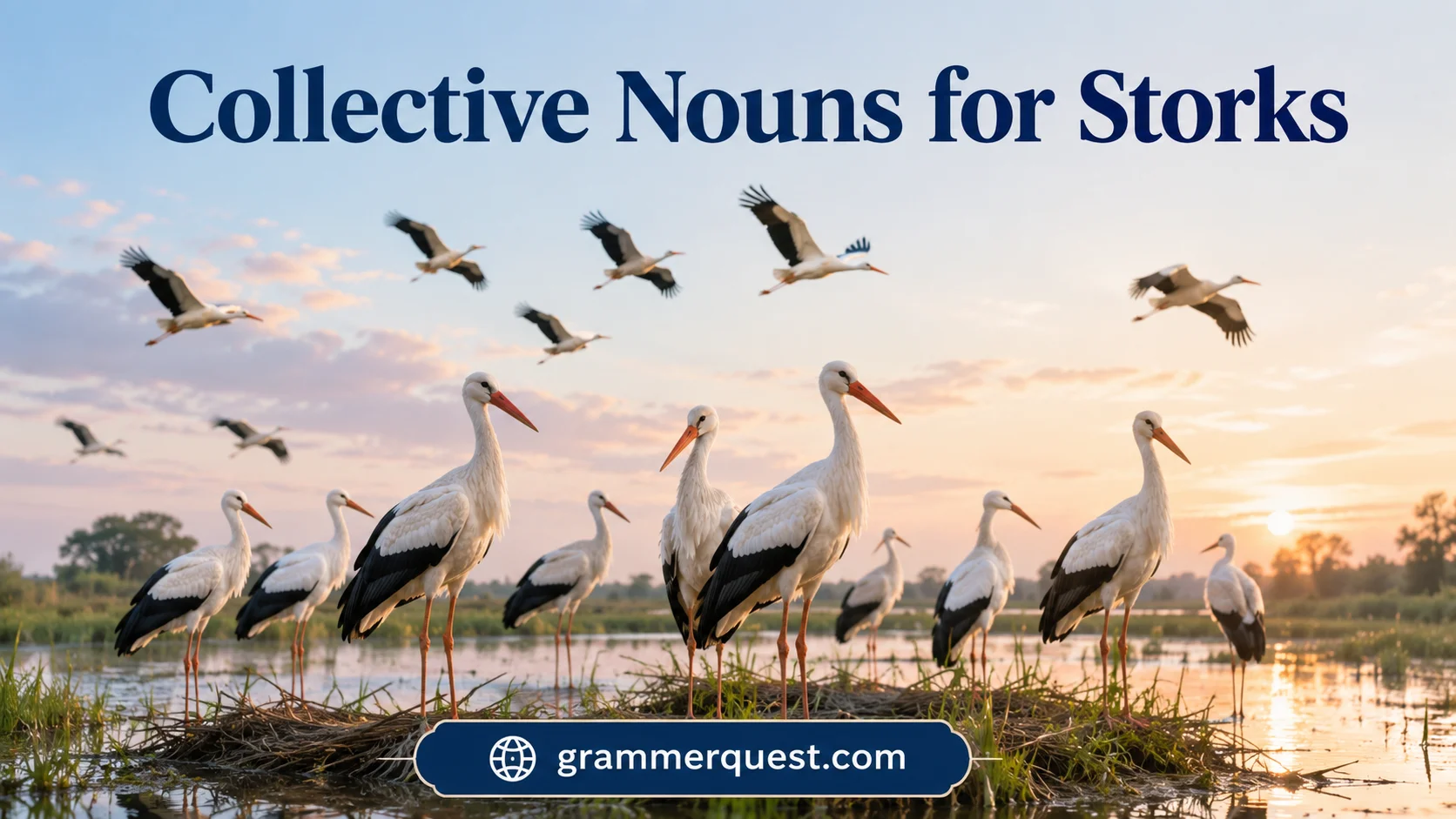
Collective Nouns for Storks are fascinating examples of how the English language assigns special names to groups of animals and birds. These unique expressions make communication more colorful and help describe animal behavior more accurately. The most common collective noun for storks is a mustering of storks, a term that comes from the idea of a gathering or assembly. Learning these bird-related terms not only improves vocabulary but also offers a deeper appreciation of language and nature.
Storks are large, elegant birds known for their long migrations and impressive flying formations. Besides a mustering, a group of storks may also be called a flight of storks when they are flying together or a phalanx of storks when migrating in an organized formation. These collective nouns reflect the birds’movements and social behavior, making them interesting examples of descriptive English. Understanding such terms can enrich both writing and everyday conversation.
Collective Nouns for Storks
| Collective Noun | Type | Simple Example |
| Muster | Group of storks | A muster of storks flew overhead. |
| Flight | Group of storks in the air | A flight of storks crossed the valley. |
| Phalanx | Organized group of storks | A phalanx of storks stood near the river. |
| Congregation | Gathering of storks | A congregation of storks rested in the wetland. |
| Colony | Nesting group of storks | A colony of storks nested on the rooftops. |
Muster of Storks
A muster is one of the most recognized collective nouns for a group of storks. It is often used when storks gather together on the ground or in a particular area.
Examples of a Muster of Storks
- A muster of storks gathered beside the lake.
- We watched a muster of storks in the field.
- The farmer noticed a muster of storks near the crops.
- A muster of storks searched for food together.
- The children admired a muster of storks by the river.
- A large muster of storks rested after migration.
- A muster of storks walked across the wetland.
- The birdwatchers photographed a muster of storks.
- A muster of storks stood quietly in the marsh.
- The sunset highlighted a muster of storks.
Flight of Storks
The term flight is commonly used when storks are seen soaring or traveling together through the sky.
Examples of a Flight of Storks
- A flight of storks passed above the village.
- We saw a flight of storks heading south.
- A flight of storks crossed the mountains.
- The sky was filled with a flight of storks.
- A flight of storks glided effortlessly overhead.
- The travelers spotted a flight of storks at dawn.
- A flight of storks moved with the wind.
- The photographer captured a flight of storks.
- A flight of storks disappeared into the distance.
- The children pointed at a flight of storks.
Phalanx of Storks
A phalanx refers to a group of storks standing or moving in an orderly formation. The term highlights their organized appearance.
Examples of a Phalanx of Storks
- A phalanx of storks lined the riverbank.
- The visitors observed a phalanx of storks.
- A phalanx of storks stood in shallow water.
- The birds formed a phalanx of storks near the marsh.
- A phalanx of storks waited for prey.
- The wetland hosted a phalanx of storks.
- We admired a phalanx of storks at sunset.
- A phalanx of storks remained perfectly still.
- The guide pointed out a phalanx of storks.
- A phalanx of storks created a striking sight.
Congregation of Storks
A congregation describes a gathering of storks that have come together in one location.
Examples of a Congregation of Storks
- A congregation of storks gathered near the pond.
- We observed a congregation of storks feeding.
- A congregation of storks rested in the meadow.
- The wetland attracted a congregation of storks.
- A congregation of storks searched for fish.
- Bird enthusiasts photographed a congregation of storks.
- A congregation of storks stood among the reeds.
- The riverbank hosted a congregation of storks.
- A congregation of storks arrived before sunset.
- We enjoyed watching a congregation of storks.
Colony of Storks
A colony refers to a group of storks living or nesting together in the same area.
Examples of a Colony of Storks
- A colony of storks nested on the rooftops.
- We visited a colony of storks in the village.
- A colony of storks returned every spring.
- The trees sheltered a colony of storks.
- A colony of storks raised their chicks together.
- Researchers studied a colony of storks.
- The nature reserve protected a colony of storks.
- A colony of storks occupied the wetland.
- The colony of storks grew larger each year.
- Tourists admired a colony of storks from afar.
Read More: Collective Nouns for Salmon
Interesting Facts About Storks
Storks are fascinating birds with remarkable characteristics. Many species can live for more than 20 years in the wild, while some individuals in protected environments have reached even greater ages. Their longevity is supported by strong migratory instincts and excellent adaptability to different habitats.
One of the most unique physiological features of storks is their long legs and elongated beaks, which help them hunt efficiently in wetlands, marshes, and shallow waters. Unlike many birds, storks have a reduced vocal system and often communicate through bill-clattering sounds instead of songs.
Storks are also impressive travelers. Some species migrate thousands of kilometers between breeding and wintering grounds, using warm air currents to glide long distances while conserving energy. Their diet is highly varied and includes fish, frogs, insects, small reptiles, rodents, and other small animals. This diverse diet allows them to thrive in different ecosystems around the world.
FAQs :
1. What is the most common collective noun for storks?
The most common collective noun for storks is a mustering of storks.
2. Why is a group of storks called a mustering?
The term mustering comes from the idea of a gathering or assembly of individuals in one place.
3. What is a flight of storks?
A flight of storks refers to a group of storks flying together in the air.
4. What does phalanx of storks mean?
A phalanx of storks describes storks flying in a structured formation, especially during migration.
5. Are collective nouns for storks commonly used?
Some terms are uncommon in daily conversation but are popular in literature, education, and bird-related content.
6. Do all birds have collective nouns?
Yes, many bird species have unique collective nouns that describe groups of those birds.
7. Where did collective nouns originate?
Most collective nouns originated from historical hunting, literature, and traditional English usage.
8. Why are collective nouns important?
They make language more vivid, descriptive, and interesting while improving vocabulary.
9. Can I use more than one collective noun for storks?
Yes, depending on the situation, you can use mustering, flight, or phalanx.
10. How can I learn more collective nouns for birds?
Reading wildlife guides, bird books, and educational language resources is a great way to discover more collective nouns.
Conclusion :
Collective Nouns for Storks showcase the creativity and richness of the English language. Whether you use mustering, flight, or phalanx, each term highlights a different aspect of how storks gather and move together. Learning these collective nouns not only expands vocabulary but also helps us appreciate the fascinating behaviors of these graceful birds. By understanding such unique expressions, readers can make their writing more engaging, descriptive, and accurate.

Emma Brooke is a passionate language enthusiast and the voice behind GrammarQuest.com. With a sharp eye for detail and a love for clear communication, she simplifies complex grammar rules into easy, practical lessons. Her goal is to help you write with confidence, clarity, and style—whether you’re a student, professional, or everyday writer.