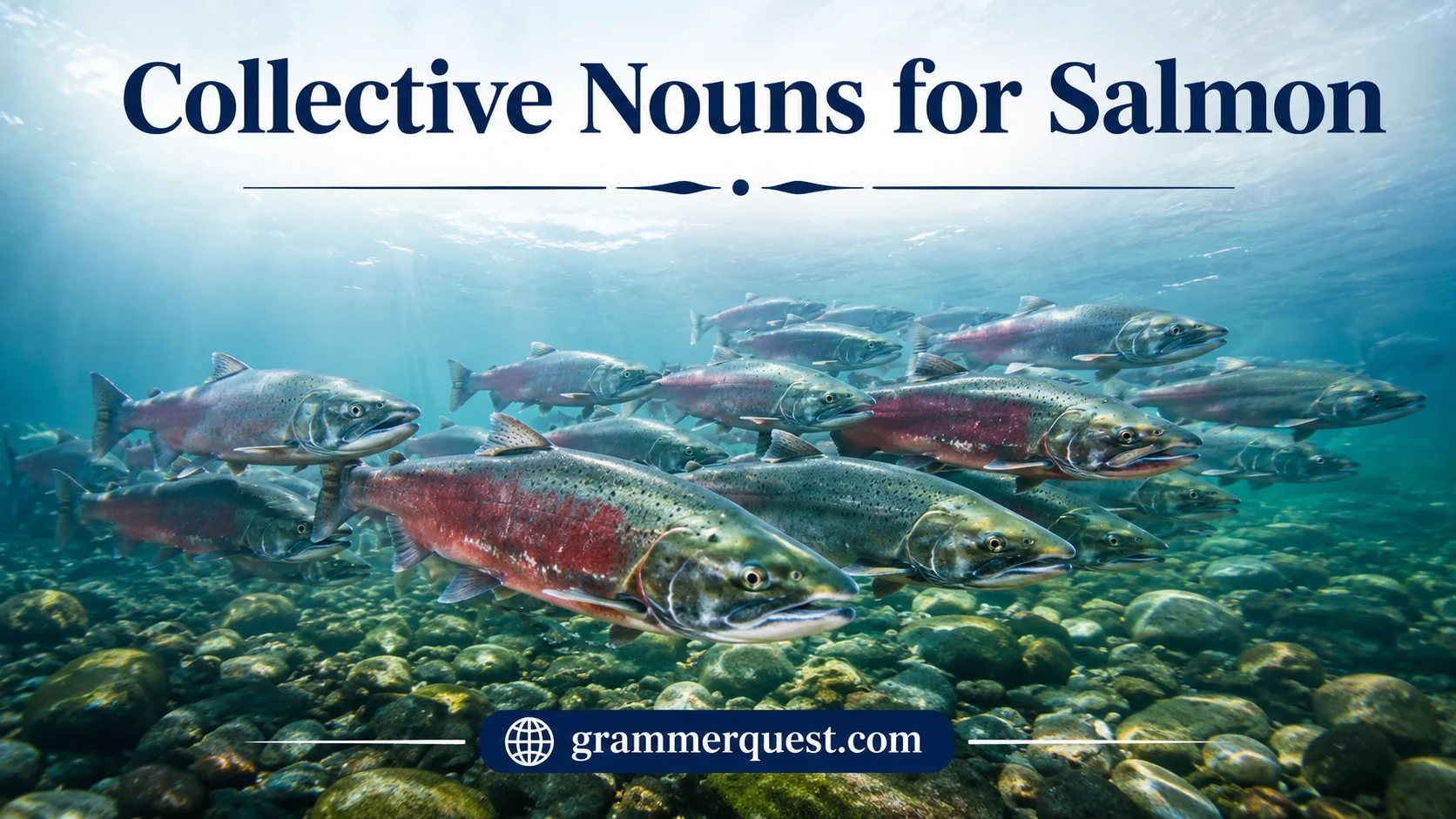
Collective Nouns for Salmon are fascinating terms that describe groups of these well-known fish in English grammar. Learning Collective Nouns for Salmon helps students, writers, and language learners improve their vocabulary and understand how group names are used in everyday communication. Salmon are famous for their long migrations through rivers and oceans, making them one of the most interesting aquatic animals. Understanding these collective nouns also makes writing more descriptive, engaging, and accurate while expanding knowledge of animal-related terms.
Salmon are an important part of marine life and freshwater ecosystems, and their group names add color to the English language. Just as people learn a school of fish or a shoal of fish, discovering collective nouns for salmon can make language learning more enjoyable. These unique expressions help build vocabulary, strengthen descriptive writing skills, andincrease confidence in speaking and reading. Exploring such terms also provides a fun way to connect grammar with the natural world.
Collective Nouns for Salmon
Table of Collective Nonus for Salmon
| Type | Simple Example |
| Run | A run of salmon moved upstream. |
| School | A school of salmon swam together. |
| Shoal | A shoal of salmon gathered near the river mouth. |
| Bind | A bind of salmon traveled through the water. |
| Haul | A haul of salmon was seen in the stream. |
Run of Salmon
A run is the most commonly used collective noun for salmon. It refers to a large group of salmon migrating, especially when they travel upstream to spawn.
Examples of a Run of Salmon
- A run of salmon entered the river.
- We watched a run of salmon swim upstream.
- The run of salmon arrived in early autumn.
- Fishermen noticed a large run of salmon.
- A run of salmon crossed the shallow water.
- The run of salmon attracted many wildlife photographers.
- A healthy run of salmon supports the ecosystem.
- The run of salmon continued for several days.
- Tourists gathered to observe the run of salmon.
- The river was full of a run of salmon.
School of Salmon
A school refers to a group of fish swimming together in a coordinated manner for protection and efficiency.
Examples of a School of Salmon
- A school of salmon moved through the lake.
- We spotted a school of salmon near the shore.
- The school of salmon changed direction quickly.
- A school of salmon swam beneath the boat.
- Divers observed a school of salmon underwater.
- The school of salmon stayed close together.
- A large school of salmon passed by.
- Predators followed the school of salmon.
- The school of salmon disappeared into deeper water.
- Children enjoyed watching the school of salmon.
Shoal of Salmon
A shoal describes a group of fish gathered together, whether they are actively swimming in coordination or simply remaining close to one another.
Examples of a Shoal of Salmon
- A shoal of salmon rested near the riverbank.
- We saw a shoal of salmon in the clear water.
- The shoal of salmon moved slowly downstream.
- Birds circled above the shoal of salmon.
- A shoal of salmon gathered near the rocks.
- The shoal of salmon remained close together.
- Scientists studied a shoal of salmon.
- The shoal of salmon avoided the predator.
- A shoal of salmon entered the estuary.
- Tourists photographed the shoal of salmon.
Bind of Salmon
A bind is a less common collective noun used for salmon and other fish species.
Examples of a Bind of Salmon
- A bind of salmon swam through the current.
- We noticed a bind of salmon near the waterfall.
- The bind of salmon traveled upstream.
- A bind of salmon filled the narrow stream.
- Researchers observed a bind of salmon.
- The bind of salmon moved steadily forward.
- A bind of salmon entered the river system.
- The bind of salmon attracted hungry bears.
- The bind of salmon reached the spawning grounds.
- The bind of salmon continued its journey.
Haul of Salmon
A haul of salmon is a rare term often associated with a large catch or collection of salmon.
Examples of a Haul of Salmon
- The fishermen returned with a haul of salmon.
- A haul of salmon was displayed at the market.
- The boat carried a haul of salmon.
- We saw a large haul of salmon today.
- The haul of salmon impressed the villagers.
- A haul of salmon filled several baskets.
- The haul of salmon was sold quickly.
- Everyone admired the haul of salmon.
- The haul of salmon came from nearby waters.
- The haul of salmon supported the local economy.
Read More: Collective Nouns for Dotterels
Interesting Facts About Salmon
Amazing Life Cycle and Longevity
Salmon are famous for their incredible migration journeys. Many species hatch in freshwater rivers, travel to the ocean where they spend several years growing, and then return to the very rivers where they were born to reproduce. Depending on the species, salmon can live between two and eight years, though some individuals survive even longer under favorable conditions.
Unique Physiological Features
One of the most remarkable features of salmon is their ability to adapt to both freshwater and saltwater environments. Their bodies undergo special physiological changes that allow them to regulate salt levels efficiently. Salmon also possess an exceptional sense of smell, which helps them locate their birthplace after years spent in the open ocean. During spawning season, many salmon develop distinctive colors and physical characteristics that make them easily recognizable.
Dietary Habits of Salmon
Salmon are opportunistic feeders whose diets change throughout their lives. Young salmon typically consume insects, larvae, and small aquatic organisms. Adult salmon in the ocean feed on crustaceans, squid, and smaller fish. Their varied diet provides the nutrients needed for growth, migration, and reproduction. Because salmon occupy an important place in aquatic food chains, they contribute significantly to ecosystem health.
Why Collective Nouns for Salmon Matter
Understanding collective nouns for salmon enhances both language skills and knowledge of wildlife. These terms provide a more precise way to describe how salmon gather, travel, and interact in nature. Whether referring to a run, school, shoal, bind, or haul, each collective noun paints a unique picture of salmon behavior and movement.
FAQs :
1. What is the most common collective noun for salmon?
The most common collective noun for salmon is a school of salmon.
2. Can a group of salmon be called a shoal?
Yes, a group of salmon can also be called a shoal of salmon, especially when referring to fish swimming together.
3. Why do salmon travel in groups?
Salmon often travel in groups for protection, easier navigation, and better chances of survival.
4. Are collective nouns for salmon used in everyday English?
Yes, terms like school of salmon are commonly used in both everyday language and educational contexts.
5. What is the difference between a school and a shoal?
A shoal is a group of fish gathered together, while a school is a more organized group swimming in the same direction.
6. Where do salmon usually live?
Salmon live in both freshwater and saltwater environments, depending on their stage of life.
7. Why are collective nouns important?
Collective nouns make communication more precise and improve descriptive writing and vocabulary.
8. Do all fish have collective nouns?
Most fish groups are referred to as a school or shoal, but some species may have unique collective nouns.
9. Are salmon migratory fish?
Yes, salmon are famous for migrating from the ocean to freshwater rivers to spawn.
10. How can learning collective nouns improve English skills?
Learning collective nouns expands vocabulary, improves grammar knowledge, and makes writing more engaging.
Conclusion :
Understanding Collective Nouns for Salmon is a fun and effective way to improve your English vocabulary and grammar skills. Whether you use school of salmon or shoal of salmon, these terms help make writing and speaking more descriptive. Learning animal collective nouns not only strengthens language skills but also increases appreciation for the fascinating behavior of salmon and other wildlife.

Henry Collins is a passionate grammar expert and the voice behind GrammerQuest.com. With a sharp eye for language and a love for clear communication, he simplifies complex grammar rules into easy, practical lessons.