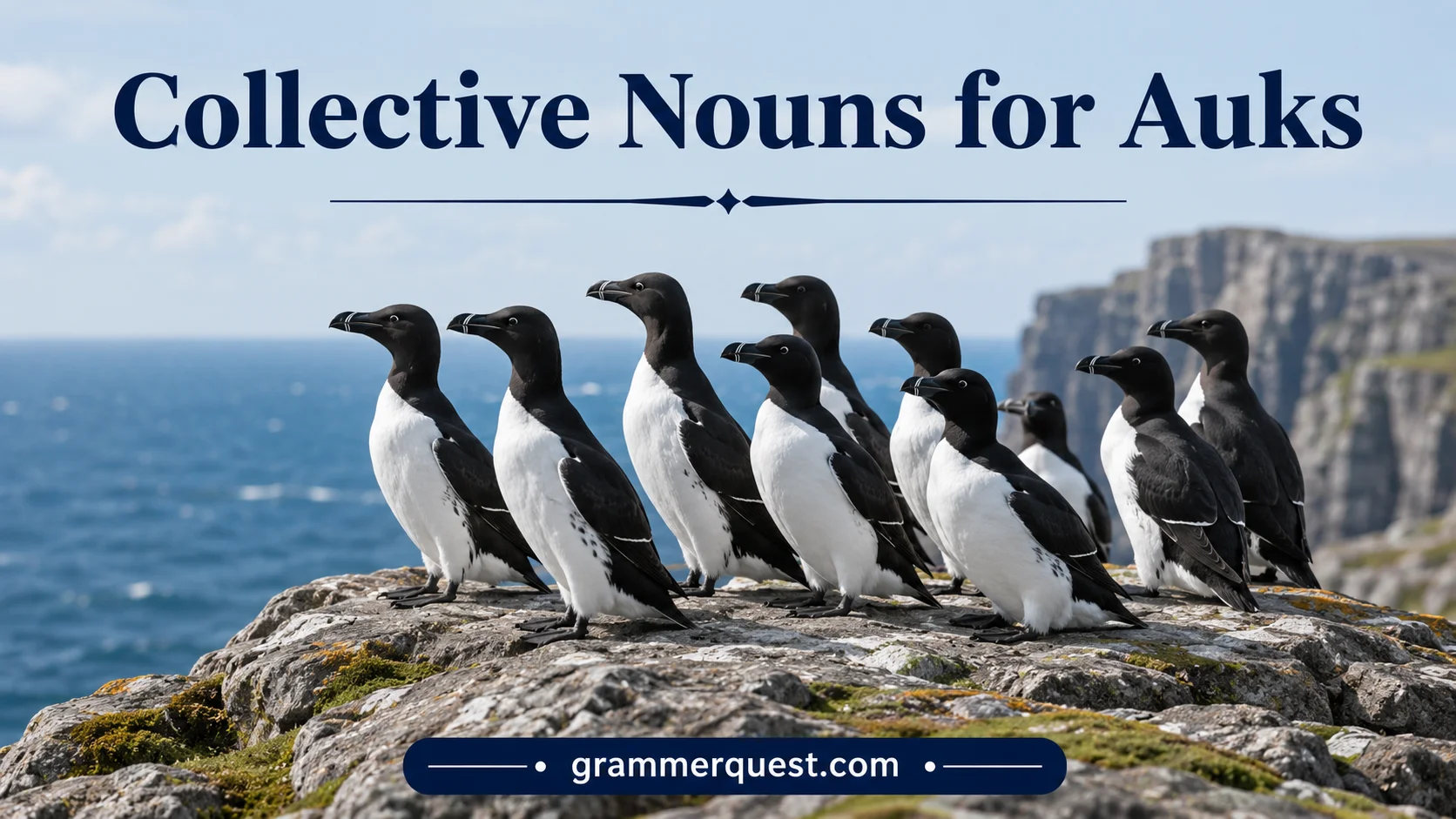
Collective Nouns for Auks make bird names more interesting because these special terms describe a group of birds in creative ways. In the English language, many collective nouns sound unusual but help people remember different species easily. Learning these names adds more fun to studying birds, especially when exploring the wider animal kingdom. Many people enjoy discovering how simple words can create unique meanings and make language more memorable.
Learning about collective nouns also helps people understand how language changes over time. Some names are self-explanatory, while others seem bizarre, remarkable, or even crazy at first. Through research and reading examples, people often become more confident when using these special terms. Finding unusual names for lesser-known animals makes studying wildlife more enjoyable and gives readers a better understanding of naming traditions.
Common Collective Nouns for Auks
| Collective Noun | Type | Simple Example |
| Colony | Group of nesting auks | A colony of auks rested on the cliff. |
| Flock | Flying group of auks | A flock of auks crossed the sea. |
| Raft | Floating group of auks | A raft of auks floated calmly. |
| Gathering | Informal group of auks | A gathering of auks covered the rocks. |
| Rookery | Breeding group of auks | The rookery of auks was noisy. |
Collective Nouns for Auks with Examples
Colony of Auks
A colony is one of the most common collective nouns used for auks because these birds nest together in very large groups on rocky cliffs.
Examples
- A colony of auks nested beside the ocean.
- The colony of auks became loud at sunrise.
- We watched a colony of auks from the boat.
- A large colony of auks covered the rocky island.
- The colony of auks protected their eggs carefully.
- Scientists studied the colony of auks during summer.
- A colony of auks rested near the cold shore.
- Tourists admired the colony of auks from afar.
- The colony of auks returned every breeding season.
- A noisy colony of auks filled the cliffs with sound.
Flock of Auks
The word flock is used when auks are flying together across the sea or coastline.
Examples
- A flock of auks flew over the icy water.
- The flock of auks moved quickly through the sky.
- We saw a flock of auks near the harbor.
- A flock of auks disappeared into the fog.
- The flock of auks circled above the waves.
- A small flock of auks landed on the rocks.
- The flock of auks searched for fish together.
- Sailors noticed a flock of auks during the storm.
- A flock of auks passed by at sunset.
- The flock of auks traveled toward the island.
Raft of Auks
A raft describes a group of auks floating together on the surface of the sea.
Examples
- A raft of auks floated quietly on the ocean.
- The raft of auks drifted with the waves.
- We photographed a raft of auks near the coast.
- A raft of auks gathered close to the fishing boat.
- The raft of auks rested after diving for food.
- A large raft of auks covered the water.
- The raft of auks moved slowly across the bay.
- Children spotted a raft of auks from the beach.
- A raft of auks floated under the cloudy sky.
- The raft of auks looked peaceful in the sea.
Gathering of Auks
The term gathering is a general collective noun used for auks assembled in one place.
Examples
- A gathering of auks stood on the rocks.
- The gathering of auks became active at dawn.
- We noticed a gathering of auks near the shore.
- A gathering of auks waited beside the water.
- The gathering of auks scattered after the noise.
- A gathering of auks shared the same nesting area.
- The gathering of auks looked beautiful together.
- A noisy gathering of auks filled the beach.
- The gathering of auks rested before flying away.
- A gathering of auks stayed close during the storm.
Rookery of Auks
A rookery refers to a breeding colony where many seabirds, including auks, gather to nest.
Examples
- A rookery of auks covered the cliffside.
- The rookery of auks was full of activity.
- Scientists visited the rookery of auks every year.
- A rookery of auks protected thousands of eggs.
- The rookery of auks echoed with bird calls.
- We saw a rookery of auks during our trip.
- The rookery of auks attracted many photographers.
- A rookery of auks formed near the icy coast.
- The rookery of auks remained busy all summer.
- A huge rookery of auks stretched across the island.
Read More: Collective Nouns for Snipe
Interesting Facts About Auks
Auks Are Long-Living Seabirds
Auks are known for their surprisingly long lifespan compared to many other bird species. Some species can live for more than twenty years in the wild when they survive harsh weather and predators. Their ability to return to the same nesting cliffs year after year shows their strong survival instincts and impressive memory. Many auks form long-term breeding partnerships, which helps them successfully raise chicks over multiple seasons.
Unique Physiological Features of Auks
Auks have several special physical features that make them excellent swimmers and divers. Their short wings may seem small for flying, but they work like underwater flippers when chasing fish beneath the sea. Auks can dive deep into cold ocean waters and stay underwater longer than many seabirds. Their dense feathers provide insulation against freezing temperatures, while their streamlined bodies help them move quickly underwater with little resistance.
Dietary Habits of Auks
Auks mainly feed on fish, squid, and tiny sea creatures such as krill. They are skilled hunters that dive into the ocean to catch prey with their sharp beaks. Different auk species may eat different types of seafood depending on where they live. During breeding season, adult auks work hard to bring food back to their chicks, often carrying several fish in their beaks at once. Their diet plays an important role in maintaining healthy marine ecosystems.
Why Collective Nouns for Auks Matter
Understanding collective nouns for auks helps people appreciate both language and wildlife. These unique terms describe how auks interact socially in colonies, rafts, and rookeries. Learning such words also makes conversations and writing more descriptive and engaging. Bird lovers, students, and language enthusiasts can all enjoy discovering the connection between English vocabulary and the natural behavior of seabirds.
FAQs :
1. What are Collective Nouns for Auks?
Collective nouns for auks are special words used to describe a group of auks together.
2. Why do birds have collective nouns?
Birds have collective nouns because these terms make language more descriptive and interesting.
3. Are collective nouns only used for birds?
No, collective nouns are used for birds, animals, people, and objects as well.
4. Why are some collective nouns unusual?
Many collective nouns were created hundreds of years ago, which is why some sound strange today.
5. Are collective nouns important in grammar?
Yes, collective nouns are an important part of grammar and vocabulary learning.
6. Can collective nouns have more than one meaning?
Yes, some collective nouns can be used differently depending on context.
7. Are collective nouns difficult to learn?
Most collective nouns become easy to remember with practice and examples.
8. Why should students learn collective nouns?
Learning collective nouns improves vocabulary and makes writing more interesting.
9. Do all animals have collective nouns?
Many animals have collective nouns, but some are more commonly used than others.
10. How can I remember collective nouns easily?
Reading examples regularly and using them in sentences helps with memorization.
Conclusion :
Collective nouns add creativity and personality to language, making simple group names more interesting. Learning Collective Nouns for Auks and other bird groups can improve vocabulary while making grammar more enjoyable and memorable.

George Whitaker is the voice behind GrammarQuest, dedicated to making grammar simple, engaging, and easy to understand. He helps learners turn confusion into confidence with clear explanations and real-world examples.