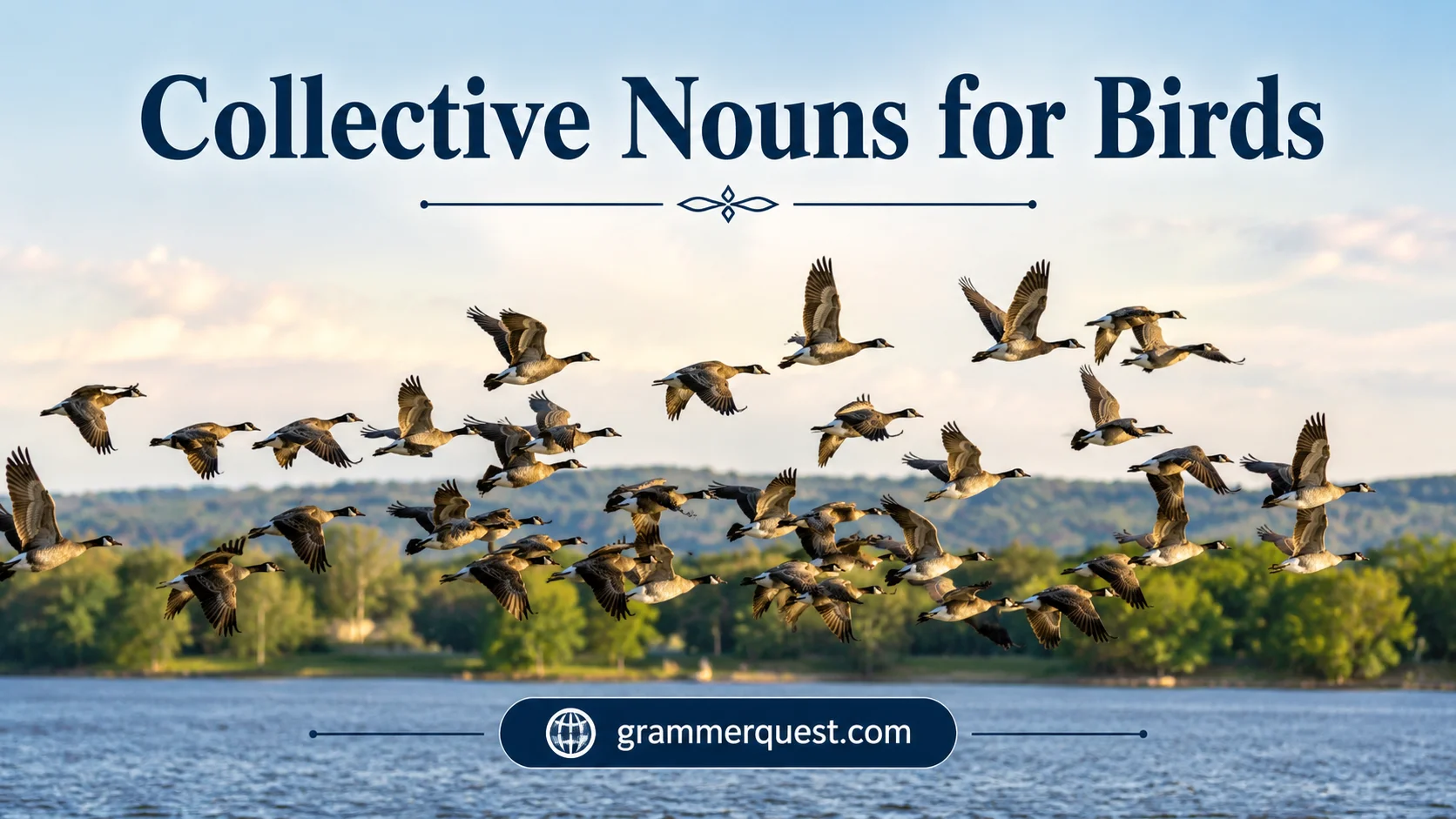
Collective Nouns for Birds help explain how groups of birds are named in everyday language. In the animal kingdom, people use special terms to describe a group of birds because these names make communication easier and more interesting. Many bird species have unique names that reflect history, behavior, or tradition. Learning these terms also improves English language skills and helps readers understand bird related expressions more naturally during daily reading and writing activities and casual conversations as well today too.
Over time, collective nouns became part of language through folklore, books, and shared traditions. Some names are common, while others sound unusual or humorous, but all add personality to bird discussions. From simple classroom learning to wildlife observation, these words make identifying groups easier. Understanding species names, plural names, and special expressions can improve vocabulary and create stronger connections between language, birds, and nature in everyday communication, reading habits, educational activities, and personal learning experiences for better long term understanding.
Collective Nouns for Birds Table
| Collective Noun | Type of Birds | Simple Example |
| Flock | General birds | A flock of birds flew overhead. |
| Colony | Penguins | A colony of penguins stood on the ice. |
| Murmuration | Starlings | A murmuration of starlings moved beautifully. |
| Gaggle | Geese | A gaggle of geese crossed the road. |
| Murder | Crows | A murder of crows sat in the tree. |
| Parliament | Owls | A parliament of owls rested quietly. |
| Charm | Finches | A charm of finches gathered near the feeder. |
| Exaltation | Larks | An exaltation of larks sang loudly. |
| Siege | Herons | A siege of herons waited by the lake. |
| Wake | Buzzards | A wake of buzzards circled above. |
Types of Collective Nouns for Birds
Flock of Birds
A flock is the most common collective noun used for birds. It describes a group of birds flying or feeding together.
Examples
- A flock of birds flew across the sky.
- We saw a flock of pigeons in the park.
- The flock landed near the river.
- A flock of sparrows sat on the fence.
- Farmers watched the flock move over the field.
- The flock searched for food together.
- A flock of parrots rested in the tree.
- The flock made loud sounds at dawn.
- Children admired the flock near the lake.
- A flock of birds disappeared into the clouds.
Murder of Crows
A group of crows is famously called a murder. This unusual term comes from old folklore and legends.
Examples
- A murder of crows gathered on the roof.
- The murder flew over the forest.
- We heard a murder of crows early in the morning.
- The murder searched for scraps of food.
- A murder of crows circled the tall tree.
- The farmer chased the murder away from the crops.
- A murder sat quietly on the branches.
- The murder made harsh sounds at sunset.
- Tourists watched the murder near the castle.
- A murder of crows followed the tractor.
Gaggle of Geese
The word gaggle is commonly used for geese, especially when they are walking on land.
Examples
- A gaggle of geese crossed the road slowly.
- The gaggle rested beside the pond.
- We heard a loud gaggle near the farm.
- A gaggle of geese searched for grass.
- The gaggle moved together in a line.
- Children fed the gaggle at the lake.
- A gaggle of geese flew south for winter.
- The gaggle became noisy at sunset.
- A gaggle blocked the pathway in the park.
- The farmer watched the gaggle carefully.
Parliament of Owls
A group of owls is called a parliament, reflecting their wise and calm appearance.
Examples
- A parliament of owls rested in the forest.
- The parliament became active at night.
- We spotted a parliament near the old barn.
- The parliament hunted quietly in darkness.
- A parliament of owls sat on the branches.
- The parliament watched the field silently.
- Tourists photographed the parliament at dusk.
- The parliament flew over the trees.
- A parliament of owls stayed hidden during the day.
- The parliament made soft hooting sounds.
Colony of Penguins
Penguins often live in large groups known as a colony.
Examples
- A colony of penguins stood on the ice.
- The colony moved toward the water together.
- Scientists studied the colony in Antarctica.
- The colony protected its young chicks.
- A colony of penguins swam in the cold sea.
- Visitors admired the colony from a distance.
- The colony huddled together during the storm.
- A colony of penguins searched for fish.
- The colony made loud calls on the shore.
- Photographers captured the colony at sunrise.
Read More: Collective Nouns Used for Dogfish
Interesting Facts About Birds
Bird Longevity
Birds can live surprisingly long lives depending on their species. Small birds like sparrows may only live a few years, while larger birds such as parrots and albatrosses can survive for several decades. Some parrots are even known to live longer than humans when cared for properly. Their lifespan often depends on habitat, diet, and protection from predators.
Unique Physiological Features
Birds have incredible body structures that help them survive and fly efficiently. Their lightweight bones reduce body weight, making flight easier. Feathers provide insulation, waterproofing, and balance during movement. Birds also have powerful eyesight, and some species can see ultraviolet light that humans cannot detect. Another amazing feature is their hollow bones, which are both strong and light.
Dietary Habits of Birds
Birds eat a wide variety of foods depending on their environment and species. Some birds are herbivores that enjoy seeds, fruits, and nectar, while others are carnivores that hunt insects, fish, or small animals. Many birds adapt their diets seasonally during migration. For example, hummingbirds mainly feed on nectar, while eagles prefer meat. Their beaks are specially shaped to match the type of food they eat.
Migration and Navigation
Many bird species travel thousands of miles during migration seasons. They use the sun, stars, and Earth’s magnetic field to navigate accurately. Birds such as geese and swallows migrate every year to find warmer climates and better food sources. This remarkable ability shows how intelligent and adaptable birds truly are.
Bird Communication
Birds communicate through songs, calls, and body movements. Some species sing to attract mates, while others use warning calls to protect their groups from danger. Parrots are especially famous for their ability to mimic human speech. These communication skills help birds survive and maintain strong social connections within their flocks or colonies.
FAQs :
1. What are collective nouns for birds?
Collective nouns for birds are words used to describe a group of birds together, such as flock or murmuration.
2. Why do birds have different collective nouns?
Different bird groups received names through history, traditions, folklore, and language development.
3. What is the most common collective noun for birds?
The word “flock” is the most common term used for most bird groups.
4. Are collective nouns for birds still used today?
Yes, many collective nouns are still used today, although some are rare or mostly historical.
5. What is a murmuration of birds?
A murmuration is a word commonly used for a large moving group of starlings.
6. Do all bird species have unique collective nouns?
No, not every bird species has a widely recognized or commonly used group name.
7. Where did collective nouns for birds originate?
Many originated from medieval traditions, hunting language, and early English writings.
8. Are collective bird names important in English learning?
Yes, they improve vocabulary and make language more interesting and descriptive.
9. Can collective nouns be used in everyday conversations?
Yes, especially common terms like flock, group, or colony.
10. Why are collective nouns for birds interesting?
They connect language, history, wildlife, and culture while making communication more colorful.
Conclusion :
Collective nouns for birds make language more creative and descriptive while helping people understand bird groups more easily. From common terms to unusual historical names, these expressions add meaning, improve vocabulary, and create a stronger connection between birds, language, and everyday communication.

Emma Brooke is a passionate language enthusiast and the voice behind GrammarQuest.com. With a sharp eye for detail and a love for clear communication, she simplifies complex grammar rules into easy, practical lessons. Her goal is to help you write with confidence, clarity, and style—whether you’re a student, professional, or everyday writer.