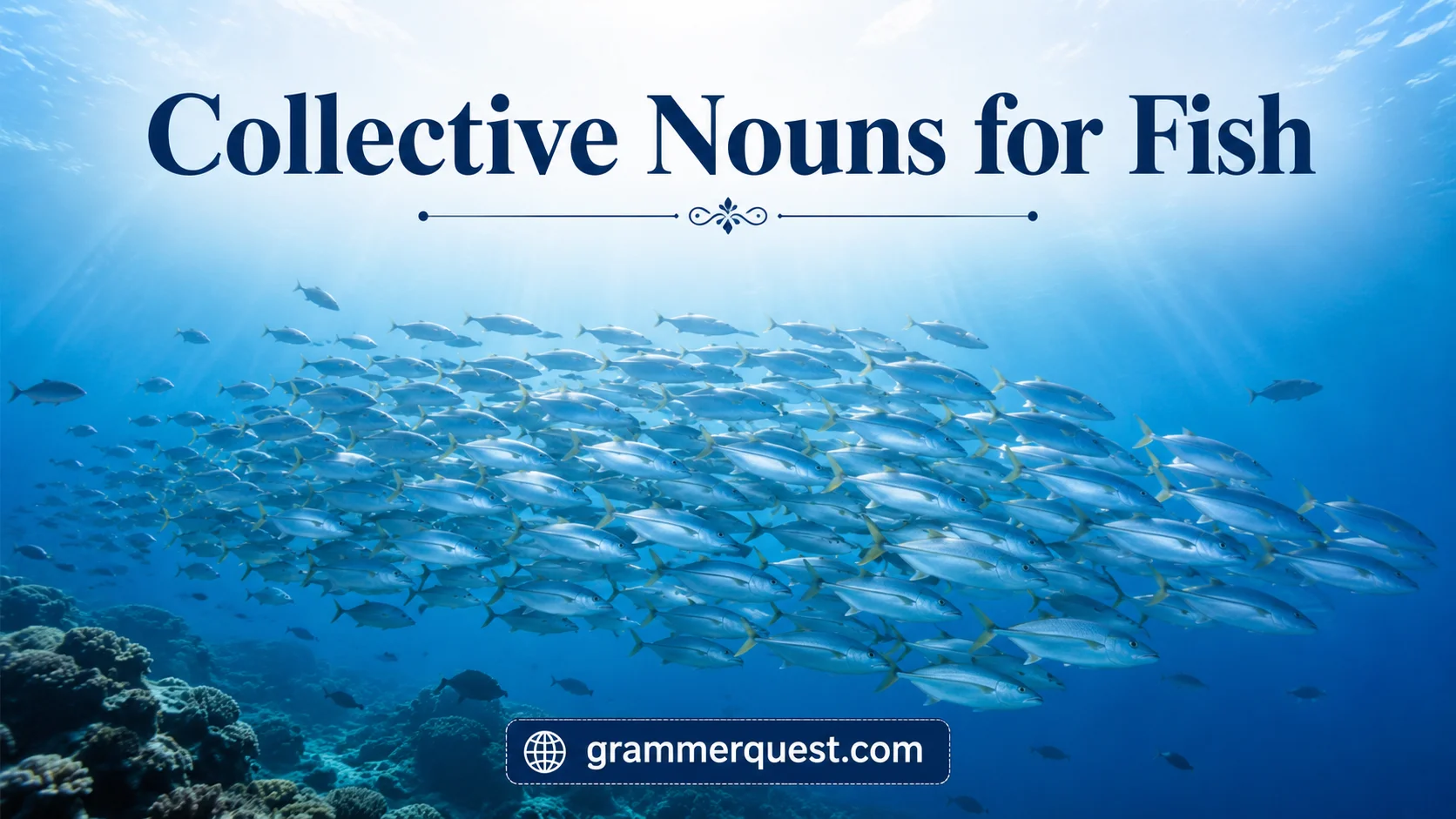
Collective Nouns for Fish are special words used to describe groups of fish and other aquatic animals in English grammar. Learning these collective nouns helps students, writers, and language learners improve their vocabulary and communication skills. The most common terms are a school of fish and a shoal of fish, which are widely used when discussing marine life. Understanding these group names makes writing more descriptive, strengthens language knowledge, and helps readers visualize how fish move and live together in oceans, rivers, lakes, and other water habitats.
Exploring the world of fish collective nouns can make language learning both educational and enjoyable. Along with fish, many sea creatures have unique group names, such as a shiver of sharks and a fever of stingrays. These interesting terms add creativity to writing and speaking while expanding vocabulary. Whether you are studying English grammar, preparing school assignments, or simply curious about wildlife, learning collective nouns for aquatic animals helps build confidence and makes descriptions of marine life more accurate, engaging, and memorable.
What Are Collective Nouns?
A collective noun is a word that refers to a group of individuals or objects as one entity. For example, a group of birds is called a flock, while a group of wolves is called a pack.
When talking about fish, collective nouns help describe how fish gather and move together in water. These terms make writing and speaking more precise and interesting.
Collective Nouns for Fish
The table below shows the most common collective nouns used for fish.
| Collective Noun | Simple Example |
| School | A school of fish swam near the reef. |
| Shoal | A shoal of fish moved through the shallow water. |
| Group | A group of fish gathered near the rocks. |
| Draft | A draft of fish crossed the river. |
| Run | A run of fish traveled upstream. |
School of Fish
A school is the most common collective noun for fish. It describes a large number of fish swimming together in an organized way.
Examples of School of Fish
- A school of fish swam across the coral reef.
- We saw a school of fish near the shore.
- The school of fish moved quickly through the water.
- A colorful school of fish surrounded the diver.
- The school of fish avoided the predator.
- A school of fish passed beneath the boat.
- The children watched a school of fish in the aquarium.
- A school of fish glittered in the sunlight.
- The school of fish changed direction together.
- We photographed a large school of fish.
Shoal of Fish
A shoal refers to a group of fish swimming together, often in a loose formation.
Examples of Shoal of Fish
- A shoal of fish gathered near the riverbank.
- We noticed a shoal of fish in the pond.
- The shoal of fish moved slowly through the water.
- A shoal of fish hid among the plants.
- The fisherman spotted a shoal of fish.
- A shoal of fish swam beneath the bridge.
- The shoal of fish scattered when disturbed.
- We observed a shoal of fish near the rocks.
- The shoal of fish remained close together.
- A shoal of fish appeared in the clear water.
Group of Fish
Group is a general collective noun used when no specific term is needed.
Examples of Group of Fish
- A group of fish swam near the dock.
- The group of fish stayed close to the surface.
- We watched a group of fish feeding.
- A group of fish moved around the coral.
- The group of fish disappeared into deeper water.
- A group of fish gathered under the boat.
- The group of fish explored the area.
- We found a group of fish in the lake.
- The group of fish traveled together.
- A group of fish rested among the weeds.
Draft of Fish
Draft is a less common collective noun for fish, often found in traditional English usage.
Examples of Draft of Fish
- A draft of fish crossed the stream.
- The draft of fish moved upstream.
- We saw a draft of fish in the river.
- The draft of fish traveled together.
- A draft of fish passed beneath the bridge.
- The draft of fish entered the shallow water.
- Fishermen followed the draft of fish.
- A draft of fish appeared after sunrise.
- The draft of fish swam rapidly.
- We admired the draft of fish from the shore.
Run of Fish
A run of fish is commonly used when fish migrate, especially when moving upstream to spawn.
Examples of Run of Fish
- A run of fish entered the river.
- The run of fish attracted many birds.
- We observed a run of fish during spring.
- The run of fish moved upstream.
- Fishermen waited for the run of fish.
- A run of fish passed through the channel.
- The run of fish was larger this year.
- Tourists watched the run of fish from the bridge.
- The run of fish continued for several days.
- A run of fish reached the spawning grounds.
Interesting Facts About Fish
Fish are among the oldest vertebrate animals on Earth and have existed for more than 500 million years. Some species are known for their impressive longevity, with certain fish living for several decades and a few even surpassing 100 years of age. Fish possess remarkable physiological features, including gills that allow them to extract oxygen from water and specialized fins that help them maintain balance and movement. Many species also have a lateral line system, which enables them to detect vibrations and movement in the surrounding water. Their diets vary greatly depending on the species; some fish are herbivores that feed on aquatic plants, others are carnivores that hunt smaller animals, and many are omnivores that consume both plant and animal matter. This incredible diversity helps fish thrive in nearly every aquatic environment on the planet.
Why Do Fish Swim in Groups?
Fish often swim together for protection, easier navigation, and improved chances of finding food. Grouping behavior can help reduce the risk of predators attacking individual fish. Swimming in schools and shoals also allows fish to communicate movement quickly and conserve energy while traveling.
The Importance of Collective Nouns in Wildlife Studies
Collective nouns help scientists, writers, and nature enthusiasts describe animal behavior accurately. Terms such as school, shoal, and run provide insight into how fish interact with one another and adapt to their environments. Understanding these words enriches both language skills and knowledge of wildlife.
FAQs :
1. What is the most common collective noun for fish?
The most common collective nouns for fish are school and shoal. Both terms describe a group of fish swimming together.
2. What is the difference between a school and a shoal of fish?
A shoal is any group of fish that stay together, while a school is a more organized group that swims in the same direction.
3. Why are collective nouns important?
Collective nouns help make communication clearer and improve descriptive writing by identifying groups with a single term.
4. What does a school of fish mean?
A school of fish refers to fish that move together in a coordinated and structured way.
5. Are collective nouns only used for fish?
No, collective nouns are used for many animals, such as a flock of birds, a pride of lions, and a herd of cattle.
6. Can fish have more than one collective noun?
Yes, fish can be described as a school, shoal, draft, or run, depending on the species and situation.
7. How do collective nouns help students?
They improve vocabulary, grammar skills, reading comprehension, and creative writing abilities.
8. What is a collective noun in English grammar?
A collective noun is a word that names a group of people, animals, or things as a single unit.
9. Are collective nouns for fish used in everyday conversation?
Yes, terms like school of fish are commonly used in education, science, fishing, and everyday discussions.
10. How can I learn collective nouns more easily?
Reading books, practicing grammar exercises, and exploring animal group names can help you remember collective nouns quickly.
Conclusion :
Learning Collective Nouns for Fish is a fun way to expand your English vocabulary and improve your grammar skills. Words such as school of fish and shoal of fish make descriptions more accurate and engaging. By understanding these unique group names, students and language learners can communicate more effectively, write with greater confidence, and develop a deeper appreciation for the fascinating world of aquatic animals and collective nouns.

Henry Collins is a passionate grammar expert and the voice behind GrammerQuest.com. With a sharp eye for language and a love for clear communication, he simplifies complex grammar rules into easy, practical lessons.