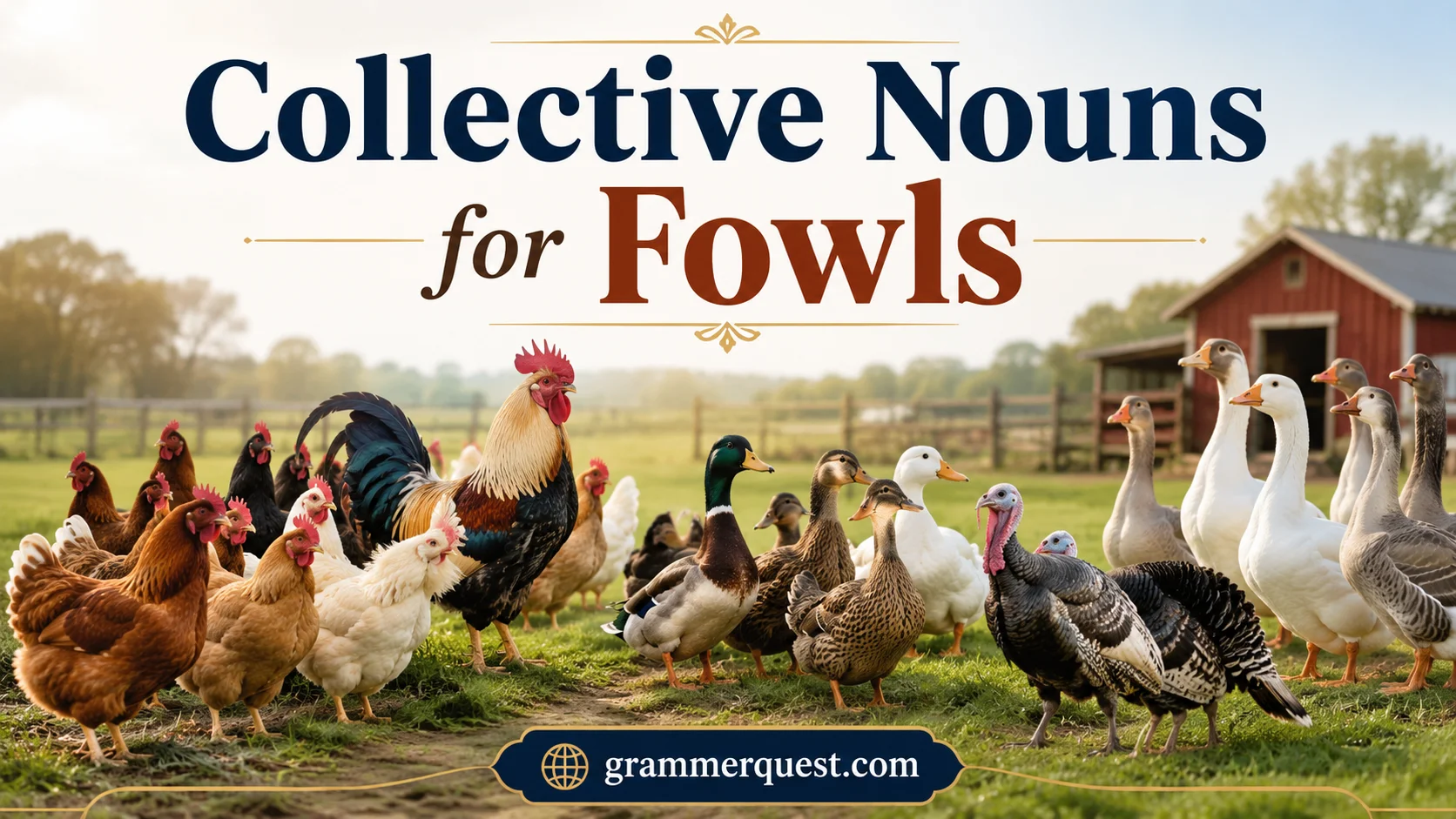
Collective Nouns for Fowls describe the special names used for groups of domestic and wild birds. These terms help explain how fowls, birds, and poultry species live, move, and interact together. Common words like flock, brood, and peep are widely used to describe different stages and group types. Learning these names makes understanding bird behavior easier while also improving vocabulary and knowledge about animal groups.
For thousands of years, humans have raised fowls for food, farming, and companionship, creating a strong connection between people and birds. Many species develop organized social structures, maintain group hierarchies, and live together for safety and survival. From young chicks to fully grown birds, these collective terms reflect interesting behaviors and historical relationships. Exploring these names reveals fascinating facts about social systems, domestication, and bird communities.
Table: Collective Nouns for Fowls (Quick Understanding)
| Type of Collective Noun | Simple Example |
| Flock | A flock of chickens |
| Brood | A brood of hens |
| Clutch | A clutch of chicks |
| Peep | A peep of chicks |
| Run | A run of fowls |
Flock of Fowls
A flock is the most commonly used collective noun for fowls, referring to a group moving or living together.
Examples
- A flock of chickens is pecking in the yard.
- We saw a flock of hens near the barn.
- The farmer owns a large flock of fowls.
- A flock of turkeys crossed the road slowly.
- The flock gathered around the feeding area.
- A flock of chickens followed the farmer.
- The flock rested under the shade of trees.
- A flock of hens clucked loudly in the morning.
- The flock scattered when the dog barked.
- A flock of fowls returned to the coop at sunset.
Brood of Fowls
A brood typically refers to a group of young birds or hens caring for chicks.
Examples
- A brood of hens stayed close to their chicks.
- The brood moved carefully across the yard.
- A brood of fowls followed their mother hen.
- The farmer saw a brood under the shed.
- A brood of chickens hatched last night.
- The brood stayed warm under the hen’s wings.
- A brood of young fowls learned to peck food.
- The brood grew stronger every day.
- A brood of hens protected their young ones.
- The brood wandered near the garden safely.
Clutch of Fowls
A clutch is used especially for eggs or newly hatched chicks.
Examples
- A clutch of chicks hatched this morning.
- The hen is sitting on a clutch of eggs.
- A clutch of fowls gathered near the nest.
- The farmer collected a clutch of fresh eggs.
- A clutch of chicks followed their mother.
- The clutch was kept warm by the hen.
- A clutch of eggs cracked open slowly.
- The clutch of fowls stayed near the coop.
- A clutch of chicks cheeped loudly.
- The hen protected her clutch from danger.
Peep of Fowls
A peep is often used for very young chicks making soft sounds.
Examples
- A peep of chicks followed the hen.
- The peep moved slowly across the yard.
- A peep of fowls gathered near the food bowl.
- The farmer heard a peep in the morning.
- A peep of chicks hid under the bush.
- The peep stayed close to its mother.
- A peep of fowls chirped softly.
- The peep ran quickly when startled.
- A peep of chicks explored the garden.
- The hen protected her peep carefully.
Run of Fowls
A run refers to a group of fowls moving together, especially in a farm setting.
Examples
- A run of fowls rushed toward the feed.
- The farmer raised a large run of chickens.
- A run of hens scattered in the field.
- The run of fowls followed the caretaker.
- A run of turkeys crossed the farmyard.
- The run gathered near the water source.
- A run of fowls scratched the soil.
- The run moved quickly when it rained.
- A run of chickens rested in the sun.
- The run of fowls returned to shelter.
Read More: Collective Nouns for Baboon
Interesting Facts About Fowls
Fowls are fascinating domestic birds known for their adaptability, intelligence, and strong social behavior. They can live for several years, with some chickens reaching 5 to 10 years or more depending on care and breed. Their longevity is closely linked to environment, diet, and protection from predators. Fowls also have unique physiological traits such as lightweight skeletal structures, excellent balance, and strong beaks designed for pecking and foraging. Their feathers not only provide insulation but also help in communication and mating displays.
Dietary habits of fowls are highly diverse—they are omnivorous and consume grains, seeds, insects, and even small plants. This flexible diet helps them survive in different environments. Interestingly, fowls also exhibit strong social hierarchy (pecking order), which determines feeding and dominance behavior within the group. Their ability to communicate through clucks, calls, and body movements makes them highly social creatures in both wild and domestic settings.
FAQs :
1. What is the collective noun for fowls?
The most common collective noun for fowls is a flock.
2. What is a group of chickens called?
A group of chickens is often called a flock, brood, or peep.
3. What does the word brood mean for fowls?
Brood usually refers to a family group of young birds or chicks with their mother.
4. What does peep mean in bird groups?
A peep is a small group of young chickens or chicks.
5. Are fowls and chickens the same thing?
Not exactly. Fowl is a broader term, while chicken is one type of fowl.
6. Why do fowls have different collective nouns?
Different collective nouns describe age, behavior, and group structure.
7. Is flock used for all birds?
Yes, flock is one of the most common collective nouns used for many birds, including fowls.
8. Do domesticated fowls live in groups?
Yes, domesticated fowls usually live in groups for safety and social interaction.
9. What is the most important collective noun to remember?
For general use, flock is the most important word to remember.
10. Why should we learn collective nouns for fowls?
They improve vocabulary and help us understand bird behavior more clearly.
Conclusion :
Collective nouns for fowls are simple, useful, and interesting to learn. Words like flock, brood, and peep help describe different bird groups in the right way. These terms also show the close connection between humans and birds, making them an important part of English vocabulary.

George Whitaker is the voice behind GrammarQuest, dedicated to making grammar simple, engaging, and easy to understand. He helps learners turn confusion into confidence with clear explanations and real-world examples.